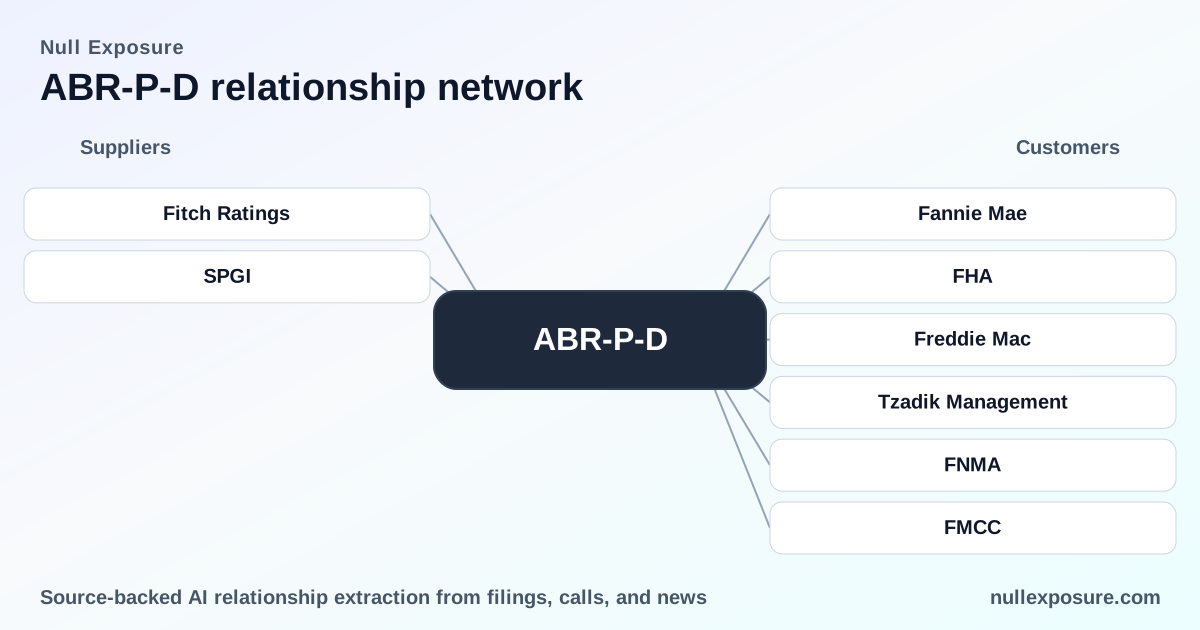
Arbor Realty Trust (ABR-P-D): Preferred-stock investors should watch rating relationships as a cost-of-capital lever
Arbor Realty Trust operates as a mortgage REIT that originates, acquires and manages mortgage loans and related securities, focused on multi-family and commercial property finance. The company monetizes through interest income on loan portfolios, fee income from loan servicing and spread management between funding costs and loan yields; the 6.375% Series D cumulative preferred shares (ABR‑P‑D) deliver a fixed dividend claim that is directly sensitive to Arbor’s funding costs and credit profile. For investors evaluating supplier and counterparty exposure, the most relevant relationships are public rating agencies that influence funding access and borrowing spreads. Learn more at https://nullexposure.com/.
Why the Series D preferred sits at the intersection of real‑estate operations and capital markets
Arbor’s business model is straightforward in investor terms: originate or acquire loans, manage them to maturity or securitize, and finance positions with debt and preferred equity. Preferred stock like ABR‑P‑D provides a fixed-income-like return but sits junior to debt, so its valuation and dividend security are heavily influenced by Arbor’s access to capital and credit standing. Rating agencies function as an external input that shapes investor perception and wholesale funding costs; consistent mentions of agency relationships in the public record indicate that these third parties are part of Arbor’s operating rhythm.
Operational constraints and company‑level signals relevant to investors:
- Contracting posture: Arbor relies on a combination of negotiated loan contracts and market financing; preferred shares represent a contractual dividend obligation that is cumulative, increasing the imperative to service dividends before common equity distributions.
- Concentration and criticality: Revenue depends on mortgage origination/acquisition and servicing pipelines; market access to funding is critical because leverage multiplies returns and risk across the portfolio. Preferred holders are exposed to any funding stress that tightens spreads.
- Maturity and optionality: The Series D is a fixed-rate cumulative instrument; this structure gives investors predictable cash flow while exposing the company to interest-rate and refinancing risk over time.
- Counterparty sensitivity: External ratings and wholesale lenders are key counterparties that influence Arbor’s cost of capital and the secondary market liquidity for preferred shares.
Rating relationships — what public mentions reveal (full list)
Below are every relationship extracted from the source material with a concise, investor-focused synopsis and a source citation.
Fitch Ratings — FY2026
Fitch is explicitly named as one of Arbor’s rating partners, highlighting that Arbor engages with Fitch for public credit assessment and market signaling; this connection supports Arbor’s access to institutional funding channels. A StockTitan news post referencing Arbor’s earnings call language mentioned Fitch in May 2026. (StockTitan, May 2, 2026)
Standard and Poor’s — FY2026 (SPGI)
Standard and Poor’s (SPGI) is cited alongside Fitch as a rating agency that covers Arbor, indicating a multi‑agency rating posture that preserves competitive access to rating opinions and institutional investors. The same StockTitan article dated May 2, 2026 referenced S&P in describing Arbor’s commitment to service and loan life-cycle quality. (StockTitan, May 2, 2026)
Fitch Ratings — FY2023
Historical mentions show Fitch was already a named rating party for Arbor in 2023, demonstrating continuity in Arbor’s agency relationships across reporting periods; this continuity matters because stable rating coverage reduces the chance of sudden information gaps for investors. A StockTitan report from March 2026 quoted language dating to the company’s 2023 coverage references. (StockTitan, March 9, 2026)
SPGI — FY2023
SPGI is recorded in the FY2023 mention as well, reinforcing that S&P’s relationship with Arbor is not a recent development but spans multiple fiscal periods, which supports consistent third‑party credit surveillance of Arbor’s obligations. The March 9, 2026 StockTitan item reiterated S&P’s role in prior public statements. (StockTitan, March 9, 2026)
Standard and Poor’s — FY2023
Standard and Poor’s is separately listed in the FY2023 references, underscoring that Arbor’s narrative to investors has repeatedly included the company’s standing with S&P and Fitch as part of its credibility and market positioning. The March 2026 StockTitan article repeated that language. (StockTitan, March 9, 2026)
What these relationships mean for ABR‑P‑D holders
- Ratings are a lever, not a binary. Being covered by both S&P and Fitch signals Arbor’s engagement with the capital markets infrastructure that determines wholesale borrowing spreads and institutional demand for both debt and preferred equity. Investors in ABR‑P‑D should treat agency coverage as an ongoing cost-of-capital input rather than a static label.
- Continuity matters. The FY2023 and FY2026 mentions demonstrate continuous engagement with major agencies; continuous coverage reduces the risk of sudden information vacuums that can widen preferred-share bid‑ask spreads.
- Public language underscores service and loan-level quality. Arbor’s investor-facing statements emphasize loan life-cycle management and customized solutions, which translate into a business strategy pitched at preserving asset performance and servicing cash flows that fund preferred dividends.
Risk checklist for investors considering ABR‑P‑D
- Interest‑rate and spread risk: fixed 6.375% coupon locks in a return but is exposed to market rate moves and Arbor’s refinancing economics.
- Funding and liquidity sensitivity: rating agency relationships and lender access are material to Arbor’s ability to refinance maturities and preserve dividend coverage.
- Structural subordination: preferred shares are junior to all company debt; operational stress or elevated credit losses will manifest first in debt metrics.
- Information flow: the presence of S&P and Fitch as named rating partners improves transparency and reduces asymmetric information risk for investors.
Bottom line and next steps
ABR‑P‑D is a yield instrument whose value is tightly linked to Arbor’s funding profile and the external validation provided by major rating agencies. The public record—repeated mentions of Fitch and Standard & Poor’s across fiscal periods—confirms that agency coverage is part of Arbor’s capital‑markets playbook and should be monitored by preferred‑share investors as a leading indicator of funding cost dynamics. For a deeper view into how counterparties and supplier relationships shape preferred‑equity risk, visit https://nullexposure.com/.
If you need a tailored counterparty risk memo or a short monitoring dashboard for Arbor’s rating actions and funding announcements, the research tools at NullExposure can help you operationalize those signals.