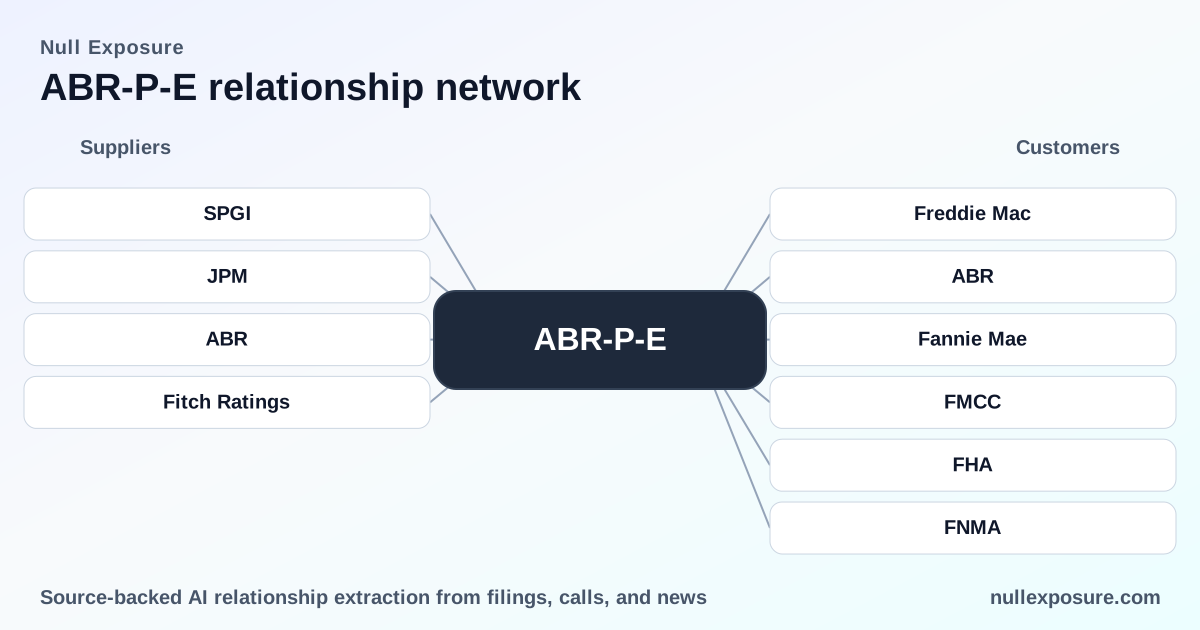
Arbor Realty Trust (ABR‑P‑E): Supplier relationships that shape credit and liquidity
Arbor Realty Trust operates as a mortgage REIT that originates, acquires and manages a diversified portfolio of real‑estate‑related loans and securities; it monetizes through interest spread on lending assets, originations and servicing fees, and capital markets funding including secured repo lines and preferred equity like the 6.25% Series E cumulative preferred (ABR‑P‑E) that pays a fixed coupon to investors. Counterparty relationships — banks, auditors, rating agencies, transfer agents and outsourced managers — are operationally critical for funding, governance and investor servicing, and therefore directly influence the risk profile of the preferred security.
Explore further company-level intelligence at https://nullexposure.com/
What investors need to know about Arbor’s operating posture
Arbor runs a capital‑intensive, market‑facing business that relies on large bank facilities for short‑term liquidity, recognized auditors for financial credibility, and major ratings agencies for market access. The company’s contracting posture is standard for a publicly traded mortgage REIT: diversified external counterparties for funding and governance, domestic institutional counterparties for liquidity, and retained operational functions such as internal audit. Concentration risks are evident where single large facilities provide material liquidity (see JPMorgan repo), and service criticality is high for providers such as the transfer agent and auditors. Overall, Arbor’s relationships reflect a mature REIT operating model but one exposed to counterparty credit and reputational channels that can transmit to preferred‑holder outcomes.
The granular readout — each supplier relationship and what it means
Below I walk through each relationship recorded in public sources; each item is a one–two sentence plain‑English note with the source.
-
Ernst & Young LLP — The Audit Committee appointed Ernst & Young as Arbor’s independent registered public accounting firm for the year ending December 31, 2026, signaling continuity with a Big Four auditor that supports financial reporting credibility. Source: Arbor’s definitive proxy statement (DEF 14A), filed May 2026 on StockTitan (https://www.stocktitan.net/sec-filings/ABR/def-14a-arbor-realty-trust-inc-definitive-proxy-statement-cb6f01c268ab.html).
-
JPM — Arbor secured a $1.1 billion repurchase (repo) facility from JPMorgan to pay off collateralized loan obligation bondholders, providing immediate liquidity and improved funding terms that materially affect balance‑sheet flexibility. Source: The Real Deal, March 27, 2025 (https://therealdeal.com/national/2025/03/27/arbor-realty-trust-faces-more-investor-fraud-suits/).
-
JPMorgan — Reporting reiterates the $1.1 billion repo line with JPMorgan which acts as a principal liquidity counterparty and shapes short‑term funding economics for Arbor’s loan portfolio. Source: Finance Yahoo Q1 analysis (March 2026) (https://finance.yahoo.com/news/abr-q1-deep-dive-elevated-062842601.html).
-
ABR (Arbor Realty Trust Inc.) — Company press releases emphasize Arbor’s service and loan‑life focus while announcing executive appointments, illustrating active management and public communications on operational priorities. Source: GlobeNewswire press release, February 17, 2026 (https://www.globenewswire.com/news-release/2026/02/17/3239294/0/en/arbor-realty-trust-inc-announces-the-appointment-of-yoni-goodman-as-its-executive-vice-president-and-chief-operating-officer.html).
-
Fitch Ratings — Fitch is listed among Arbor’s rating agencies and is referenced in press materials, indicating Fitch’s views contribute to market perception and pricing of Arbor securities. Source: GlobeNewswire releases (Feb–Mar 2026) and related news distribution outlets (https://www.globenewswire.com/news-release/2026/02/17/3239294/0/en/arbor-realty-trust-inc-announces-the-appointment-of-yoni-goodman-as-its-executive-vice-president-and-chief-operating-officer.html).
-
Standard and Poor’s — S&P is referenced alongside Fitch as an active ratings counterparty, reinforcing that two major rating agencies feed investor assessment and capital cost for Arbor. Source: GlobeNewswire releases (Feb–Mar 2026) and syndicated news (QuiverQuant, Yahoo, Bitget).
-
Standard and Poor’s (QuiverQuant mention) — Financial media syndication repeats S&P references in coverage of executive hires and rating commentary, reinforcing public visibility of S&P’s role in Arbor’s credit profile. Source: QuiverQuant news (March 2026) (https://www.quiverquant.com/news/Arbor+Realty+Trust%2C+Inc.+Appoints+Jeff+Lee+as+Executive+Vice+President+and+Head+of+Agency+Lending).
-
Fitch Ratings (QuiverQuant mention) — Syndicated reporting cites Fitch in the same context, again signaling that Fitch commentary is part of Arbor’s external credit narrative. Source: QuiverQuant news (March 2026) (https://www.quiverquant.com/news/Arbor+Realty+Trust%2C+Inc.+Appoints+Jeff+Lee+as+Executive+Vice+President+and+Head+of+Agency+Lending).
-
SPGI — S&P Global (SPGI) shows up in media references to Arbor’s ratings, establishing SPGI as the entity behind the S&P brand whose ratings influence funding spreads and investor demand. Source: QuiverQuant/GlobeNewswire syndication (March 2026).
-
Fitch Ratings (GlobeNewswire earnings call notice) — Arbor’s scheduled earnings and investor communications reference Fitch, underscoring ongoing engagement with ratings agencies ahead of investor calls. Source: GlobeNewswire, February 6, 2026 (https://www.globenewswire.com/news-release/2026/02/06/3234089/0/en/Arbor-Realty-Trust-Schedules-Fourth-Quarter-2025-Earnings-Conference-Call.html).
-
SPGI (GlobeNewswire earnings notice) — S&P is again noted in the earnings‑release context; this repetition signals that ratings are a standing component of Arbor’s investor relations messaging. Source: GlobeNewswire, February 6, 2026.
-
Standard and Poor’s (GlobeNewswire earnings notice) — The company’s earnings schedule references S&P, confirming the ratings relationship is active during investor reporting cycles. Source: GlobeNewswire, February 6, 2026.
-
JPM (Finance Yahoo) — Analyst coverage described Arbor’s $1.1 billion repurchase facility with JPMorgan as improving funding terms and liquidity, a material operational development for creditors and preferred holders. Source: Yahoo Finance (Q1 deep dive, 2026) (https://finance.yahoo.com/news/abr-q1-deep-dive-elevated-062842601.html).
-
JPMorgan (Finance Yahoo) — Yahoo’s finance reporting reiterates JPMorgan as the counterparty on the repurchase facility, highlighting the bank’s role in Arbor’s funding stack. Source: Yahoo Finance (https://finance.yahoo.com/news/abr-q1-deep-dive-elevated-062842601.html).
-
Equiniti Trust Company, LLC — The definitive proxy states Equiniti (formerly American Stock Transfer & Trust) is Arbor’s transfer agent, a function that is operationally critical for dividend, proxy and ownership recordkeeping for preferred holders. Source: DEF 14A proxy, May 2026 (https://www.stocktitan.net/sec-filings/ABR/def-14a-arbor-realty-trust-inc-definitive-proxy-statement-cb6f01c268ab.html).
-
Fitch Ratings (Yahoo Singapore crosspost) — International syndication of Arbor’s earnings schedule again references Fitch, reflecting consistent third‑party credit signaling across platforms. Source: Yahoo Finance Singapore (March 2026) (https://sg.finance.yahoo.com/news/arbor-realty-trust-schedules-fourth-215100323.html).
-
Fitch Ratings (preferred dividend notice) — A GlobeNewswire release declaring preferred stock dividends references Fitch, linking rating agency coverage to capital distributions. Source: GlobeNewswire, March 30, 2026 (https://www.globenewswire.com/news-release/2026/03/30/3265018/0/en/Arbor-Realty-Trust-Declares-Preferred-Stock-Dividends.html).
-
Standard and Poor’s (preferred dividend notice) — The same dividend announcement also cites S&P, indicating ratings are invoked in investor communications around pay events. Source: GlobeNewswire, March 30, 2026.
-
Arbor Commercial Mortgage, LLC — Proxy disclosures note ACM employees and consultants provide services and are eligible for company compensation plans, highlighting an affiliated operating relationship that supports origination and servicing activities. Source: DEF 14A, May 2026 (https://www.stocktitan.net/sec-filings/ABR/def-14a-arbor-realty-trust-inc-definitive-proxy-statement-cb6f01c268ab.html).
-
Arbor Commercial Mortgage, LLC (ACM historical role) — The filing records ACM was Arbor’s external manager through mid‑2017, a historical governance fact that informs legacy operational arrangements. Source: DEF 14A, May 2026.
-
Alliance Advisors LLC — Arbor engaged Alliance Advisors to assist in soliciting proxies from brokers and nominee holders at modest fees, an example of targeted governance outsourcing ahead of shareholder votes. Source: DEF 14A, May 2026.
-
Fitch Ratings (additional syndication) — Multiple syndicated outlets repeat Fitch references in their reporting, underscoring consistent external credit commentary across channels. Source: Bitget, Yahoo, GlobeNewswire crossposts (March 2026).
-
Fitch Ratings (Bitget Asia) — Regional syndication again cites Fitch, showing global distribution of rating references that influence investor perception beyond U.S. outlets. Source: Bitget Asia, March 2026 (https://www.bitget.com/asia/news/detail/12560605203827).
-
SPGI (Bitget) — Bitget repetition of S&P coverage points to SPGI’s public role in shaping Arbor’s credit narrative in non‑traditional financial media. Source: Bitget Asia.
-
Standard and Poor’s (Bitget) — Bitget also references S&P, confirming the duplication of ratings commentary across platforms. Source: Bitget Asia.
-
Fitch Ratings (GlobeNewswire French release) — A French GlobeNewswire release of Arbor’s earnings schedule again lists Fitch, showing multilingual distribution of the same vendor relationships. Source: GlobeNewswire FR (February 2026).
-
SPGI (GlobeNewswire FR) — The French release names S&P, mirroring English releases and reinforcing the global footprint of the ratings relationship. Source: GlobeNewswire FR.
-
Standard and Poor’s (GlobeNewswire FR) — The French‑language distribution continues to pair Arbor with S&P references and investor messaging on credit. Source: GlobeNewswire FR.
-
DLA, LLC — The proxy mentions an internal audit report and Sarbanes‑Oxley compliance report from internal auditor DLA, LLC, indicating Arbor maintains internal audit capabilities and compliance oversight with an external provider. Source: DEF 14A, May 2026.
Investment implications — what this network means for ABR‑P‑E holders
- Funding concentration is a material operational risk: the $1.1 billion JPMorgan repo facility is a liquidity lifeline; changes in that relationship would directly affect Arbor’s short‑term funding cost and the security’s backstop.
- Ratings and audit relationships drive market access and perceived creditworthiness: S&P, Fitch and Ernst & Young collectively underpin market confidence and disclosure integrity; they shape yield spreads and investor appetite for preferreds.
- Operational criticality is high for transfer agent and internal audit: Equiniti and DLA are single points for recordkeeping and compliance reporting that, if disrupted, would affect dividend processing and governance.
- Affiliated servicing and historical management links: ACM’s role in services and legacy external management history inform operational continuity and potential related‑party considerations.
For investors and operators evaluating ABR‑P‑E, the actionable takeaway is to weight counterparty exposure (notably JPMorgan), monitor rating agency commentary and audit continuity, and confirm transfer agent and dividend processing arrangements in ongoing due diligence. If you want a consolidated supplier map and continuous monitoring for ABR‑P‑E, visit our platform for coverage and alerts at https://nullexposure.com/