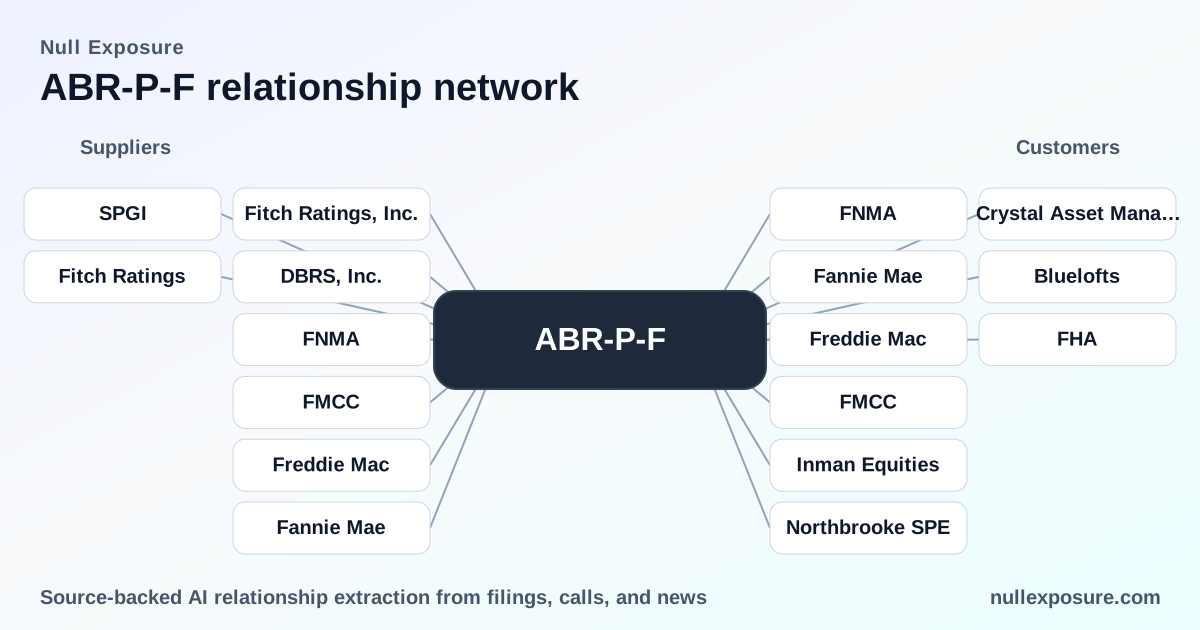
Arbor Realty Trust (ABR-P-F) — Counterparty Map and What It Means for Investors
Arbor Realty Trust operates as a mortgage REIT that originates, acquires and services multifamily and commercial loans, then monetizes those assets through interest spread, servicing fees and capital‑markets executions such as securitizations; the 6.25% Series F cumulative preferred (ABR‑P‑F) is a financing instrument that delivers a fixed income stream funded by that lending and structured‑finance activity. Arbor’s business model is capital‑markets centric: agency lending pipelines, rated securitizations and trustee arrangements are the levers that convert loan books into distributable cash flow. For more detailed counterparty intelligence and original source links, visit https://nullexposure.com/.
Why this matters to an investor: Arbor’s ability to sustain preferred distributions and to access term funding is directly tied to the health of its agency seller/servicer relationships, the ratings agencies that underwrite its securitizations, and the trustees and structuring banks that execute transactions.
The operating model in plain English — what the supplier map implies for credit
Arbor’s operating posture is purposefully transactional and market‑facing. It underwrites and services loans for Fannie Mae and Freddie Mac, packages collateral into securitizations, and uses trustees and rating agency ratings to distribute risk in capital markets. That structure creates three durable characteristics:
- Concentration on agency channels and capital markets: Agency approval as a DUS or Optigo seller/servicer and repeat securitization placements are core to funding and scale.
- Counterparty criticality: Ratings agencies and trustees are not peripheral; they are gating functions for issuance, pricing and investor acceptance.
- Mature, repeatable contracting: Frequent public securitizations and preferred dividends indicate a routine, institutionalized approach to funding rather than opportunistic one‑offs.
There are no explicit constraint excerpts in the supplied feed to reassign to a single counterparty; treat that absence as a company‑level signal—Arbor’s public communications emphasize market access and agency affiliation rather than vendor operational constraints.
Every supplier relationship surfaced in the feed — what each partner does for Arbor
Below I list every relationship that appears in the results and the evidence supporting it. Each entry is one or two sentences with a source cue drawn from the press coverage in the results.
- Fitch Ratings, Inc. — Fitch rated certain notes in Arbor’s collateralized loan obligation and other securitizations, supporting deal distribution and investor confidence (GlobeNewswire press release, June 2, 2025).
- DBRS, Inc. — DBRS provided ratings for all notes in the same securitization, playing a central role in the transaction’s market acceptance (GlobeNewswire press release, June 2, 2025).
- Fitch Ratings, Inc. (press recap on Yahoo Finance) — Coverage on Yahoo Finance repeated that Fitch was one of the rating agencies on Arbor’s public securitization, reinforcing that Fitch engagement is active across Arbor transactions (Yahoo Finance article, March 2026).
- Freddie Mac — Arbor is identified as an approved Freddie Mac Optigo® seller/servicer, which secures a pipeline for agency‑sponsored lending and fee income (company release republished in QuiverQuant, March 2026).
- DBRS, Inc. (Yahoo Finance recap) — The Yahoo Finance report also cited DBRS as a ratings provider on Arbor’s securitization, confirming multi‑agency rating coverage (Yahoo Finance article, March 2026).
- Fannie Mae — Arbor is listed as a leading Fannie Mae DUS® lender, establishing a strategic channel for originating and selling multifamily loans into agency execution programs (Arbor press release, May 2, 2025).
- FNMA (alternate listing for Fannie Mae) — Press materials that use the FNMA identifier repeat Arbor’s role as a Fannie Mae DUS lender, reflecting the same agency relationship in regulatory and investor communications (GlobeNewswire, May 2, 2025).
- FNMA (duplicate press entry) — The feed contains multiple entries that reiterate Fannie Mae / FNMA affiliation in Arbor’s quarterly and transaction announcements, indicating persistent public positioning with that agency (GlobeNewswire, May 2, 2025).
- Freddie Mac (with inferred symbol FMCC) — A separate press mention lists Freddie Mac alongside Arbor’s seller/servicer status, confirming repeated Freddie Mac program participation across filings (QuiverQuant news item, March 2026).
- UMB Bank, N.A. — UMB is named as the fiduciary agent/trustee on a material debt issuance, which signals trustee services used to administer investor payments and covenant enforcement for Arbor’s secured issuance (Investing.com coverage of the bond issue, May 2, 2026).
- SPGI (S&P Global) — Standard & Poor’s (S&P) was referenced as a ratings party on Arbor’s rated instruments, adding another layer of market validation for securitized paper (Yahoo Finance coverage, March 2026).
- Standard and Poor’s — Multiple press releases cite Standard & Poor’s as rating Arbor deals and as part of the firm’s capital‑markets positioning, underscoring the firm’s recurring role across Arbor disclosures (GlobeNewswire press releases, Aug–Sep 2025).
- UMB Bank, N.A. (Portuguese press repeat) — International coverage reiterated that UMB Bank acted as the fiduciary administrator on recent issuances, corroborating the trustee appointment in multiple jurisdictions (Investing.com Portuguese edition, May 2, 2026).
- Fitch Ratings (preferred‑dividend announcement reference) — A GlobeNewswire item around preferred dividends referenced Fitch’s role in Arbor’s public standing, linking rating agency coverage to dividend communications (GlobeNewswire, Sep 29, 2025).
- Standard and Poor’s (preferred‑dividend announcement reference) — The same dividend announcement referenced S&P, indicating that Arbor’s shareholder communications situate ratings coverage as part of the capital‑markets narrative (GlobeNewswire, Sep 29, 2025).
- SPGI (repeated S&P reference) — Press items in the summer of 2025 repeatedly note S&P involvement in rated transactions and company communications, confirming a pattern of S&P engagement (GlobeNewswire, Aug 1, 2025).
- Standard and Poor’s (quarterly report reference) — Quarterly results and investor notices include Standard & Poor’s in the list of rating agencies, which supports credit‑market positioning for Arbor’s issuance pipeline (GlobeNewswire, Aug 1, 2025).
- Fitch Ratings (quarterly report reference) — Quarter‑period releases cite Fitch alongside S&P as part of Arbor’s ratings footprint, demonstrating multi‑agency coverage across reporting cycles (GlobeNewswire, Aug 1, 2025).
What investors should take away — opportunities and risk vectors
- Opportunity: predictable funding channels. Arbor’s seller/servicer status with Fannie Mae and Freddie Mac and repeat use of rated securitizations create predictable avenues for monetization and refinancing of loan assets.
- Risk: reliance on market access and ratings. Preferred dividends and structured financings depend on continued access to capital markets and favorable ratings; any disruption to ratings agency support, trustee relationships or agency program eligibility would increase funding costs.
- Operational implication: counterparty stewardship is material. Trustee selection (UMB Bank) and recurring engagement with S&P, Fitch and DBRS signal that Arbor runs standardized, institutional transactions where counterparty performance directly affects execution and pricing.
Actionable next steps for diligence
- Request the latest agency seller/servicer agreements and recent prospectus documentation for the most recent securitizations; confirm trustee terms with UMB Bank and the scope of ratings (S&P, Fitch, DBRS) on outstanding deals. For a consolidated view of these counterparties and to access original press links, consult our research hub at https://nullexposure.com/.
Bold takeaway: Arbor’s preferred security is a product of a repeatable capital‑markets machine—agency pipelines, rating agency coverage and trustee infrastructure are the critical suppliers whose continuity determines funding cost and dividend durability.