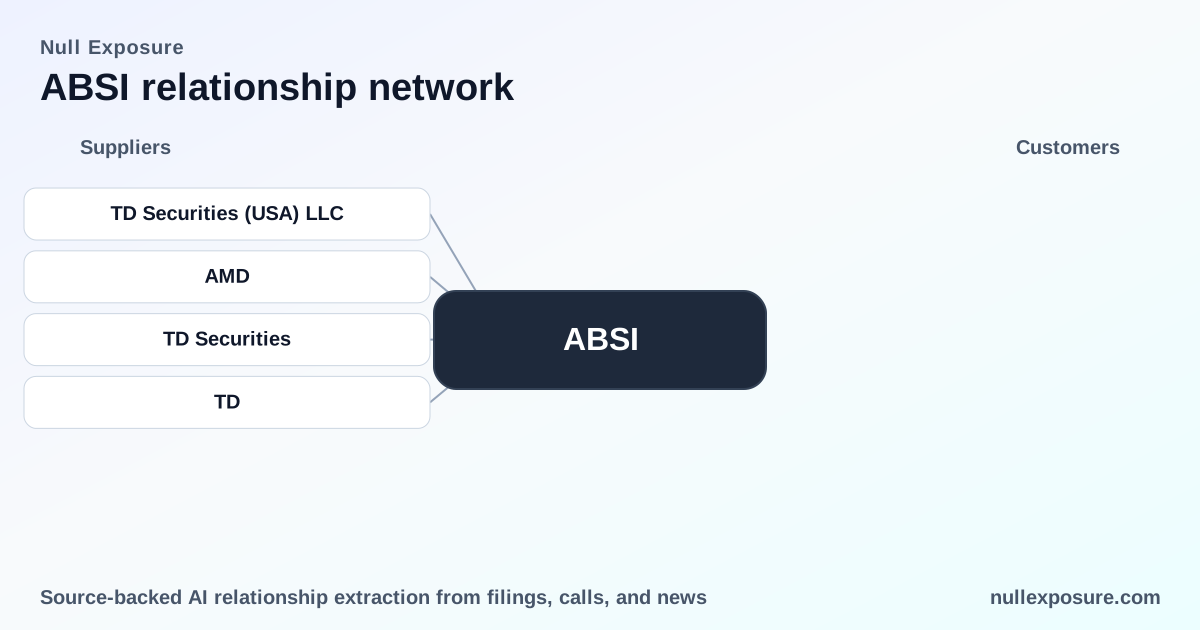
Absci Corp (ABSI): Supplier map and capital-market counterparties that shape execution risk
Absci operates a proprietary, AI-driven platform to design and manufacture protein-based therapeutics and offers those capabilities to pharma partners under collaboration, service and license arrangements. The company monetizes through collaboration fees, milestone and royalty economics on partnered programs, fee-for-service discovery work, and intermittent capital markets activity to fund growth — most visibly via an active Form S‑3 shelf and a sales agreement that enables up to $100 million of common stock issuance. For investors and operators, the critical lens is how Absci’s supplier and capital-counterparty relationships translate into compute and manufacturing continuity, capital flexibility, and concentration risk. For supplier diligence tools and relationship analytics, visit https://nullexposure.com/.
How Absci’s supplier posture translates into operational constraints
Absci combines long-term infrastructure commitments with opportunistic procurement. Public disclosures and filings indicate the business maintains a multi-year compute contract and equipment financing, while continuing to purchase some lab consumables on a purchase‑order basis.
- Absci has a long-term cloud compute commitment (company-level disclosure naming Oracle Cloud Infrastructure) that runs through early 2028 with scheduled annual financial commitments; this signals a deliberate strategy to secure production-scale compute capacity rather than relying solely on spot cloud capacity.
- The company also uses equipment financing and fixed-term payment structures for capital items, placing mid-single-digit millions of committed spend on the balance sheet and implying predictable cash flows for capital suppliers.
- Simultaneously, Absci sources certain laboratory consumables and reagents via purchase orders without standing contracts, producing spot exposure and supplier substitution risk for some inputs.
- Manufacturing is treated as outsourced and partnership-driven: Absci relies on third-party CDMOs and partners’ in‑house manufacturing for cGMP production, which makes manufacturing relationships operationally critical even if Absci does not internally own large production assets.
Together these signals indicate a supplier model that is mixed maturity (infrastructure is contracted long-term; consumables remain spot), moderately concentrated for critical capabilities (compute, CDMO manufacturing), and material to operations when interruptions occur.
The public counterparties you should know (every relationship in the filings and press)
Below are all counterparties surfaced in the supplier/counterparty coverage set, each followed by a concise summary and the public source.
TD Securities (USA) LLC — FY2026
Absci has an active Form S‑3 shelf filed Aug. 12, 2025 that includes a sales-agreement prospectus with TD Securities (USA) LLC allowing up to $100 million of common stock to be sold under the shelf, providing immediate capital market flexibility. Source: StockTitan news releases referencing the August 12, 2025 S‑3 (news mentions dated March 9, 2026).
TD Securities — FY2025
Absci’s communications from FY2025 also reference an effective Form S‑3 shelf enabling up to $400 million of securities in total and up to $100 million of common stock under a sales agreement with TD Securities, underscoring the standing capital‑markets arrangement. Source: StockTitan news article on clinical dosing and corporate updates (first seen March 9, 2026).
AMD — FY2026
Absci disclosed a technology partnership with AMD that includes a $20 million equity investment and collaboration to scale compute for protein design, signaling a strategic supplier/partner role for high‑performance compute hardware and ecosystem support. Source: Yahoo Finance coverage of Absci’s Origin‑1 AI announcement (March 2026).
TD Securities (USA) LLC — FY2026 (alternate press mention)
A separate press release reiterates the S‑3 shelf and the sales agreement with TD Securities (USA) LLC, confirming the same capital markets arrangement across multiple corporate announcements. Source: StockTitan news release on clinical leadership appointments (March 9, 2026).
TD — FY2026 (ticker/inferred symbol)
Press excerpts indexed with the simplified label “TD” repeat the S‑3 and sales agreement disclosure; this is an additional notice that the TD relationship is repeated in Absci’s FY2026 communications. Source: StockTitan news (March 9, 2026).
TD Securities — FY2026 (preliminary filing mention)
A later news item (May 2, 2026) calls the August 12, 2025 filing “preliminary” and again references the sales agreement prospectus for up to $100 million with TD Securities, confirming ongoing public positioning for equity access. Source: StockTitan coverage (May 2, 2026).
TD Securities — FY2025 (data release mention)
Another FY2025 press release reiterates the Form S‑3 shelf and the sales agreement prospectus with TD Securities, consistent with multiple mentions across corporate news items — indicating the sales-agreement channel is a standing, repetitively disclosed relationship. Source: StockTitan news on ex‑vivo data (March 9, 2026).
What the relationship mix implies for risk and opportunity
- Capital markets flexibility is centralized. The repeated disclosures about an S‑3 shelf and a sales agreement with TD Securities/TD Securities (USA) LLC show Absci has structured a clear route to raise equity quickly, reducing financing execution risk in the near term. The trade‑off is concentration of execution risk in a single investment-bank channel for at‑the‑market or block sales.
- Compute capability is a strategic supplier relationship. The AMD partnership plus a named multi‑year agreement with Oracle Cloud Infrastructure (OCI) for compute capacity are foundational to Absci’s platform — compute is not ancillary; it is a core enabler of the AI-driven discovery workflow. The disclosed OCI commitments and the AMD $20M investment show the company is investing to lock in capacity and vendor support, which reduces spot‑capacity volatility risk but creates vendor concentration.
- Manufacturing remains outsourced and critical. Public constraints show Absci will continue to rely on CDMOs for cGMP manufacture; therefore counterparties that provide clinical and commercial manufacturing services are single points of failure for program timelines.
- Mixed contracting maturity increases procurement complexity. Long-term, contracted infrastructure and financed capital assets coexist with spot procurement of consumables — a split posture that requires active supplier management to prevent disruptions in lab operations.
Practical diligence checklist for investors and operators
- Confirm the terms and expiration of the S‑3/sales agreement with TD Securities and monitor utilization of the $100M sales-agreement capacity.
- Validate compute commitments: verify OCI contract milestones/termination clauses and the timeline/conditions of the AMD collaboration and investment.
- Map manufacturing counterparties (CDMOs) and assess redundancy and qualification timelines for any single-source processes.
- Review equipment-financing schedules and contingency funding to understand cash flow draws related to the 1–10M spend band.
For more supplier relationship intelligence and to review comparable counterparty maps, visit https://nullexposure.com/.
Bottom line
Absci’s public disclosures demonstrate a deliberate mix of secured, long-term compute and capital commitments alongside spot purchases and outsourced manufacturing. That configuration reduces certain platform risks (compute capacity, capital access) while preserving material concentration around a small set of critical counterparties — TD Securities for capital execution, AMD/OCI for compute, and CDMOs for manufacturing. Active counterparty monitoring and contractual diligence are essential for investors evaluating execution risk and operators managing continuity.