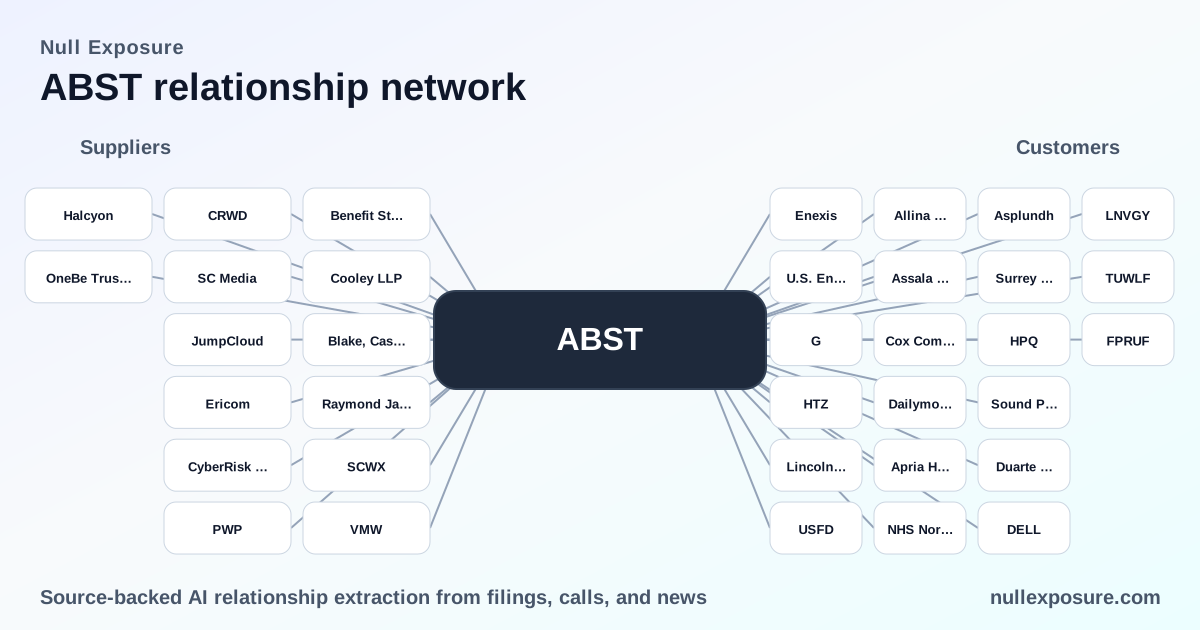
Absolute (ABST) supplier map and what it means for investors
Absolute operates as an enterprise cyber-resilience platform that monetizes primarily through subscription licenses and modular add‑ons (endpoint resilience, secure access, web gateway) while extending reach via technical integrations and channel partnerships; recent transaction activity has engaged major financial and legal advisors, underscoring the strategic value of the company’s partner ecosystem. For investors and operators evaluating ABST supplier exposure, the partner roster shows a deliberate mix of technology integrations, channel enablement and transaction advisers that collectively support product depth, go‑to‑market scale and deal execution.
Learn more at https://nullexposure.com/.
Why the partner list matters to underwriting and ops
Absolute’s partners are not cosmetic co‑brands — they are functional enablers. Integrations with EDR, XDR and identity vendors broaden product capability and stickiness, while MSP and gateway partners expand distribution to managed service channels. The presence of multiple financial and legal advisers in the public record signals a mature contracting posture and transactional readiness rather than informal advisory support.
- Contracting posture: Engagement of top-tier financial and law firms for the announced acquisition indicates formal, arms‑length deal processes consistent with enterprise-grade governance.
- Concentration and criticality: Technical partners like CrowdStrike, VMware, and Secureworks are feature-level dependencies for specific resilience capabilities, meaning technical interoperability is critical for certain product modules but not single-sourced across the entire platform.
- Maturity: Public press releases and certified integrations suggest these relationships are productionized (certified integrations and channel programs), not pilot-stage experiments.
- There are no supplier constraint disclosures in the records reviewed, an operational signal that no material supplier-level covenants or restrictions were reported in the sources provided.
Supplier map: the relationships you need on your checklist
Below is a plain-English walkthrough of every partner and adviser referenced in the available reporting, with compact sourcing.
-
Perella Weinberg Partners (PWP) — Served as Absolute’s financial advisor in connection with the announced acquisition process, indicating institutional M&A engagement and valuation support. According to Investing News coverage of the March 2026 acquisition announcement, Perella Weinberg Partners acted as Absolute’s financial advisor.
Source: Investing News, March 2026. -
Raymond James Ltd. — Provided financial advice to Absolute’s Special Committee during the acquisition process, reflecting independent advisory input for the board’s review. Investing News reported Raymond James advised the Special Committee in the same March 2026 acquisition filing.
Source: Investing News, March 2026. -
Cooley LLP — One of Absolute’s legal advisors on the acquisition, signaling the company retained major U.S. transactional counsel to manage deal documentation and regulatory matters. The acquisition announcement lists Cooley LLP as legal counsel.
Source: Investing News, March 2026. -
Blake, Cassels & Graydon LLP — The Canadian law firm named alongside Cooley as legal counsel in the acquisition, consistent with cross‑border legal coverage for a deal involving Canadian and U.S. stakeholders. The same acquisition materials list Blake, Cassels & Graydon as counsel.
Source: Investing News, March 2026. -
Benefit Street Partners (BSP) — Absolute amended terms of its senior credit agreement with Benefit Street Partners in anticipation of the transaction, indicating active debt‑facility management tied to deal execution and leverage posture. Investing News reported the amendment to the senior credit agreement ahead of the acquisition.
Source: Investing News, March 2026. -
CrowdStrike (CRWD) — A technical integration partner whose telemetry and prevention capabilities are integrated with Absolute’s resilience workflows to help stop breaches and recover endpoints at scale; featured across product blogs and press releases. Absolute’s product blog and press materials document the CrowdStrike integration as part of its resilience offering.
Source: Absolute corporate blog and press releases, 2025–2026. -
Secureworks (SCWX) — Absolute’s Application Resilience capability added support for Secureworks Taegis XDR, expanding XDR compatibility within endpoint recovery and resilience workflows. The product blog announcing the Application Resilience update lists Secureworks Taegis XDR as supported.
Source: Absolute product blog, March 2026. -
VMware (VMW) — VMware Carbon Black EDR is among the EDR integrations now supported by Absolute’s Application Resilience, signaling interoperability with a major virtualization and security vendor widely used in enterprises. Absolute’s Application Resilience announcement lists VMware Carbon Black EDR as supported.
Source: Absolute product blog, March 2026. -
JumpCloud — Listed as a supported application within Application Resilience, indicating Absolute’s coverage of identity and device management services that many IT organizations deploy. The Application Resilience feature update cites JumpCloud support.
Source: Absolute product blog, March 2026. -
Halcyon — Identified as a supported application for Application Resilience, extending Absolute’s compatibility footprint into additional endpoint protection tooling. The product update references Halcyon among supported apps.
Source: Absolute product blog, March 2026. -
OneBe TrustDelete — Included in the list of applications supported by Application Resilience, representing further third‑party tooling that Absolute can detect and remediate in resilience scenarios. The Application Resilience announcement includes OneBe TrustDelete support.
Source: Absolute product blog, March 2026. -
Ericom — Powers the Absolute Secure Web Gateway Service add‑on for the Absolute Edge customers, indicating a white‑label or OEM relationship for web gateway capabilities that integrate with Absolute Secure Access policies. Absolute platform pages describe the Secure Web Gateway Service as “powered by Ericom.”
Source: Absolute product pages (Absolute Core and Absolute Enterprise), 2025–2026. -
ConnectWise — Certified integration with ConnectWise RMM on the ConnectWise Asio platform allows managed service providers to combine Absolute Resilience offerings with ConnectWise’s RMM tooling, strengthening channel distribution to MSPs. Absolute announced the certified integration and ConnectWise partnership in a 2025 press release.
Source: Absolute press release, 2025. -
SC Media — Absolute Security is the exclusive award sponsor for the new Resilient CISO Award promoted by SC Media, indicating marketing and industry positioning efforts to influence security decision‑makers. A press release noted the sponsorship and award recognition at RSAC 2026.
Source: SC Media/press release coverage, March 2026. -
CyberRisk Alliance — As co‑producer of the SC Awards, CyberRisk Alliance partnered with Absolute as the corporate sponsor for the Resilient CISO Award, an example of targeted brand investments to entrench Absolute with enterprise CISOs. Coverage of the award launch cites Absolute Security as the exclusive sponsor.
Source: CyberRisk Alliance/press release, March 2026.
What investors should pull from the list
- Ecosystem strategy: Absolute is executing a two‑track supplier strategy — critical technical integrations (CrowdStrike, VMware, Secureworks, JumpCloud, Halcyon, OneBe) that enhance product capability, and commercial/channel relationships (ConnectWise, industry sponsorships) that extend go‑to‑market reach. These partnerships increase product defensibility and customer renewal velocity for the integrated modules.
- Transaction readiness and governance: The appointment of Perella Weinberg Partners, Raymond James, Cooley and Blake Cassels demonstrates a formalized, institutional approach to M&A and financing — a governance signal investors value when assessing exit optionality or refinancing risk.
- Operational risk profile: While several integrations are functionally important, the partner list does not indicate single‑vendor lock‑in for Absolute’s core platform; rather, it reflects a diversified integration layer that reduces supplier concentration risk for the product as a whole.
- Marketing and channel depth: Sponsorships and MSP integrations show targeted investments in demand generation and channel sales execution, which matters for adoption among enterprise and MSP customers.
If you want a consolidated supplier risk scorecard or a transactional-readiness briefing tailored to financial due diligence, visit https://nullexposure.com/ for detailed supplier intelligence and briefings.
Bold takeaway: Absolute’s supplier network balances critical technical integrations with professional advisers and channel partners, supporting both product resiliency and transaction execution — a profile consistent with a mature enterprise security vendor positioned for strategic outcomes.