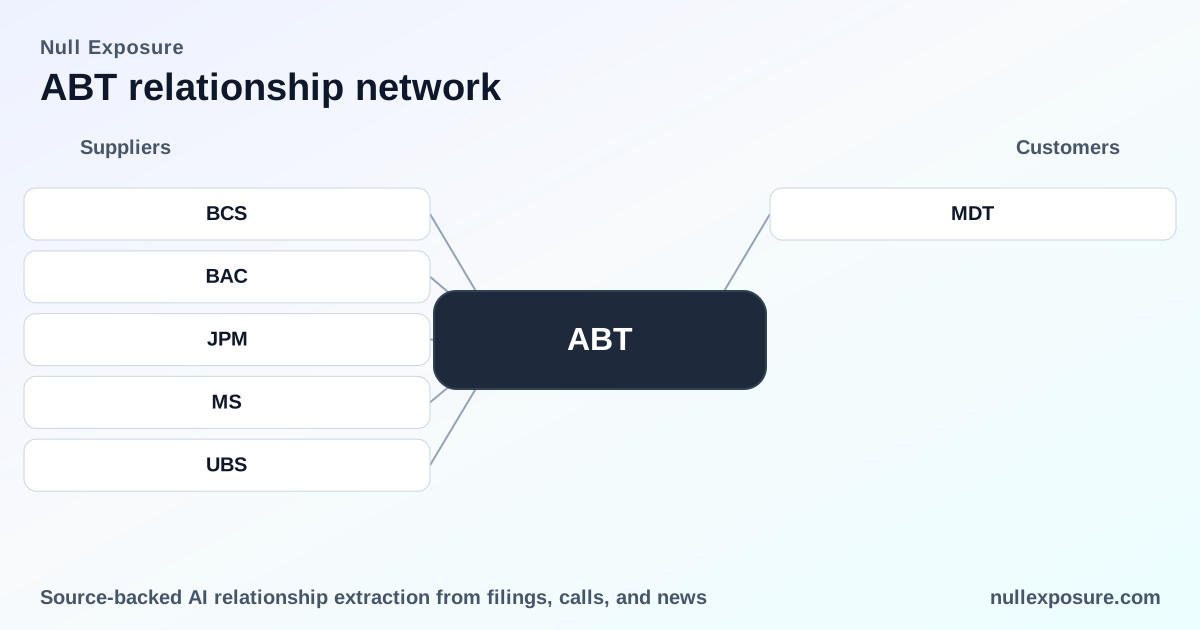
Abbott Laboratories (ABT): Supplier relationships, counterparties and operational constraints investors should price in
Abbott Laboratories is a diversified healthcare manufacturer that monetizes through four operating pillars—medical devices, diagnostics, branded generics and nutrition—by selling finished products and recurring consumables to health systems, distributors and retail channels. Its commercial model combines long-lived supply contracts and global manufacturing scale with capital markets activity to fund strategic M&A and product rollouts; revenue is driven by repeat consumables (sensors, reagents) and device placements that create durable aftermarket streams. For investors evaluating Abbott’s supplier and counterparty posture, the company presents high operational criticality, global sourcing, and a contracting profile tilted toward multi-year arrangements. For a concise view of counterparties and implications, see Null Exposure’s supplier intelligence at https://nullexposure.com/.
Executive takeaways for portfolio and operations teams
- Abbott operates as a manufacturing-led, contract-intensive business: its global footprint (89 manufacturing sites) and stated lease/credit arrangements indicate multi-year commitments to suppliers and infrastructure.
- Counterparty mix combines large financial institutions (underwriters/lenders) and specialist industrial suppliers, reflecting both capital markets activity and single-vendor product relationships in devices and diagnostics.
- Key risk vectors for investors: concentration of supplier relationships for specific consumables, execution risk on integration of large acquisitions, and refinancing needs tied to sizeable note issuances. Monitor procurement continuity for Libre/Lingo consumables and any supplier extensions or disruptions.
- Actionable signal: treat Abbott’s supplier relationships as strategically critical—disruptions to a handful of precision suppliers would be more consequential than a similar supplier outage at a consumer-goods company.
How Abbott’s operating model shows up in the constraints
Abbott’s publicly reported disclosures and contracts reveal several company-level characteristics investors should internalize:
- Long-term contracting posture: Multiple excerpts reference leases and a five-year credit agreement, signaling that Abbott structures obligations on a multi-year basis and therefore negotiates with strategic suppliers and lenders under extended terms.
- Global sourcing and manufacturing criticality: Abbott purchases raw materials worldwide and operates 89 manufacturing facilities, indicating a geographically distributed but supply-chain-dependent model where logistics and regulatory approvals are material to operations.
- Service-provider relationships and enterprise counterparties: filings reference major banks and agents in credit facilities, pointing to large-enterprise counterparties on the financial side of the business.
- Manufacturing concentration: the prominence of manufacturing in the firm’s profile makes supplier continuity and quality controls a central operational control for sustaining margins.
These are company-level signals — they should inform counterparty risk assessments, vendor concentration stress tests, and operational due diligence when underwriting exposure to ABT.
Supplier and counterparty map — every relationship surfaced in the record
NVE Corp (NVEC)
Abbott has an active supplier relationship with NVE Corp, and NVE publicly reported an extension of its supplier agreement with Abbott for two years, indicating continued procurement of NVE’s components and short- to medium-term revenue visibility for the supplier. A Yahoo Finance note from March 10, 2026 referenced the extension, and an earnings transcript cited by Investing.com reiterated Abbott as a demanding customer in May 2026.
Sources: Yahoo Finance (Mar 10, 2026); Investing.com earnings transcript (May 3, 2026).
Morgan Stanley
Morgan Stanley served as a lead underwriter in Abbott’s multi-tranche senior notes pricing, which priced to fund Abbott’s acquisition activity and liquidity needs, reflecting the bank’s role on the capital markets side rather than product supply. TradingView reported the underwriting syndicate and pricing details on March 9, 2026.
Source: TradingView coverage of the pricing agreement (Mar 9, 2026).
J.P. Morgan
J.P. Morgan is reported as a counterparty and underwriter on Abbott’s $20.0 billion senior notes offering, forming part of the syndicated capital-markets relationship that supports Abbott’s large strategic transactions and balance sheet management. TradingView captured the underwriting list on March 9, 2026.
Source: TradingView coverage of the pricing agreement (Mar 9, 2026).
BofA Securities
BofA Securities participated in the underwriting syndicate for Abbott’s $20 billion multi‑tranche notes, which Abbott used to fund strategic M&A initiatives and to refinance. This places BofA in a financing-counterparty role rather than a manufacturing supplier. TradingView reported the syndicate on March 9, 2026.
Source: TradingView coverage of the pricing agreement (Mar 9, 2026).
Barclays
Barclays appears in the same underwriting syndicate for Abbott’s senior notes issuance, providing debt-distribution capacity and balance sheet execution support for the company’s acquisition financing. TradingView reported Barclays as a participant on March 9, 2026.
Source: TradingView coverage of the pricing agreement (Mar 9, 2026).
Exact Sciences (EXAS)
Abbott announced an acquisition of Exact Sciences—an up-to-$23 billion deal—to strengthen its diagnostics franchise, which will materially reshape Abbott’s supplier and integration priorities as diagnostics reagent and test manufacturing scale up under Abbott ownership. CNBC covered the acquisition announcement (Nov 20, 2025), and financing for the deal links to the aforementioned bond issuance.
Source: CNBC (Nov 20, 2025).
UBS Financial Services, Inc.
UBS appears in Abbott’s SEC-related filings as a named securities exchange or transfer agent counterparty in filing excerpts, indicating UBS acts in a financial-services capacity (custody/transfer or distribution channels) tied to Abbott’s listed securities. The SEC filing excerpt is reflected in StockTitan’s SEC posting (Mar 9, 2026).
Source: StockTitan / SEC filing excerpt (Mar 9, 2026).
AptarGroup (ATR)
AptarGroup reported involvement with Abbott’s Libre and Lingo product lines, signaling a supplier relationship tied to device consumables or delivery systems for Abbott’s continuous glucose monitoring and related offerings—a functional supplier link with operational implications for consumables throughput. The remark appeared in an earnings transcript summarized by Investing.com on May 2, 2026.
Source: Investing.com earnings transcript (May 2, 2026).
What investors should monitor next
- Supplier extensions and contract terms: watch public statements and supplier earnings for renewals like the NVE two‑year extension; these give forward revenue sightlines for both Abbott and suppliers.
- Integration execution on Exact Sciences: monitor reagent supply continuity, regulatory filings and any one-off supplier substitution costs after acquisition close.
- Debt markets and underwriter syndicate activity: the $20B notes issuance and its syndicate members signal how Abbott is financing strategic moves; track credit spreads and liquidity conditions that could affect refinancing capacity.
- Manufacturing continuity and geographic risk: given Abbott’s global sourcing, geopolitical or regulatory events in supplier regions will have outsize operational impact.
Bold action: review supplier concentration exposure for Libre and Lingo consumables and stress-test P&L sensitivity to a six- to twelve-month supplier disruption.
Bottom line
Abbott’s supplier picture combines strategic, contractually anchored manufacturing relationships (consumables and device components) with large financial counterparties supporting capital allocation and M&A. For investors this translates to a business with predictable aftermarket revenue but measurable execution and financing risks tied to major acquisitions and a relatively concentrated supply chain. For a practical supplier-risk report tailored to your portfolio exposure, visit https://nullexposure.com/ for deeper counterparty mapping and monitoring.