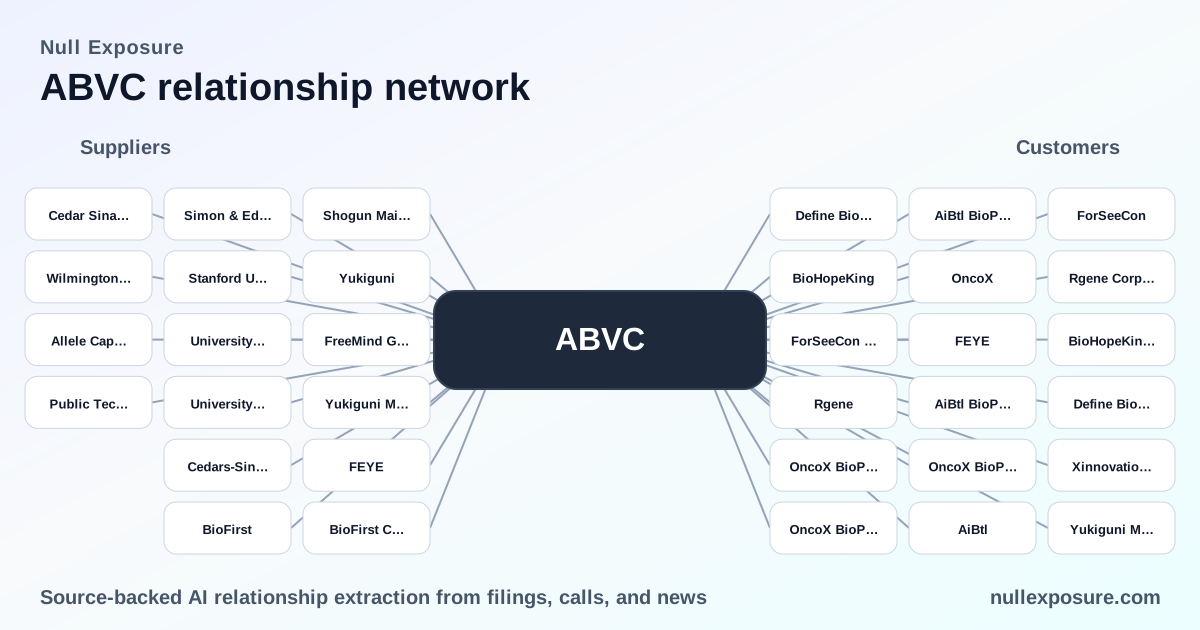
ABVC Biopharma: Supplier network, operating constraints, and what investors should know
ABVC Biopharma (NASDAQ: ABVC) operates as a clinical-stage biopharma that licenses early-stage inventions from research institutions, develops them through proof-of-concept and Phase II trials, and pursues commercialization or distribution partnerships. The company monetizes by in-licensing therapeutic candidates, advancing clinical data to unlock licensing fees and partner deals, and by securing distribution rights for ophthalmology products to generate near-term revenue. Revenue today is small and R&D-driven; value accrual depends on successful clinical milestones and external commercialization or distribution arrangements. For deeper supplier-mapping and procurement signals, see NullExposure’s supplier profiles: https://nullexposure.com/
Operational profile at a glance
- ABVC’s model is licensor-centric and R&D-heavy, relying on third-party research institutions for intellectual property and on external suppliers for specific APIs and raw materials.
- Supplier concentration is meaningful: extracted API for several oncology candidates is sourced primarily from a single Japanese supplier, which the company identifies as critical to timelines.
- Financially, ABVC is a small-cap biotech with limited revenue (Revenue TTM ~$0.8M) and negative EPS, so supplier disruptions would have outsized programmatic and cash-flow consequences.
Read on for a relationship-by-relationship run through of every supplier, vendor and institutional partner cited in public filings and news.
Institutional licensors and clinical partners that underpin the pipeline
ABVC builds its clinical development pathway through institutional licenses and trial sites with established medical centers.
Stanford University
ABVC uses in-licensed technology and conducts proof-of-concept work at Stanford; this relationship is a component of the company’s early clinical validation strategy. According to investor communications and company filings describing the network of research institutions, Stanford is a named research partner supporting trials (reported in various 2025–2026 releases).
University of California, San Francisco (UCSF)
UCSF is another licensor/clinical site used for proof-of-concept and early-stage trials, forming part of ABVC’s strategy to validate candidates in respected centers (referenced in 2025–2026 company announcements and filings).
Cedars-Sinai Medical Center
Cedars-Sinai is listed alongside Stanford and UCSF as a research collaborator where ABVC runs proof-of-concept and Phase II activity; the relationship supports clinical credibility and investigator-led studies (cited in 2025–2026 press materials and the 2025 10‑K).
- Source context: multiple 2025–2026 press reports and the company’s 2025 Form 10‑K filings refer to this research network.
Raw-material and API suppliers with program-level impact
Yukiguni / Yukiguni Maitake Co.
Yukiguni supplies Yukiguni Maitake Extract 404, the API contained in four oncology/hematology candidates (ABV-1703, ABV-1519, ABV-1502, ABV-1501); ABVC identifies this supplier as the primary source and warns that interruptions would delay and materially increase the cost of R&D for those programs. According to the company’s Form 10‑K disclosures (FY2024–FY2026 filings), Yukiguni is a critical, concentrated supplier for multiple candidates.
- Source: ABVC 2024–2026 Form 10‑K disclosures referencing Yukiguni Maitake Extract 404.
Shogun Maitake Canada, Co. Ltd.
Shogun supplies mushrooms grown in controlled, pesticide‑free environments used in ABVC’s plant-derived product work; the company lists Shogun as a supplier in its 2025–2026 annual report. This relationship supports raw-material integrity for ABVC’s natural-product candidates.
- Source: ABVC 2025 Form 10‑K and related 2026 filings.
Commercialization and distribution partners
ForSeeCon Eye Corporation (ForSeeCon / FEYE referenced)
ABVC secured distribution rights for a range of ophthalmology products through a global licensing/collaboration with ForSeeCon, positioned as a near-term revenue avenue for the company’s eye-care pipeline. Press coverage and company announcements describe this agreement as an avenue to broaden market access for ABVC’s ophthalmology assets (reported in 2024–2026 media).
- Source: ForSeeCon distribution reports in 2024 media and 2026 press coverage (Yahoo Finance, Ophthalmology Times).
FEYE (ticker inference)
Public articles refer to ForSeeCon/FEYE in the context of the ophthalmology collaboration; FEYE is referenced in news summaries covering the licensing announcement and distribution rights.
- Source: 2024–2026 media coverage (Yahoo Finance summary of licensing deal).
Service providers, auditors, placement agents and transfer agents
FreeMind Group
ABVC engaged FreeMind Group to identify non-dilutive grant funding (NIH, DOD, NSF, FDA, BARDA, foundations) to support R&D and reduce financing dilution. This engagement was announced in a 2022 press release and is cited in company communications.
- Source: GlobeNewswire press release (May 2022).
Simon & Edward, LLP
Shareholders ratified Simon & Edward, LLP as ABVC’s independent registered public accounting firm for fiscal year ending December 31, 2026; this was disclosed in the FY2026 proxy materials and coverage of the 2026 annual meeting.
- Source: FY2026 definitive proxy statement and meeting materials (filed 2026).
WWC, P.C.
WWC, P.C. previously served as ABVC’s independent auditor but agreed not to renew its engagement as of October 10, 2024; the change is disclosed in proxy and Form 10‑K statements.
- Source: FY2026 proxy disclosures and 10‑K notes on auditor transition.
Vstock Transfer, LLC (Vstock Transfer)
Vstock Transfer, LLC is the company’s transfer agent and handles shareholder mailing and householding processes, referenced in the 2026 proxy materials.
- Source: FY2026 proxy statement (transfer agent contact information).
Allele Capital Partners, LLC & Wilmington Capital Securities, LLC
Allele served as exclusive placement agent with Wilmington as executing broker‑dealer on an offering; ABVC agreed to cover placement expenses and issued a small warrant as part of the arrangement, per the 2025 10‑K financing disclosure.
- Source: 2025 Form 10‑K financing and placement-agent disclosures.
Wilmington Capital Securities, LLC
Acted as the executing broker‑dealer with Allele in the placement; details are included in the company’s offering disclosures.
- Source: 2025 Form 10‑K.
Public Technologies
Public Technologies generated an announcement referenced in mid‑2026 newsfeeds; the mention is informational and not indicative of a strategic supplier relationship.
- Source: Public Technologies announcement (2026 news feed).
Zoom
Zoom is referenced solely as the virtual meeting platform for ABVC’s shareholder meetings in proxy materials; it is a logistics vendor for investor communications.
- Source: FY2026 proxy instructions to attend via Zoom.
Other operational partners and service mentions
BioFirst Corporation / BioFirst
BioFirst provided R&D support services and previously received agreed consideration for past research efforts; ABVC’s agreements require a payment obligation (historically $3.0M in cash or stock) for BioFirst’s contributions. Disclosures in the company’s 10‑K describe the arrangement and related payment terms.
- Source: 2025–2026 Form 10‑K and related notes.
BioKey
ABVC highlights operations at BioKey’s Silicon Valley facility and multi‑product capabilities in communications about manufacturing and commercialization support; the relationship supports U.S.-based product capabilities and functional foods development.
- Source: MarketBeat and company disclosures (2025).
What the constraints tell investors about ABVC’s operating posture
- Contracting posture — long-term commitments exist. The company’s disclosed lease renewals (extensions to 2029) and other multi-year arrangements indicate ABVC adopts multi‑year operating commitments in key jurisdictions, supporting continuity of operations.
- Concentration and criticality — single-supplier risk is real and disclosed. ABVC explicitly identifies Yukiguni as the primary provider of a key API; the filings characterize that supplier as critical to multiple oncology candidates and warn that interruptions would delay and increase program costs.
- Relationship roles — ABVC functions principally as licensor and integrator. Public filings characterize ABVC as licensing inventions from researchers and then coordinating trials and commercialization, while third parties act as licensors, manufacturers and service providers.
- Maturity — partnership mix spans academic licensors, small-cap placement agents, and small professional service firms. The network combines high‑credibility research institutions (Stanford/UCSF/Cedars‑Sinai) with boutique placement agents and specialized suppliers, reflecting a company in clinical development rather than full-scale commercial operations.
Key investor takeaways
- Pipeline risk is supplier‑sensitive: several oncology candidates rely on a single sourced extract; program delays would be costly for a company with limited revenue and negative EPS.
- Clinical credibility is an asset: licenses and trial sites at Stanford, UCSF and Cedars‑Sinai bolster scientific validation and potential partner interest.
- Near-term commercial optionality exists via the ForSeeCon ophthalmology distribution agreement, which provides a non‑dilutive revenue pathway distinct from licensing exits.
If you want a shorthand supplier risk summary or a downloadable partner table for ABVC’s filings, visit NullExposure’s supplier page for ABVC: https://nullexposure.com/suppliers/abvc
Bold decisions on allocation should weigh ABVC’s concentrated supplier exposure and reliance on licensing‑to‑partner commercialization, balanced against the credibility of its academic collaborators and the company’s efforts to secure non‑dilutive funding sources.