Above Food (ABVE): Supplier relationships and what they mean for investors
Above Food Ingredients operates as a vertically integrated regenerative-ingredient company that develops proprietary seeds and plant-based product lines, sells branded ingredients and consumer products, and monetizes through product sales, asset acquisitions and strategic technology partnerships. Revenue comes primarily from packaged-food sales and ingredient licensing, while near-term corporate value is being shaped by asset purchases, equity issuances and strategic investors that embed technology into the commercial model. For investors evaluating supplier and partner exposure, the counterparty mix is a mix of strategic tech backers, former asset sellers converted into equity, and a recently appointed auditor to restore public reporting compliance. Learn more at https://nullexposure.com/.
Quick investment positioning: capital structure, scale and governance signals
Above Food reports roughly $295 million in trailing revenues, yet negative EBITDA and operating margins, and a market capitalization near $36 million, creating a classic early-stage public company profile where revenue scale exists but profitability and governance are under repair. Key operating signals: negative EBITDA (-$40M), gross profit reported negative on TTM basis, diluted EPS of -2.35 and low institutional ownership (~14.6%), which concentrates control and increases sensitivity to major strategic investors. The company is actively addressing Nasdaq compliance and auditing gaps — a material governance event that investors should treat as a directional inflection point for market confidence.
Who Above Food is working with—and what it means
Below are the relationships surfaced in public reporting and press coverage. Each entry is a concise, plain-English summary with an attribution to the underlying reporting.
-
Arcadia Biosciences (RKDA) — Above Food acquired the GoodWheat brand from Arcadia in mid‑2024; Arcadia’s 2024 Form 10‑K records the sale with net consideration of $3.7 million, while contemporaneous press discussed a $4.0 million transaction. Arcadia continues to hold equity received in partial repayment and has delivered notices related to stock-election options on the underlying promissory note. According to Arcadia’s 2024 10‑K filing (filed Feb 2026) and subsequent press releases through late‑2025, Arcadia holds 2.7 million Above Food shares as partial repayment and is pursuing resolution of outstanding balances. (Arcadia Form 10‑K, Feb 2026; GlobeNewswire Nov 7, 2025.)
-
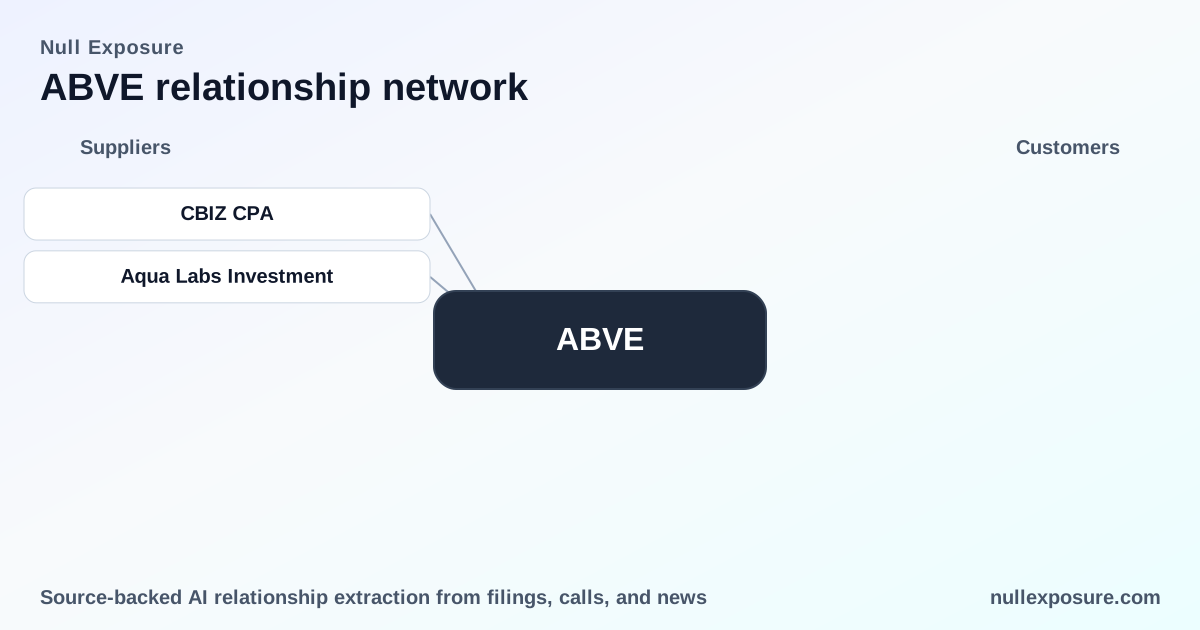
Aqua Labs Investment / Aqua 1 Foundation — A strategic capital relationship: Above Food secured a reported $20 million strategic investment from Aqua 1 Foundation, whose Abu Dhabi entity, Aqua Labs Investment, will provide Web3 and stablecoin technologies to be embedded in Palm Global’s platforms and, by extension, Above Food’s ecosystem. Gulf News and related coverage described Aqua Labs as the exclusive technology partner for Palm Global platforms and a major strategic backer of the transaction announced in March 2026. (Gulf News, Mar 9, 2026; StockTitan coverage, Mar 9, 2026.)
-
Palm (Palm Global, PALM.LON) — Palm is positioned as a strategic platform partner combining financial-technology capabilities with Above Food’s agronomy and seed development to target global food-security initiatives; a Globe and Mail press release in May 2026 framed the relationship around integrating plant-based proteins and genomics with Palm’s fintech stack. The coverage presents Palm as a distribution and technology partner rather than a direct supplier. (The Globe and Mail press release, May 2, 2026.)
-
CBIZ CPA — Above Food appointed CBIZ CPA as its independent auditor to complete the FY2025 audit and facilitate filing the Annual Report on Form 20‑F, a compliance move intended to bring the company into accordance with Nasdaq Listing Rule 5250(c)(1). The auditor appointment was disclosed in a company press release in March 2026 describing steps to regain reporting compliance. (Company release on Newsfile, Mar 9, 2026.)
What these relationships collectively signal about the business model
With no formal constraints listed in the disclosures, the company-level signals drawn from the relationship mix are clear and materially informative:
- Contracting posture: Above Food uses a mix of cash, promissory notes and equity to settle deals and acquire assets, indicating flexibility but also potential balance-sheet strain when counterparties accept equity as partial repayment. This indicates a willingness to structure transactions that conserve cash in favor of equity-linked settlements.
- Concentration and counterparty importance: A small set of large strategic partners and investors (Palm, Aqua 1, and the Arcadia transaction counterpart) dominate the strategic landscape; that concentration amplifies counterparty risk and governance influence relative to a highly diversified supplier base.
- Operational criticality: Technology and fintech integration (via Aqua/Palm) is positioned as more than marketing—these partners are intended to be operational enablers for scaling distribution and payments, making the success of these relationships important to commercial ramp.
- Maturity and governance: The CBIZ CPA auditor appointment and active efforts to file FY2025 20‑F materials are material corporate governance steps that reduce information risk if executed on schedule, but they also highlight that the company is in a remediation phase for public reporting.
Risks and upside from a supplier/investor perspective
Above Food’s ecosystem presents asymmetric outcomes for counterparties and investors:
- Risk: equity exposure as consideration. Counterparties accepting stock (or receiving stock as partial repayment) are exposed to equity dilution and price volatility; Arcadia’s holding of 2.7 million shares is a tangible example of non‑cash consideration transferring market risk to former sellers.
- Risk: governance and disclosure execution. Failure to complete the FY2025 audit and Form 20‑F filing would materially damage access to capital and partnerships; the CBIZ engagement is therefore a near-term operational risk–mitigation that investors should track closely.
- Upside: strategic tech partners can unlock new distribution and monetization mechanisms. If Palm and Aqua Labs successfully integrate fintech and Web3 rails that drive transaction efficiency and new markets, Above Food can scale non-traditional revenue streams beyond commodity ingredient sales.
- Balance-sheet dynamic. High revenue relative to market cap implies a low market valuation that could re-rate rapidly if margin conversion and governance are proven; conversely, persistent negative EBITDA and unremediated reporting issues will cap valuation.
How investors and operators should use this information
- Use the Arcadia transaction and Aqua/Palm strategic arrangements as leading indicators of how Above Food finances growth—watch equity transfers, promissory-note resolutions and auditor milestones as primary triggers for valuation moves.
- Treat the CBIZ CPA appointment and the company’s 20‑F timeline as immediate operational KPIs: successful filings reduce cost of capital and unlock broader institutional interest.
- Monitor counterparties’ public statements for indications they will monetize held ABVE shares or exercise contractual options, since those actions directly affect free float and potential sell pressure.
For a unified view on counterparties, audit progress and event-driven exposures across small-cap issuers like Above Food, consider a diagnostic deep dive at https://nullexposure.com/.
Bottom line
Above Food’s supplier and partner map combines legacy asset acquisitions paid partially in equity, a strategic fintech/Web3 investor syndicate, and active governance remediation. This mix creates both leverage and risk: strategic partners can materially accelerate commercial scale, while equity‑based settlements and public‑reporting remediation create near‑term execution risk that will determine whether revenue scale converts into sustainable investor value.