Averin Capital Acquisition (ACAAU): Who the SPAC leaned on to bring $250m public
Averin Capital Acquisition Corp. (ACAAU) is a classic sponsor-led SPAC: it raised public capital through a $250 million IPO, placed proceeds in a trustee-held trust, and now holds cash and public units while it seeks a business combination in technology, healthcare, or consumer sectors. The company’s monetization pathway is straightforward — raise cash via unit sales, preserve liquidity in a trust, execute a business combination that creates equity value, and realize sponsor economics through post-combination equity and sponsor promote — with underwriter and trustee relationships governing transaction execution and funds security.
For a focused view of counterparties and contract posture, see the full supplier map at https://nullexposure.com/.
The IPO ecosystem that matters for investors
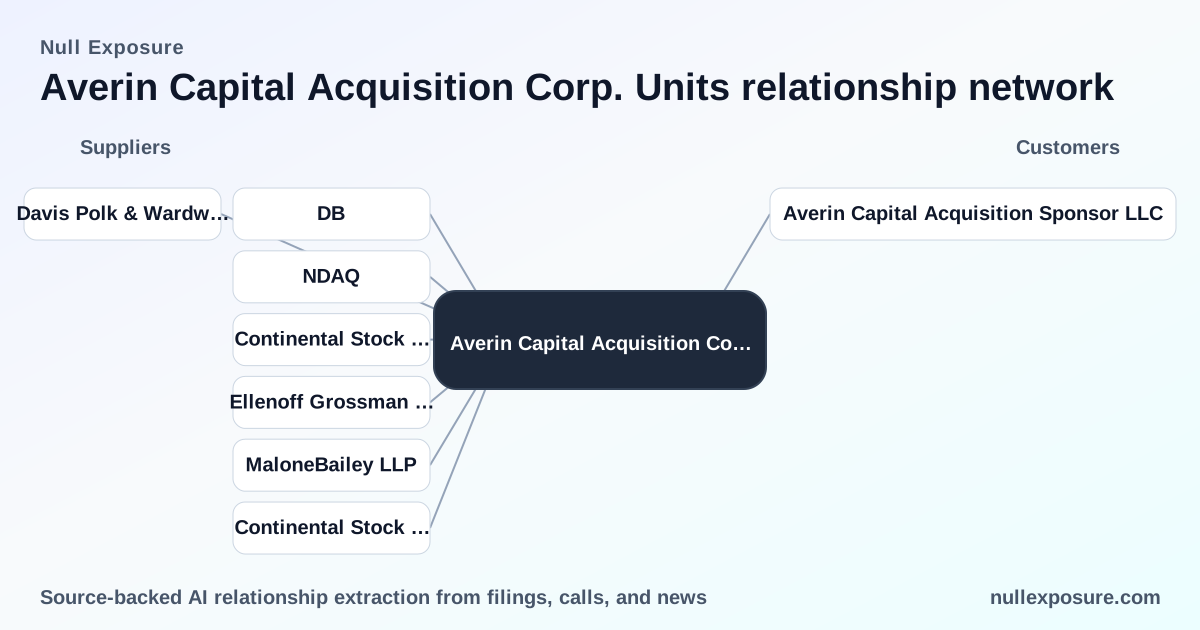
ACAAU’s public debut relied on a small set of service providers that control listing access, custody of IPO proceeds, deal execution and standard legal/accounting work. That concentration — one bookrunner, one trustee, two law firms, one auditor and the listing venue — is typical for a SPAC, but it also concentrates operational risk around a handful of counterparties. Below are the relationships pulled from public coverage and filings.
If you want the supplier network visualized for due diligence, visit https://nullexposure.com/ for a mapped view.
Deutsche Bank Securities Inc. / DB / Deutsche Bank
Deutsche Bank Securities Inc. acted as the sole book-running manager for ACAAU’s $250 million IPO, meaning it led distribution, pricing and underwriting coordination for the offering. According to Investing.com coverage in early May 2026, Deutsche Bank served as the sole bookrunner on the deal. (Investing.com, May 2, 2026)
DB (as referenced in alternate press) performed the same bookrunner role and handled underwriting mechanics and the deferred discount referenced in IPO proceeds reporting. Multiple press notices confirm Deutsche Bank’s sole bookrunner status in March–May 2026. (SPACInsider / Renaissance Capital reporting, March–May 2026)
A related mention of “Deutsche Bank” across filings reiterates the bank’s exclusive underwriting role and the standard underwriter fees and deferred discount that reduce net proceeds available to the trust. (FinancialContent Markets reporting, February–May 2026)
Nasdaq / Nasdaq Global Market / Nasdaq Global Stock Market LLC / NDAQ
ACAAU’s units began trading on the Nasdaq Global Market under the ticker ACAAU on February 19, 2026, and related Class A shares and warrants trade under ACAA/ACAAW once separated. Stocktitan and Bitget press coverage document the Nasdaq listing and ticker assignments. (StockTITAN, March 9, 2026; Bitget, May 2, 2026)
Nasdaq’s role is the standard exchange listing provider: it grants market access and imposes listing compliance obligations that will govern disclosure cadence through the SPAC lifecycle. (TechnologyMagazine / GlobeNewswire distribution, March 2026)
Continental Stock Transfer & Trust / Continental Stock Transfer & Trust Company
ACAAU placed the IPO proceeds into a U.S.-based trust account managed by Continental Stock Transfer & Trust Company acting as trustee, with headline figures showing roughly $249.35–$283.86 million referenced across filings including the over-allotment exercise. TradingView and Investing.com coverage cite the trustee placement and amounts held in trust. (TradingView, March 2026; Investing.com, May 2, 2026)
The trustee relationship is critical: the trust safeguards investor capital and defines redemption mechanics, making Continental Stock Transfer & Trust a key operational counterparty for cash security and compliance. (Markets FinancialContent article, February 2026)
Ellenoff Grossman & Schole LLP
Ellenoff Grossman & Schole LLP served as issuer’s counsel for the transaction, handling corporate and disclosure work for the SPAC entity and its offering documents, as noted in SPACInsider’s IPO coverage. (SPACInsider, March 9, 2026)
Issuer counsel shapes liability exposure in registration materials and the legal structure of sponsor agreements; Ellenoff’s engagement reflects standard SPAC counsel responsibilities.
Davis Polk & Wardwell LLP
Davis Polk & Wardwell LLP acted as underwriter’s counsel, advising Deutsche Bank and the underwriting syndicate on legal aspects of the offering and U.S. securities law compliance, according to SPACInsider reporting. (SPACInsider, March 9, 2026)
Underwriter counsel typically drafts underwriting agreements and supports due diligence, making Davis Polk a counterparty concentrated on deal protection for the bookrunner.
MaloneBailey LLP
MaloneBailey LLP served as auditor for the SPAC, providing the financial statements and audit comfort required for the registration statement and listing process, per SPACInsider’s summary of the closing. (SPACInsider, March 9, 2026)
An auditor’s role in a SPAC is limited but material: audit sign-off validates the balance sheet position and trust accounting that underpins investor protections.
Collective takeaways for investors and operators
- Counterparty concentration is high but conventional. One bookrunner (Deutsche Bank), one trustee (Continental), one listing venue (Nasdaq), and a small set of legal/audit firms handled the IPO — standard SPAC architecture but a single-point concentration for underwriting and custody risk.
- Cash conservatism is explicit. The large trust placement reported across filings makes the SPAC essentially a cash-holder until an acquisition is announced; that custody relationship drives redemption mechanics and capital security.
- Professional counterparties reduce execution risk but concentrate governance. Well-known firms (Deutsche Bank, Davis Polk, MaloneBailey) lower execution risk while centralizing contractual leverage in a few providers.
What the constraints data says about ACAAU’s operations
The sourced relationship data contains no explicit supplier constraints flagged in the dataset. As a company-level signal, that indicates public coverage focused on transaction roles rather than ongoing supply-chain or vendor-limit constraints — consistent with a newly listed SPAC whose primary dependencies are service providers tied to the IPO and trust structure.
Investment implications and risks
For investors, ACAAU is provisionally a cash vehicle whose upside depends on sponsor deal sourcing and execution competence. Key operational risks are counterparty concentration and sponsor selection risk rather than traditional vendor or revenue execution risk. Watch the trustee disclosures, redemption rates, and any amendments to underwriting or sponsor agreements closely — these are the levers that will materially affect per-share economics at combination.
For operators and counterparties evaluating supplier relationships, the structure is predictable: standard underwriting, trustee, legal, and audit relationships govern the offering lifecycle, and negotiating clarity around fee mechanics, indemnities and disclosure schedules is the primary commercial leverage.
If you want a mapped supplier view to support due diligence, find the network and source documents at https://nullexposure.com/.
Bold summary: ACAAU is a traditionally structured SPAC with concentrated but high-quality counterparties; the real value proposition for investors lies in the sponsor’s acquisition strategy, while operational risk centers on the trustee and underwriting arrangements.