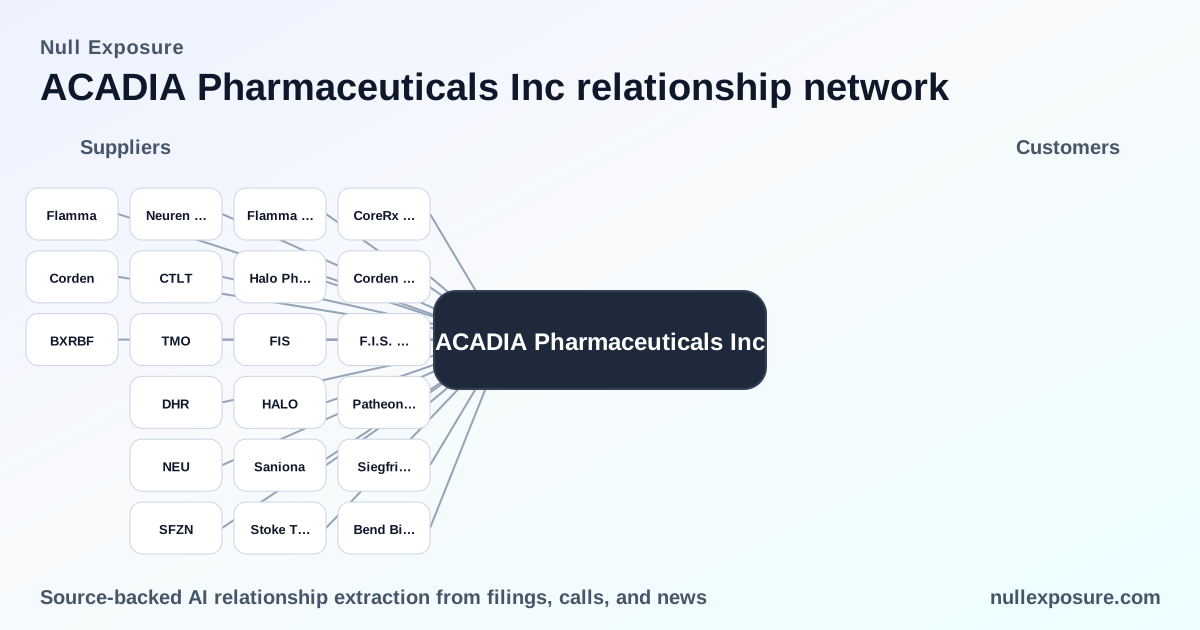
ACADIA Pharmaceuticals: supplier map and what it means for investors
ACADIA Pharmaceuticals operates as a virtual manufacturer: the company licenses, develops and commercializes CNS small-molecule drugs but outsources virtually all drug substance and finished-product manufacturing to third parties. ACAD generates revenue from commercial sales of NUPLAZID and DAYBUE (trofinetide) and finances pipeline programs through licensing and milestone-driven deals, while relying on contract manufacturers for production and supply continuity. For a deeper look at how those outsourced relationships translate into operational and financial risk, read on. If you want the vendor map in one place, visit https://nullexposure.com/ for a direct supplier snapshot.
Quick take: the operating model investors must price
ACADIA’s business model is outsourced manufacturing plus licensing and commercial sales. The company has no in‑house large‑scale manufacturing: it depends on a network of CDMOs and license partners for active pharmaceutical ingredients (APIs), drug product, and co-development assets. That posture creates both financial leverage (lower fixed capex) and concentrated operational risk: supply interruptions, single‑source lines and geographic concentration in EMEA/NA are material to revenue and margin continuity. The company’s public filings treat certain agreements as long‑term framework contracts and one recent license with Saniona as a material upfront payment recorded to R&D.
What the contracts and constraints imply for governance and risk
- Contracting posture: ACADIA uses master/framework agreements and product agreements to secure manufacturing capacity rather than owning plants, implying dependency on CDMO performance and renewal terms. Evidence in the filings references master manufacturing agreements and product agreements across multiple years (documented in FY2015–FY2021 language).
- Concentration & geography: Manufacturing is concentrated across North America and EMEA (Switzerland and Europe), so geopolitical, regulatory inspections or localized disruptions are high‑impact company risks.
- Role & criticality: Third parties act as manufacturers (primary role), with additional functions from service providers and licensors; ACADIA has no internal manufacturing redundancy.
- Contract tenor: ACADIA holds framework and auto‑renewing agreements with multi‑year initial terms and automatic renewals, indicating long‑term dependency rather than short ad‑hoc buy arrangements.
- Financial exposure: Licensing and milestone obligations can be large — the Saniona deal included a $28.0 million upfront payment and up to $582.0 million in contingent milestones, representing meaningful potential spend and R&D accounting effects (recorded in FY2024 filings).
- Materiality: Filings flag supply failures as potentially material to operations and financials; treat supply counterparties as mission‑critical.
Supplier relationships: full list and investor notes
Below I cover every supplier and partner mentioned in Acadia’s supplier results with a concise investor‑oriented summary and source pointer.
CoreRx Inc.
ACADIA contracted CoreRx to produce trofinetide commercial products under a Commercial Supply Agreement dated March 1, 2023; this manufacturer relationship is documented in the FY2024 10‑K. (Source: Acadia FY2024 10‑K)
Corden Pharma Bergamo S.p.A.
Corden is contracted to manufacture trofinetide API for commercial use, referenced in the FY2024 and reiterated in the FY2025 10‑Ks; Corden is a core API supplier for DAYBUE. (Source: Acadia FY2024 and FY2025 10‑K)
Patheon Pharmaceuticals Inc. (a Thermo Fisher subsidiary)
Patheon manufactures NUPLAZID drug products (10 mg tablets and 34 mg capsules) for commercial U.S. distribution under an agreement effective May 1, 2022; filings also note Patheon capacity for DAYBUE and cross‑North American supply. (Source: Acadia FY2024 and FY2025 10‑K)
F.I.S. Fabbrica Italiana Sintetici S.p.A. (FIS)
FIS is contracted to manufacture trofinetide API and is named among multiple contract manufacturers supporting DAYBUE drug substance production as described in FY2024 and FY2025 filings. (Source: Acadia FY2024 and FY2025 10‑K)
Siegfried AG
Siegfried is contracted to manufacture the pimavanserin API used in NUPLAZID drug product for commercial sale, marking it as a key API supplier for an established product. (Source: Acadia FY2024 10‑K)
Bend Biosciences (formerly CoreRx Inc.; ticker BXRBF referenced)
Filings note that CoreRx renamed to Bend Biosciences and continues as the contracted manufacturer for trofinetide commercial products; the FY2025 10‑K lists Bend as the successor manufacturer. (Source: Acadia FY2025 10‑K)
Flamma Group S.p.A (Flamma)
Flamma is listed among additional contract manufacturing organizations engaged to produce trofinetide drug substance for DAYBUE commercial use in FY2025 disclosures. (Source: Acadia FY2025 10‑K)
Halo Pharmaceuticals, Inc. (Halo / HALO)
Halo is contracted to manufacture DAYBUE STIX 5g, 6g, and 8g stick packs for commercial use in the U.S., making it the primary finished‑product packager for the stick‑pack presentation. (Source: Acadia FY2025 10‑K)
Catalent Pharma Solutions LLC (Catalent / CTLT)
Catalent is contracted to manufacture NUPLAZID 34 mg drug product for commercial use in the U.S.; Catalent’s role is listed in FY2025 filings as a drug‑product manufacturer for a marketed asset. (Source: Acadia FY2025 10‑K)
Patheon / DHR / TMO (alternate references)
Multiple entries refer to Patheon and parent Thermo Fisher ticker references (DHR/TMO), reinforcing that Patheon’s Thermo Fisher ownership is material to counterparty credit and scale when evaluating supply resilience. (Source: Acadia FY2025 10‑K)
Saniona
ACADIA entered a license agreement in November 2024 to develop and commercialize ACP‑711 and paid Saniona a $28.0 million upfront fee; the contract carries up to $582.0 million in milestone payments and was expensed as R&D in FY2024 filings. This is a material licensing spend that impacts near‑term R&D expense cadence and contingent obligations. (Source: Acadia FY2025 constraints / license excerpt referencing Nov 2024)
Neuren Pharmaceuticals Limited (Neuren / NEU)
Acadia expanded a license with Neuren in July 2023 to acquire rights to trofinetide outside North America and global rights to NNZ‑2591, with structured milestone payments supporting the international rollout strategy. (Source: Acadia filings referenced in trading and press commentary, FY2026 news coverage)
Stoke Therapeutics, Inc.
Stoke appears in coverage as a collaboration partner for RNA‑based CNS programs; listed in investor outreach material and news commentary as part of ACADIA’s broader R&D partnership network. (Source: Directorstalk Interviews investor commentary, FY2026)
Other ticker‑level and alternate references (FIS, HALO, SFZN, NEU, BXRBF)
The results include multiple shorthand/ticker references (FIS, HALO, SFZN, NEU, BXRBF) that correspond to the manufacturers and license partners above; filings across FY2024–FY2025 repeat these counterparties under both full names and tickers. (Source: Acadia FY2025 10‑K and FY2024 10‑K)
Key investor implications and where to focus diligence
- Supply concentration is real and documented: ACADIA outsources virtually all manufacturing and lists multiple single‑purpose CDMOs; investors should stress‑test scenarios for inspection delays, capacity loss at Corden/FIS/Siegfried, and alternate sourcing timelines.
- Licensing and milestone exposure affect cash flow volatility: The Saniona upfront payment and large contingent obligations are recorded in filings and should be incorporated into free‑cash‑flow scenarios under different development outcomes.
- Counterparty credit and parent company support matter: Where manufacturers are subsidiaries of large industrials (e.g., Patheon/Thermo Fisher), that reduces small‑CDMO counterparty risk but creates dependence on large CDMO scheduling and capacity allocation.
- Geography and regulatory risk: API manufacture concentrated in Europe/Switzerland and finished product in North America implies cross‑border logistics and inspection timing are drivers of supply continuity.
If you want a consolidated supplier risk dashboard for ACADIA that maps renewal windows, single‑source exposure and geographic concentration, see the supplier hub at https://nullexposure.com/ — the vendor map is updated to reflect FY2024–FY2025 filings.
Conclusion: ACADIA’s commercial strength rests on marketed products, but operational execution is outsourced and therefore supply‑chain resilience and licensing commitments are the principal investment levers. Active monitoring of CDMO performance, contract renewals and milestone cash flows is essential for any investor or operator evaluating ACAD supplier relationships.