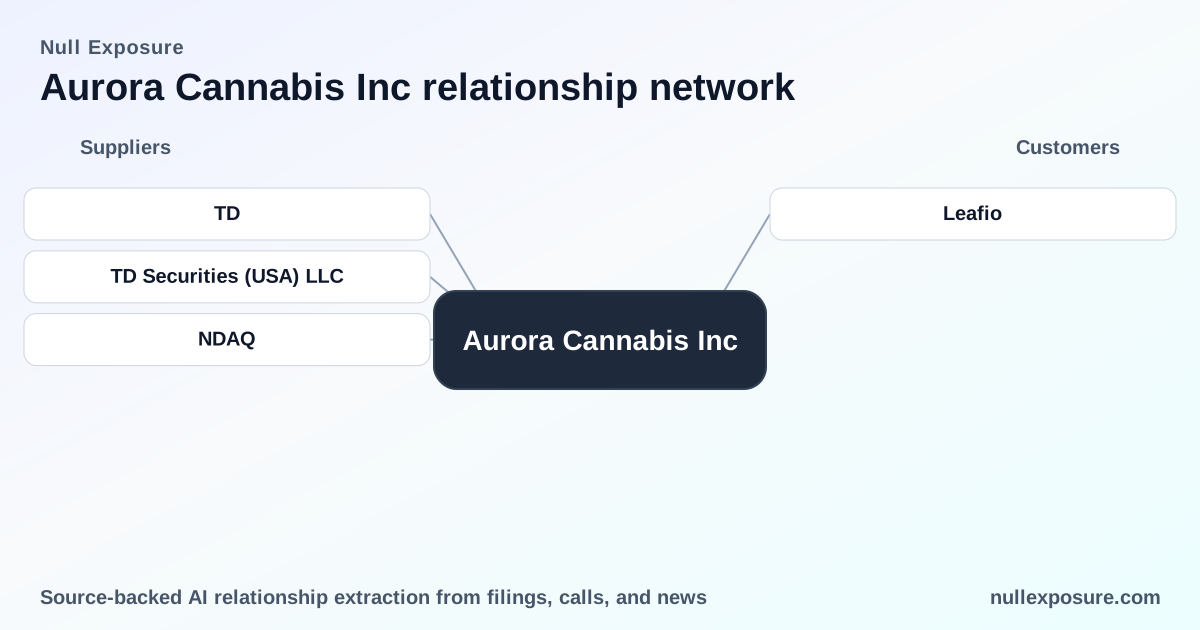
Aurora Cannabis (ACB): Supplier map and why it matters to investors
Aurora Cannabis operates as a global producer and distributor of medical cannabis, monetizing through finished-product sales to regulated markets, targeted M&A to add EU‑GMP cultivation capacity, contract manufacturing agreements for international distribution, and opportunistic equity issuance to shore up liquidity. Investor attention should focus on how Aurora converts manufacturing capacity and international partnerships into higher‑margin export sales while funding that expansion through at‑the‑market equity programs and selective acquisitions. For a practical supplier diligence view, visit https://nullexposure.com/.
Quick snapshot that frames supplier risk and opportunity
Aurora reported annual revenue of US$373.1M with a gross profit of US$134.4M and a negative EBITDA in the latest reported period, reflecting ongoing margin pressure even as the company pursues international growth. The balance of organic capacity (EU‑GMP) and third‑party manufacturing is central: internal cultivation assets and recent bolt‑on deals give Aurora control over supply, while manufacturing agreements extend its geographic reach. The company also uses ATM equity programs as a live financing tool to fund expansion, a structural feature investors must price into downside scenarios.
Why these supplier moves change the investment case
Aurora’s supplier relationships are not passive procurement contracts — they are strategic levers. Acquisitions that add EU‑GMP capacity directly increase the company’s ability to serve high‑value international medical markets, reducing reliance on third parties; conversely, contract manufacturing deals accelerate market entry without the capital drag of greenfield builds. Equity distribution programs through investment banks both underwrite growth and dilute shareholders, so supplier and financing relationships together define Aurora’s capital‑allocation story.
Relationship-by-relationship analysis
Bioxyne Ltd
Bioxyne entered a manufacturing agreement to produce medicinal cannabis products for Aurora for international distribution, giving Aurora an Australian manufacturing foothold to serve markets where local supply chains matter. According to Mugglehead (May 2, 2026), the pact positions Aurora to push forward with its international ambitions via an Australian partner (https://mugglehead.com/bioxyne-to-manufacture-aurora-cannabis-products-for-international-distribution/).
Bioxyne Limited (BXN)
Bioxyne Limited, through media reporting, is identified as the parent signing the arrangement to manufacture Aurora’s products, reinforcing that the transaction is with an ASX‑listed life sciences operator rather than an ad hoc third party. StratCann reported the agreement and noted the structural relationship through Bioxyne’s platforms (May 2, 2026) (https://stratcann.com/news/australias-bioxyne-signs-manufacturing-agreement-with-aurora-cannabis/).
Breathe Life Sciences (BLS)
Breathe Life Sciences, a wholly owned subsidiary of Bioxyne, is cited as the operational counterparty handling manufacturing, which implies Aurora is using an established local manufacturer rather than building greenfield capacity in Australia. StratCann’s coverage references BLS as the execution vehicle for the manufacturing agreement (May 2, 2026) (https://stratcann.com/news/australias-bioxyne-signs-manufacturing-agreement-with-aurora-cannabis/).
Bioxyne (generic reference)
Multiple outlets used the shorthand “Bioxyne” when describing the deal, underlining market recognition that Bioxyne is the manufacturing supplier facilitating Aurora’s international distribution strategy through 2026 press announcements (StratCann, May 2, 2026).
Safari Flower Company
Aurora acquired Safari Flower Company in a cash‑and‑stock deal valued at approximately US$26.5M, adding a 59,000‑square‑foot EU‑GMP indoor cultivation and manufacturing facility in Ontario to its footprint and increasing capacity aimed at Germany, Australia, Poland, and the UK. PR Newswire (May 2, 2026) described the acquisition as accretive to Aurora’s global medical leadership and supportive of high‑margin international markets (https://www.prnewswire.com/news-releases/aurora-cannabis-accelerates-global-medical-cannabis-leadership-with-accretive-acquisition-of-safari-flower-company-expanding-eu-gmp-capacity-to-serve-growing-high-margin-international-markets-302742337.html).
Safari Flower Co.
Industry reporting emphasized the facility’s EU‑GMP certification and its operational alignment with Aurora’s cultivation strategy, reinforcing that this acquisition is primarily capacity‑driven rather than a distribution deal. Cannabis Business Times covered the facility characteristics and strategic fit (May 2, 2026) (https://www.cannabisbusinesstimes.com/international/news/15822299/aurora-acquires-safari-flower-co-accelerating-global-medical-cannabis-leadership).
TD (Toronto‑Dominion / TD Securities label)
Aurora established an at‑the‑market (ATM) share offering under a sales agreement to distribute common shares through TD Securities, creating an ongoing financing channel to fund acquisitions and working capital. The prospectus supplement and PR filings dated March 9, 2026, note that TD Securities (USA) LLC is the agent for the ATM program (PR Newswire, March 9, 2026) (https://www.prnewswire.com/news-releases/aurora-cannabis-announces-filing-of-prospectus-supplement-for-at-the-market-offering-program-302678634.html).
TD Securities (USA) LLC
SEC‑format filings and public prospectus language identify TD Securities (USA) LLC as the agent under the February 4, 2026 sales agreement, confirming the legal channel Aurora uses for its US‑market ATM distributions and reinforcing the company’s reliance on capital markets as a liquidity source (stock filing, March 9, 2026) (https://www.stocktitan.net/sec-filings/ACB/6-k-aurora-cannabis-inc-current-report-foreign-issuer-1d6d0bb45a36.html).
NASDAQ / NDAQ (exchange references)
Public filings specify that ATM share sales will be executed through the NASDAQ Capital Market or another US marketplace at prevailing market prices, making market liquidity and trading dynamics an operational input to Aurora’s financing cadence (PR Newswire, March 9, 2026) (https://www.prnewswire.com/news-releases/aurora-cannabis-announces-filing-of-prospectus-supplement-for-at-the-market-offering-program-302678634.html).
Reliva CBD
Industry commentary notes Aurora’s acquisition of Reliva CBD in Massachusetts as a strategic opening into the US consumer market, signaling a broader North American distribution strategy that complements its medical export focus. A TradingView discussion captured this positioning in early May 2026 (https://www.tradingview.com/symbols/BOATS-ACB/ideas/page-7/).
Operational constraints and company‑level signals
No relationship‑level contractual constraints were provided in the source feed; as a company‑level signal, this indicates Aurora’s public disclosures emphasize transactional announcements rather than granular supplier covenants. From an operating model perspective:
- Contracting posture: Aurora blends acquisitions (to own EU‑GMP capacity) with manufacturing agreements (to scale quickly into new jurisdictions), indicating a hybrid in‑house + outsourced manufacturing model.
- Concentration: The company’s emphasis on a few strategically located EU‑GMP facilities and a small number of manufacturing partners concentrates execution risk in those sites and agreements.
- Criticality: EU‑GMP certification and third‑party manufacturing relationships are critical to Aurora’s ability to serve high‑value international medical markets.
- Maturity: Aurora is a mature licenced producer with active capital‑markets financing (ATM) used as a tactical funding tool, consistent with a company balancing growth investments and liquidity management.
These signals should be read against Aurora’s financials: positive revenue scale with negative EBITDA and negative EPS, which makes supplier execution and access to financing fundamental to near‑term valuation.
Investment implications and risks
- Upside: Acquired EU‑GMP capacity and manufacturing partnerships accelerate revenue access to Europe and the Asia‑Pacific, where medical pricing supports higher margins.
- Downside: Reliance on ATMs and a concentrated set of certified facilities increases dilution and execution risk if export demand or regulatory access slows.
- Catalysts to watch: Integration of Safari Flower, production ramp with Bioxyne/BLS outputs in Australia, and ATM usage rates disclosed in quarterly filings.
For deeper supplier due diligence and ongoing monitoring of these counterparties, visit https://nullexposure.com/ for the supplier intelligence view.
Bottom line
Aurora’s supplier strategy is intentionally hybrid: own critical EU‑GMP capacity where margin matters and contract out manufacturing to accelerate market entry, while using marketable equity programs to finance this playbook. Investors should value Aurora’s capacity expansion and international contracts, but price in financing dilution and concentrated operational risk when constructing scenarios.