Acco Group Holdings (ACCL): Underwriters, supplier posture, and what investors should know
Acco Group Holdings sells and distributes office supplies and productivity accessories through owned brands and a global distribution network, generating revenue primarily from product sales across business and consumer channels. The company monetizes through manufacturing, branded distribution agreements and channel sales; its recent public offering brought capital-market counterparties into the supplier mix, creating a short but important set of third‑party relationships that affect capital access and market liquidity. For investors and operators, the critical near-term supplier relationships are capital markets partners (underwriters) rather than long-term component vendors.
Explore deeper supplier intelligence at https://nullexposure.com/ for related counterparty profiles and market context.
Why the underwriting relationships matter for an early-stage public issuer
Acco Group’s supplier posture, in the context of its recent Nasdaq listing, is transactional and event-driven: the listed counterparties provided underwriting and book‑running services for the IPO and thus were critical to the company’s access to public capital. This contracting posture is short-term and performance‑based, not a recurring manufacturing supply relationship. That creates a different risk profile: concentration of capital-market counterparties affects market entry and float dynamics, but does not directly affect product production or distribution.
Company-level signals strengthen this view. Acco is a small-cap issuer with a thin public float (shares float 2.9 million versus 13.95 million outstanding) and extremely high insider ownership (92% insiders), which produces governance concentration and amplified price volatility after listing. Financial margins are strong for the scale reported—profit margin ~20.9% and operating margin ~22%—but the company’s public-market maturity is nascent and liquidity is limited.
No supplier constraints were extracted from the dataset; that absence itself is a company-level signal indicating limited structural constraint reporting in the collected supply-side data.
Who handled the offering: the relationships in plain terms
Below are every relationship pulled from the source set, with a short plain‑English description and a compact source note.
-
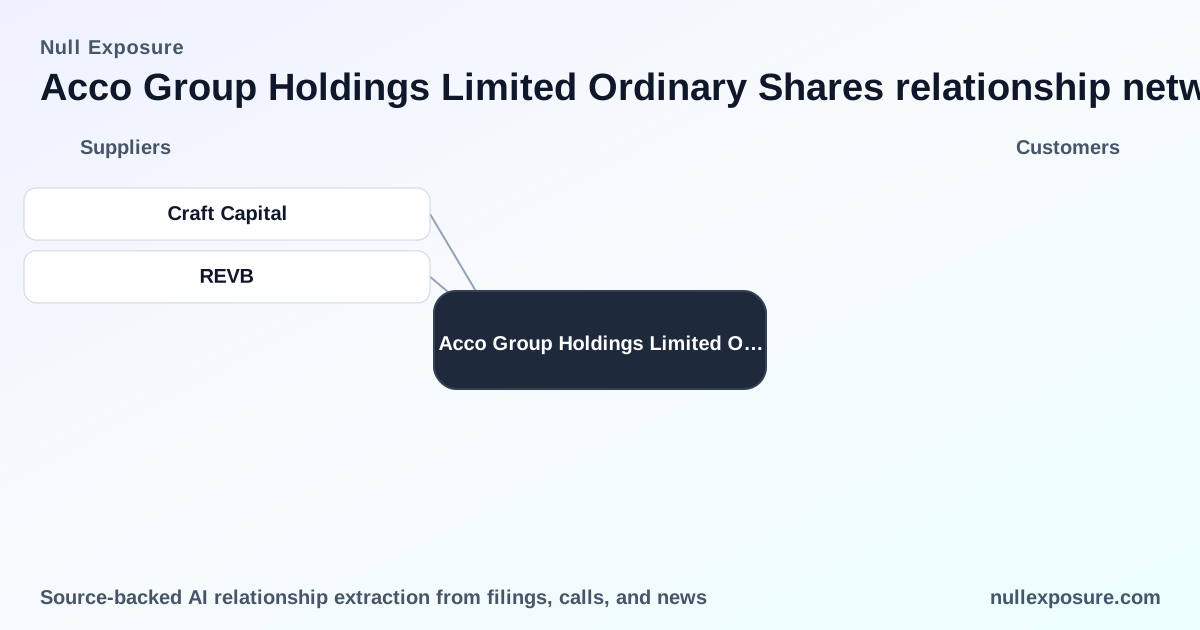
Craft Capital Management LLC — Craft Capital acted as the representative of the underwriters in Acco’s offering, leading the book-running and distribution for the IPO process. According to Investing.com coverage of the Nasdaq debut, Craft Capital was named the lead underwriter for the deal (May 2, 2026).
Source: Investing.com (reporting on the Nasdaq listing, May 2, 2026) — https://www.investing.com/news/stock-market-news/acco-group-holdings-begins-trading-on-nasdaq-at-405share-higher-than-4share-ipo-price-93CH-4295188 -
Revere Securities LLC — Revere served as an underwriter alongside Craft Capital on the offering, providing co‑underwriting and distribution support for the transaction. The same Investing.com article identifies Revere Securities as a co‑underwriter on the IPO (May 2, 2026).
Source: Investing.com (coverage of the offering and trading debut, May 2, 2026) — https://www.investing.com/news/stock-market-news/acco-group-holdings-begins-trading-on-nasdaq-at-405share-higher-than-4share-ipo-price-93CH-4295188 -
Craft Capital — Separately recorded in the news stream, Craft Capital is credited with joint book‑running responsibilities for the offering in follow‑up reporting; the reference reinforces Craft Capital’s front-line role in pricing and allocation during the IPO process. Intellectia.ai’s news aggregation lists Craft Capital as a joint book‑running manager (March 9, 2026).
Source: Intellectia.ai news aggregation (March 9, 2026) — https://intellectia.ai/en/stock/ACCL/news -
REVB (inferred symbol for Revere) — The corpus includes an inferred ticker REVB tied to Revere’s role as a joint book‑running manager, indicating that some sources mapped Revere to a market identifier when describing underwriting duties. Intellectia.ai shows Craft Capital and Revere acting as joint book‑running managers (March 9, 2026).
Source: Intellectia.ai news aggregation (March 9, 2026) — https://intellectia.ai/en/stock/ACCL/news -
Revere — An additional mention of Revere in the news flow reiterates its joint book‑running role; this duplicate entry consolidates the picture that Revere and Craft Capital shared primary underwriting responsibilities. Intellectia.ai’s March 9, 2026 feed lists Revere among book‑running managers.
Source: Intellectia.ai news aggregation (March 9, 2026) — https://intellectia.ai/en/stock/ACCL/news
What these relationships mean for operations and investor risk
-
Contracting posture: Transactional and event-driven — underwriters were engaged specifically to execute the IPO; ongoing supplier obligations to these counterparties are limited post‑offering. That creates a capital-market dependency at a single point in time rather than a supply-chain dependency.
-
Concentration and criticality: The underwriting function was concentrated among two firms, increasing single-event execution risk; had these managers underperformed, capital access or market debut pricing could have been materially affected. For operating partners, this means the company’s public debut depended on a narrow set of capital-market suppliers.
-
Maturity: The business is an early-stage public company. Market metrics show limited public float and high insider ownership, which amplifies governance concentration and post-listing price sensitivity; these are company-level maturity signals rather than vendor-specific constraints.
-
Financial health context: Acco reports strong margins (operating margin ~22%, profit margin ~20.9%) and modest revenue scale (revenue TTM ≈ $4.89M). These results support creditworthiness for short-term commercial relationships but do not substitute for a diversified supply-chain profile or institutional investor base.
Investment takeaway and recommended next steps
Acco’s supplier map is dominated by capital‑markets counterparties tied to its IPO: Craft Capital and Revere acted as the joint underwriters and book‑runners, facilitating market entry and initial liquidity. That structure creates a concentrated, transaction‑heavy supplier posture that is important for evaluating near-term liquidity, pricing and shareholder dispersion but is not a substitute for analysis of operating suppliers in manufacturing or distribution.
-
For investors: monitor post‑listing liquidity, insider lock‑up expirations, and any disclosure of recurring vendor relationships beyond capital markets. High insider ownership and low institutional participation amplify execution risk and price volatility.
-
For operators and counterparties: insist on clarity around future capital needs and whether the company will re-engage similar underwriters for follow‑on offerings; the IPO underwriters created market access once, and repeat access will depend on governance and performance metrics.
If you want a structured supplier report or counterparty risk profile that ties these underwriting relationships to broader market and governance signals, visit https://nullexposure.com/ for the full intelligence package and tailored monitoring.