ACCO Brands: supplier relationships, deal flow, and procurement posture investors should price in
Acco Brands Corporation is a global designer, manufacturer and distributor of office, school, consumer and technology accessories that monetizes through branded product sales and scale-driven procurement. Revenue generation is retail- and B2B-facing, underpinned by a hybrid manufacturing model (roughly 40% in-company; 60% externally sourced) and sizable forward purchase commitments that indicate a large, predictable procurement runway. For investors and operators evaluating supplier and acquisition exposure, the company combines a low multiple operating profile with clear supply-chain concentration into Asia and material purchasing scale. For procurement intelligence and supplier mapping, visit https://nullexposure.com/ for full platform access.
Why this matters to value and operational risk
ACCO’s business converts branded intellectual property and global distribution into steady cash flow; the company runs a capital-light distribution model for the majority of its SKUs while retaining some in-house manufacturing for control over critical product lines. Key financial context: Revenue TTM roughly $1.52bn, EBITDA $163.7m, EV/EBITDA ~6.85 and a market capitalization near $292m, which positions the firm as a value-oriented industrial with operational leverage to procurement outcomes. The company’s forward purchase commitments (about $118.8m) and sourcing concentration make supplier relationships a primary driver of margin variability and inventory risk.
If you want a granular supplier map and to quantify counterparties driving those commitments, start here: https://nullexposure.com/.
The material relationships uncovered in public reporting
Two related items surface in the supplier/transaction record. Below are plain-English summaries and sources for each.
-
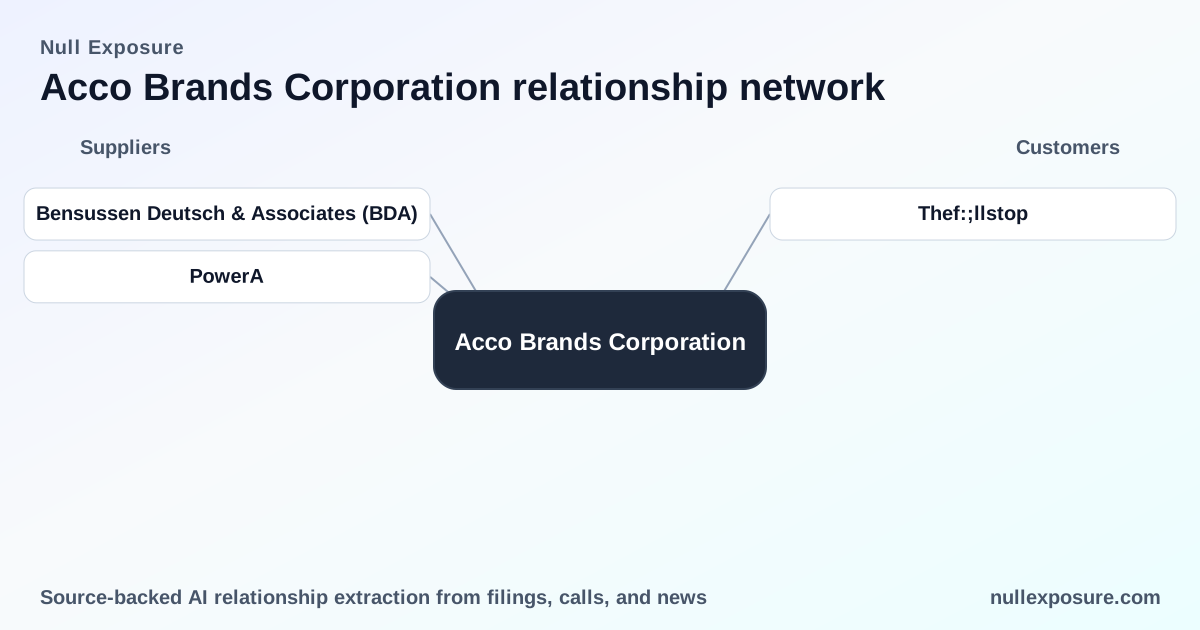
Bensussen Deutsch & Associates (BDA): In a transaction recounted in industry reporting, BDA sold the PowerA video gaming accessories brand to Acco Brands, transferring a promotional-products-line to ACCO as part of its branded expansion strategy. Source: ASI Central, Promogram newsletter (November 2020). https://members.asicentral.com/news/newsletters/promogram/november-2020/bda-sells-its-powera-brand/
-
PowerA: As the acquired product brand, PowerA — a video gaming accessories company — was acquired by ACCO Brands from BDA, extending ACCO’s reach into consumer gaming peripherals and diversifying its product mix beyond traditional office and school goods. Source: ASI Central, Promogram newsletter (November 2020). https://members.asicentral.com/news/newsletters/promogram/november-2020/bda-sells-its-powera-brand/
These two items are linked: the second line is the asset, the first names the seller. The ASI Central Promogram report from November 2020 is the primary public reference for this transaction.
What the BDA / PowerA acquisition signals for supplier strategy
The PowerA deal is not a one-off hobby; it illustrates ACCO’s deliberate use of acquisitions to add branded consumer product lines that can be folded into existing procurement and distribution channels. Acquisitions reduce time-to-market for new categories but increase the importance of supplier integration, especially offshore sourcing. For investors, that translates into:
- Higher integration-related procurement spending in the short-to-medium term as ACCO standardizes vendor contracts and consolidates component purchases.
- Margin upside if ACCO captures purchasing synergies, and downside if Asian supply constraints or manufacturing issues force cost pass-throughs.
For direct procurement visibility and to see how these relationships map to purchase commitments, consult https://nullexposure.com/.
Company-level constraints and what they imply about ACCO’s operating model
Several company-level signals shape how ACCO sources and contracts:
- APAC sourcing concentration: Approximately 60% of product sourcing is from lower-cost countries, primarily in Asia. That is a structural supply-chain concentration and assigns a geopolitical and logistics premium to vendor selection and contract safeguards.
- Buyer posture and scale: The firm reports unconditional purchase commitments totaling roughly $118.8m, indicating a buyer posture that locks in supply and pricing for inventory — this is consistent with high-volume, calendar-driven procurement cycles for academic and retail seasons.
- Partial vertically integrated manufacturing: ACCO manufactures about 40% of its products in-company, which gives it operational control over some critical SKUs but still leaves the majority of volume dependent on third-party suppliers.
- Counterparties are major financial institutions: Treasury and hedging counterparties are large banks, signaling a mature corporate finance function that manages FX, commodity or interest rate exposures with institutional partners.
- Spend scale: The company-level signal of >$100m in purchase commitments places ACCO in a higher procurement spend band, which supports negotiating leverage but also concentrates execution risk.
These are company-level characteristics and are not tied to any single reported relationship unless that relationship is named explicitly.
Operational risks and durability of the supplier model
ACCO’s supplier model is durable when the company executes integration and retains purchasing leverage, but risks are material and quantifiable:
- Concentration risk: Heavy APAC sourcing creates sensitivity to tariff changes, freight shocks and regional factory disruptions.
- Integration risk: Acquisitions like PowerA increase short-term procurement complexity; failure to harmonize supplier contracts reduces targeted synergies.
- Counterparty credit and market risk: Reliance on major financial institutions for hedging protects ACCO from direct market shocks, but exposes the firm to institutional counterparty concentration.
These risks are balanced by scale-driven purchasing power, an established brand portfolio, and an experienced treasury function—factors that preserve earnings multiple expansion if procurement execution succeeds.
What investors and operators should do next
- For investors: Stress-test margin scenarios against APAC disruption and slower synergies from recent acquisitions. Reprice multiples accordingly given current EV/EBITDA ~6.85 and visible purchase commitments.
- For procurement operators: Prioritize supplier consolidation, contract standardization and freight diversification to reduce the APAC concentration premium and realize expected synergies from brand acquisitions.
If you want to map ACCO’s suppliers to specific contracts and counterparties, get deeper visibility at https://nullexposure.com/.
Bottom line
ACCO is a value-oriented branded-products operator with meaningful procurement scale and a hybrid manufacturing model. The BDA/PowerA transaction shows how ACCO grows category exposure through acquisitions that increase procurement complexity while offering margin upside through consolidated purchasing. For investors, the delta between realized and forecasted procurement synergies is the principal earnings swing; for operators, the immediate focus should be on supplier integration and APAC risk mitigation.
For a complete supplier scorecard and contract-level analysis that quantifies the $118.8m purchase-commitment footprint, visit https://nullexposure.com/ and begin a tailored review of ACCO’s supplier exposures.