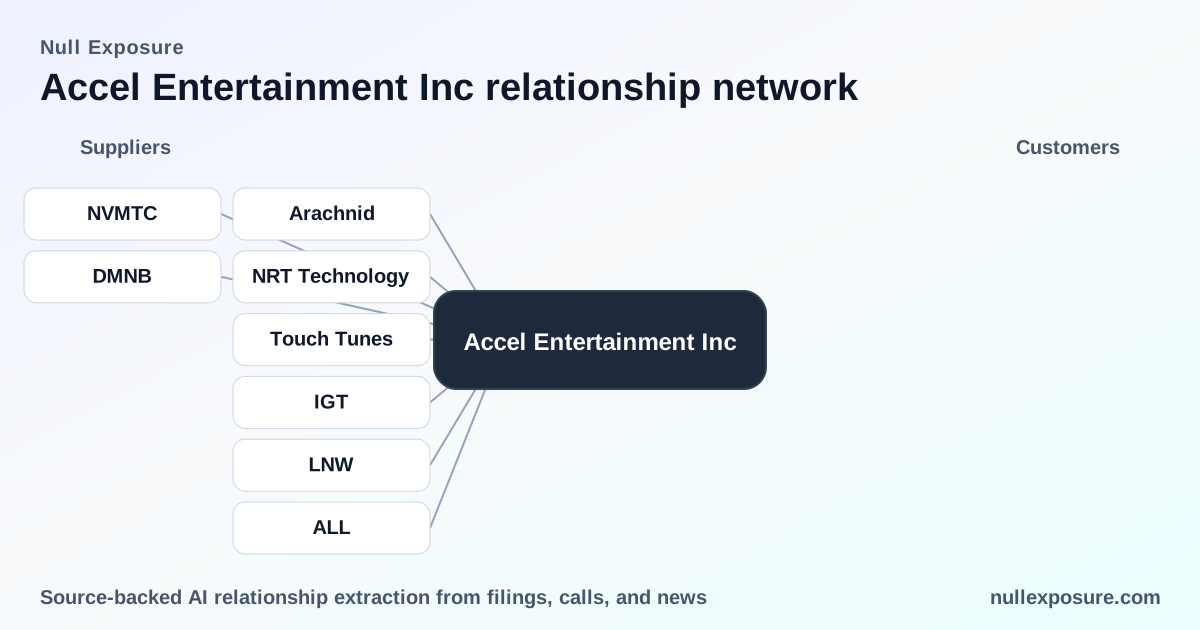
Accel Entertainment (ACEL): Supplier map, contract posture, and what it means for route investors
Accel Entertainment operates and monetizes as a distributed games operator: the company installs and operates multi‑game terminals, redemption machines and ancillary amusement devices in third‑party locations and collects a share of play and redemption revenue while amortizing route acquisition costs over contract lives. The business converts installed footprint and device density into recurring cash flow, sourcing hardware and software from a small group of specialized suppliers and recognizing route/customer acquisition as long‑lived intangible assets that are amortized over extended contract terms. For investors, supplier relationships are a direct lever on uptime, growth cadence and capital intensity.
Learn more about supplier intelligence and route exposure at https://nullexposure.com/.
Why the supplier roster matters for route economics
Accel’s procurement breaks into two functional groups: (1) manufacturers of multi‑game gaming terminals and (2) providers of redemption terminals, amusement devices and stand‑alone ATMs. The first group supplies the core revenue‑producing gaming inventory; the second group supplies complementary cash and entertainment devices that increase throughput in retail locations. A consistent flow of terminal inventory, timely software licensing and predictable maintenance are prerequisites for route uptime and cash generation.
Company disclosures establish two important operating constraints that govern these relationships at the corporate level: Accel records route and customer acquisition costs as intangible assets and amortizes them on a straight‑line basis over 18 years, and many of the technologies the company uses are licensed from third parties. Those signals imply a contracting posture oriented to long‑horizon location economics and a reliance on third‑party software for device functionality and compliance — both critical to evaluate when assessing supplier risk and negotiating leverage.
Explore deeper supplier coverage at https://nullexposure.com/.
The supplier list — what Accel says in its FY2025 10‑K
Below are the supplier relationships named directly in Accel’s FY2025 10‑K, each summarized in plain English with the filing cited.
-
Arachnid — Accel purchases redemption terminals, amusement devices and stand‑alone ATMs from Arachnid as part of its complementary device procurement. According to Accel’s FY2025 Form 10‑K, Arachnid is listed among the reputable suppliers for those products.
(Source: Accel Entertainment FY2025 10‑K) -
NRT Technology — NRT Technology is named as a supplier of redemption terminals, amusement devices and stand‑alone ATMs that Accel uses to populate high‑traffic locations. The FY2025 10‑K lists NRT Technology in the company’s procurement roster.
(Source: Accel Entertainment FY2025 10‑K) -
TouchTunes — TouchTunes is identified as a supplier for redemption and amusement devices, reflecting Accel’s purchase of varied entertainment hardware to drive dwell time and incremental spend. This is stated in the FY2025 10‑K.
(Source: Accel Entertainment FY2025 10‑K) -
International Game Technology (IGT) — Accel purchases multi‑game gaming terminals from leading manufacturers such as International Game Technology, which supplies the core gaming inventory deployed across routes. The FY2025 10‑K explicitly names IGT.
(Source: Accel Entertainment FY2025 10‑K) -
Light & Wonder, Inc. — Light & Wonder is listed among the manufacturers from which Accel acquires multi‑game gaming terminals, per the FY2025 10‑K. These vendors supply the main revenue‑generating kiosks.
(Source: Accel Entertainment FY2025 10‑K) -
Aristocrat — Aristocrat is included in the list of leading manufacturers that provide multi‑game gaming terminals to Accel, as disclosed in the FY2025 10‑K.
(Source: Accel Entertainment FY2025 10‑K) -
Novomatic — Accel names Novomatic as a supplier for multi‑game gaming terminals in its FY2025 10‑K, signaling procurement from global OEMs.
(Source: Accel Entertainment FY2025 10‑K) -
Diamond — Diamond is identified as another supplier of redemption terminals, amusement devices and stand‑alone ATMs that Accel purchases, according to the FY2025 10‑K.
(Source: Accel Entertainment FY2025 10‑K)
What the mix of vendors implies for risk and negotiating power
The supplier roster shows broad coverage across both core gaming OEMs and secondary device providers, which reduces single‑vendor concentration risk relative to a one‑vendor procurement strategy. However, several structural observations matter for investors:
- Criticality is high for multi‑game OEMs. The core terminals supplied by IGT, Light & Wonder, Aristocrat and Novomatic are revenue‑critical: supply disruptions or software incompatibilities would directly reduce route yield and growth.
- Contracting posture is long‑horizon. Accel’s capitalization and 18‑year amortization of route acquisition costs align supplier, landlord and location economics toward long‑term relationships rather than short replacement cycles; that raises the premium on vendor reliability and lifecycle support.
- Software licensing is a non‑trivial exposure. The company explicitly relies on third‑party licensed software; any licensing disputes, platform migration costs or changes in upgrade pricing are value‑relevant.
- Scale affords negotiating leverage but not immunity. Accel’s revenue scale (Revenue TTM ~$1.33B; EBITDA ~$189M) gives purchasing heft, yet OEMs that control proprietary game content and software have asymmetric pricing power for feature upgrades and certification windows.
Key takeaway: investors should treat supplier stability and software licensing terms as operational levers that translate directly to route uptime and capital efficiency.
Operational constraints and what to watch next
The FY2025 disclosures flag two company‑level constraints that influence supplier risk: long‑term, non‑cancelable route contracts with 18‑year amortization, and reliance on third‑party licensed technology. For investors, these translate into actionable monitoring points:
- Track contract renewal cadence and any early‑termination clauses that could force accelerated amortization or replacement spending.
- Monitor vendor software certification schedules and upgrade cadence, because slow certification delays terminal placement and revenue ramp.
- Watch for concentration shifts toward any single OEM over time; a rising share from one supplier increases single‑point failure risk.
If you want continuous monitoring of supplier footprints and contract signals for route operators, start with our supplier intelligence tools at https://nullexposure.com/.
Investment implications and next steps for due diligence
Accel’s supplier ecosystem is diversified across device categories and reputable OEMs, which supports steady deployment and route economics. Primary investment risks are operational: supplier availability, certification timelines, and software licensing renegotiations that can impose upgrade or replacement costs. Given Accel’s scale and valuation multiples (EV/EBITDA ~6.6), the upside is in accelerating route fills and maintaining high terminal uptime; the downside centers on supplier disruption compressing utilization and lengthening payback periods.
Practical next steps for investors evaluating Accel:
- Request contract level detail on vendor SLAs, upgrade obligations and warranty terms.
- Model sensitivity to terminal downtime and upgrade capex over the amortization horizon.
- Monitor procurement trends in subsequent filings for shifts in supplier concentration.
For tailored supplier due diligence and route exposure analysis, visit https://nullexposure.com/ — our tools are built for investors and operators who need actionable supplier insight.
Bottom line: Accel’s supplier relationships are functional and diversified but materially consequential to route economics; evaluate vendor reliability and software licensing terms as part of any investment thesis.