Arch Capital Group Ltd (ACGL): supplier relationships and what they mean for investors
Arch Capital Group Ltd underwrites property & casualty, reinsurance and mortgage insurance risk around the globe and monetizes through underwriting margins, ceded reinsurance arrangements and investment income on reserves. The business expands its platform both organically and by acquisition — capturing fee and underwriting economics from specialty lines, Lloyd’s syndicates and program-distributed products — while managing counterparty exposure through reinsurance and capital markets structures. Arch’s scale (roughly $33.98B market cap; ~ $19.9B revenue TTM; ROE ~19.5%) gives it both pricing power and the need for sophisticated supplier and reinsurer management.
Explore supplier risk and counterparty intelligence at NullExposure.
The operating logic: how supplier relationships drive margins and risk transfer
Arch is not just an insurer; it is a platform operator that combines direct underwriting, delegated distribution and strategic reinsurance. The company routinely cedes premium on quota share and excess-of-loss bases, sources facultative and treaty reinsurance, and delegates underwriting authority to managing general agents and program administrators where commercially attractive. These supplier relationships are core to how Arch scales specialty lines without proportionally increasing capital or fixed costs.
Key elements of the operating model drawn from the company’s filings:
- Long-duration mortgage reinsurance coverages that decline over a multi-year amortization schedule, indicating a contracting posture that links capacity to loan amortization and therefore to long-term cashflow predictability.
- A global reinsurance footprint executed through subsidiaries (Arch Re Bermuda, Arch Re U.S., Lloyd’s syndicates, Arch Re Europe), reflecting distributed operations and diversified geographic exposure.
- Extensive use of brokers, MGAs and third-party administrators for distribution and claims management, positioning Arch as both a service provider and distributor in different product lines.
These characteristics create a dual commercial posture: Arch is a buyer of retrocessional capacity and a seller/distributor of insurance paper — which gives the company flexibility but requires rigorous supplier governance.
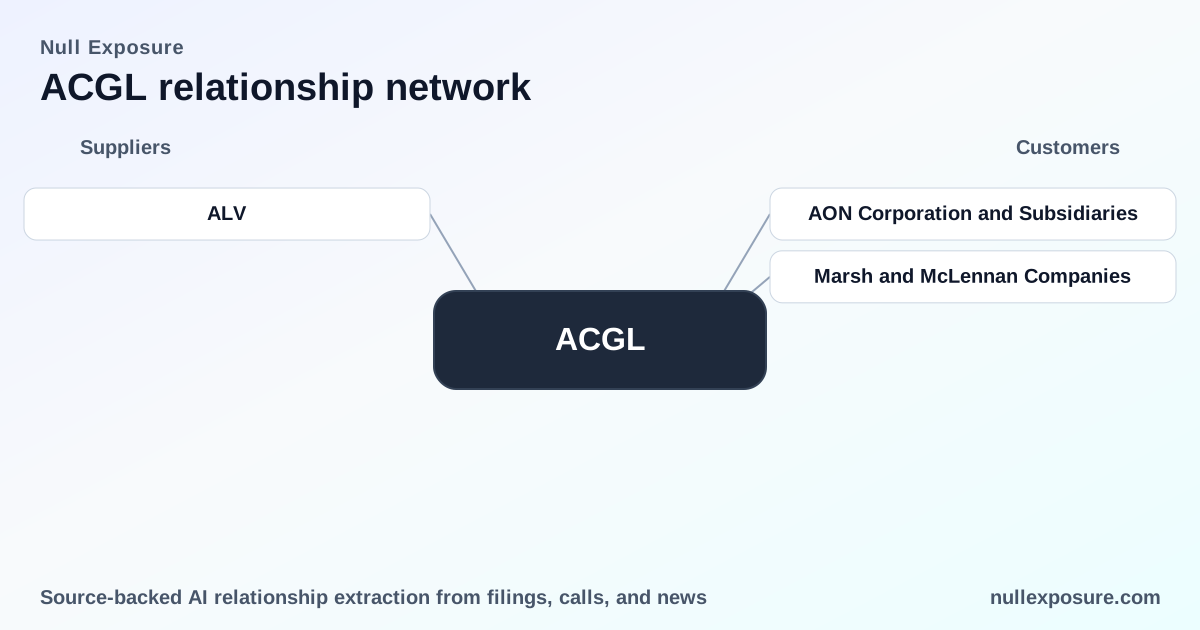
The single reported supplier relationship: Allianz (what changed)
According to a TradingView news summary referencing Arch’s FY2026 disclosures, Arch completed the acquisition of the U.S. MidCorp and Entertainment insurance businesses from Allianz on August 1, 2024, expanding Arch’s U.S. specialty insurance footprint. This deal increases Arch’s scale in entertainment and related specialty underwriting channels and brings additional distribution relationships inherited from Allianz. (TradingView news, FY2026).
All reported relationships — one-by-one, plain English
Allianz — U.S. MidCorp and Entertainment businesses
Arch closed the acquisition of Allianz’s U.S. MidCorp and Entertainment insurance operations on August 1, 2024, adding specialty underwriting capacity and distribution channels to Arch’s U.S. platform; the move is documented in coverage of Arch’s FY2026 filings. (TradingView news, FY2026).
Constraints and what they signal about Arch’s supplier posture
Arch’s filings provide explicit constraints that reveal how the firm structures its supplier relationships and where counterparties fit in the capital stack:
- Long-term contract structures where relevant. Mortgage reinsurance programs amortize coverage over a ten-year period, meaning counterparties to those treaties accept a decaying exposure profile and multi-year performance expectations. This is a company-level design choice that favors stability of claims timing over episodic renewals.
- Global operations. Arch runs reinsurance through multiple domiciles and Lloyd’s syndicates, indicating counterparties will often interact with non-U.S. legal entities and regulatory regimes — a commercial reality that increases complexity but reduces single-jurisdiction concentration.
- Service-provider posture. Arch routinely relies on third-party managers, brokers, MGAs, program administrators and external claims handlers, and it contracts with cloud and SaaS providers for operations. This creates operational reliance on specialized suppliers while allowing Arch to scale underwriting capacity without commensurate internal headcount growth.
- Buyer of retrocessional capacity. The company purchases limited retrocession as part of its aggregate risk program, meaning Arch is selective about who it brings onto its retrocession panel and that such suppliers play a backstop role rather than front-line exposure.
- Distribution via brokers and delegated authorities. Arch’s product distribution mixes direct facultative placement with broker-mediated treaty sales and delegated underwriting to MGAs — a structure that increases distribution reach but concentrates outsourcing risk in a small set of high-authority program administrators.
These constraints together imply Arch prefers durable, creditworthy counterparties, long-term treaty structures in mortgage-related lines, and a distributed supplier base that increases capacity but requires strong oversight.
Explore how these supplier dynamics affect counterparties at NullExposure.
Commercial implications for investors and operators
- Concentration and criticality. Arch’s reliance on a handful of MGAs, brokers and Lloyd’s mechanisms concentrates operational dependency; any material failure at a large program administrator would have outsized claims-handling and new business effects.
- Maturity and counterparty credit. The long-term nature of mortgage reinsurance and the use of special-purpose reinsurance vehicles (as the firm discloses) elevate counterparty credit as a first-order risk; Arch’s monitoring of reinsurers and preference for “substantial, financially sound carriers” mitigates but does not eliminate this exposure.
- Integration risk from acquisitions. The Allianz deal accelerates scale in entertainment and MidCorp business but requires rapid integration of distribution agreements, policy terms and claims processes; integration missteps will affect near-term loss ratios more than headline revenue.
- Operational supplier footprint. Dependence on major cloud and SaaS providers and third-party administrators creates a parallel technology and service-provider risk layer that investors should track as part of operational resilience assessments.
Bottom line: Arch’s supplier strategy trades increased scale and distribution reach for elevated third‑party governance requirements; the firm’s financial strength offsets many risks but raises the bar on counterparty monitoring.
Actionable next steps for investors and counterparties
- Review delegated underwriting agreements and program administrator concentration to quantify operational dependency and potential loss-acceleration channels.
- Map reinsurance counterparty credit profiles, especially for mortgage reinsurance and special-purpose vehicles, to understand tail exposure.
- Monitor integration milestones and claims trends from the Allianz MidCorp/Entertainment acquisition for early signs of underwriting drift.
For in-depth counterparty and supplier analytics, visit NullExposure.
Conclusion: what to watch next
Arch is executing a classic platform growth play — combining acquisitions, delegated distribution and strategic reinsurance — while operating at scale globally. Key investor focus areas are program administrator concentration, reinsurance counterparty credit, and the operational integration of recent acquisitions (notably the Allianz assets added in 2024). Continued monitoring of filings and claims trends will separate temporary dis-synergies from persistent risk shifts; investors should reassess supplier governance as part of any position in ACGL.