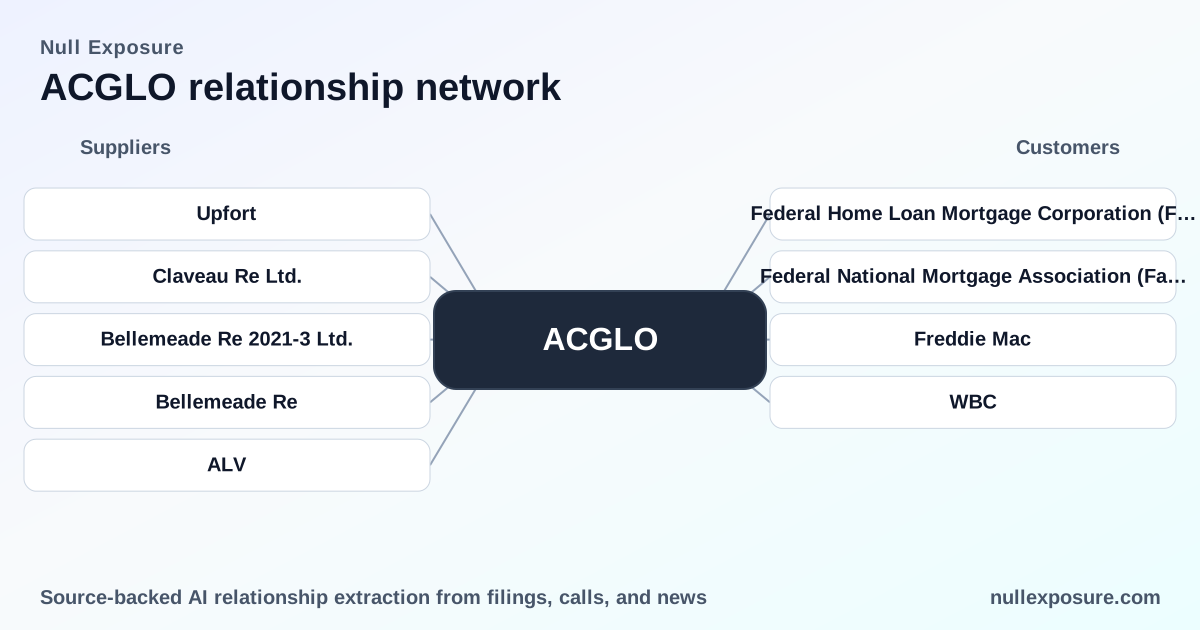
Arch Capital Group Ltd (ACGLO): Supplier relationships that move capital and risk
Arch Capital Group Ltd operates as a diversified specialty insurer and reinsurer headquartered in Bermuda, monetizing through underwriting income, investment returns on float, and structured transfer of risk via reinsurance and insurance-linked securities. As a preferred stock holding in the insurance sector, ACGLO's value to investors is driven by how effectively Arch transfers or retains catastrophic and mortgage risk, the scale of its ceded protections, and the liquidity profile of its capital stack. For investors evaluating supplier and partner exposure, the company’s use of longer-duration mortgage reinsurance vehicles and active retrocession strategies is central to underwriting economics and capital efficiency. Learn more about supplier relationships and risk mapping at https://nullexposure.com/.
What Arch actually buys, sells and underwrites — the operating model in plain English
Arch underwrites a mix of primary insurance, reinsurance and mortgage insurance and then manages capital by ceding portions of that risk through treaty reinsurance, retrocession and ILS (insurance-linked securities). The firm also uses third-party administrators, managing general agents and delegated underwriting relationships to scale distribution and claims handling. This structure lets Arch scale premium volumes while controlling incremental capital needs, but it also creates counterparty concentration and recovery risk when large reinsurance or retrocession recoverables are involved.
- Contracting posture: Arch runs a hybrid contracting model — a material portion of its exposure is under 12‑month “losses occurring” policies typical of property & casualty while key mortgage reinsurance arrangements are multi-year, declining-cover structures tied to amortizing mortgage portfolios.
- Concentration and criticality: Recoverables are material — unpaid loss recoverables linked to reinsurance total in the high tens of millions and reflect meaningful counterparty dependence.
- Maturity and liquidity: Access to multi-year credit facilities and ten-year declining reinsurance contracts provide predictability, but they also bind capital allocation over longer horizons.
If you want to map these supplier dynamics into a counterparty scorecard or monitor active recoverables, start with an operational scan at https://nullexposure.com/.
Firm-level constraints that shape supplier strategy
The public record highlights several constraints that are company-level signals for investors evaluating Arch’s supplier relationships:
- Long-term contracting signal: Arch has entered aggregate excess-of-loss mortgage reinsurance agreements that decline over a ten-year amortization horizon, indicating multi-year reliance on structured collateralized vehicles rather than only short-term treaty swaps.
- Short-term underwriting posture still present: Many property and casualty contracts remain typical 12‑month “losses occurring” policies, preserving annual repricing and rate adequacy options.
- Geographic domiciling and legal routing: Several SPV and reinsurance structures are Bermuda-domiciled, underlining regulatory, tax and insolvency considerations relevant to recovery timing.
- Material recoverable exposure: Filings note that an inability of reinsurers or retrocessionaires to perform could have a material adverse effect on Arch’s results — a clear signal of financial criticality.
- Role diversity: Arch functions as both buyer and seller of reinsurance and also engages third-party service providers — claims managers, MGAs, and IT vendors — creating multi-dimensional counterparty risk.
- Active programme posture and scale: The company actively cedes premium through quota share and excess-of-loss treaties and shows unpaid recoverables in excess of $100 million in certain line items, supporting the classification of high spend / material exposure.
These constraints frame how investors should weigh counterparties tied to ceded risk, collateralized vehicle performance and operational vendor resilience.
The supplier and partner list — what each relationship means for Arch
Below I cover every supplier/partner relationship captured in the available results and what each connection implies for investors.
Upfort — cybersecurity underwriting partner
Arch has integrated with Upfort to expand cyber underwriting capabilities, reflecting a strategy to scale cyber product offerings through technology partnerships and enhance cyber resilience across its book. According to a year-end 2023 press release reported by Bernews, Arch’s technology integration with Upfort accelerates its cyber underwriting capability (FY2023; Bernews).
Claveau Re Ltd. — retrocession via cat bond issuance
Claveau Re Ltd. is the special-purpose vehicle used by Arch for its first retrocession-focused property catastrophe bond; the issuance was upsized to $150 million of protection, indicating Arch’s use of ILS to transfer peak catastrophe exposure and expand retrocessional capacity. Artemis reported the upsized pricing and target protection level tied to Arch’s retrocession program (FY2021; Artemis).
Claveau Re Ltd. (target sizing) — strategic capacity expansion
Separately, Arch targeted up to $150 million for the Claveau Re Ltd. Series 2021-1 issuance, demonstrating an active capital markets approach to increase retrocession limits when market conditions are favorable. Artemis covered the target increase as part of Arch’s broader retrocession strategy (FY2021; Artemis).
Bellemeade Re 2021-3 Ltd. — mortgage reinsurance through ILS
Bellemeade Re 2021-3 Ltd. provided close to $508 million of mortgage reinsurance capacity for Arch, showing the company uses securitized vintage‑style mortgage vehicles to offload mortgage credit and indemnity risk. Artemis documented the $508 million mortgage ILS placement tied to Arch’s mortgage reinsurance programme (FY2021; Artemis).
Bellemeade Re — indemnity reinsurance recoverables and long-term structure
Arch secures indemnity reinsurance through Bellemeade Re with documented recoverables (for example, $315 million of indemnity reinsurance cited in industry coverage), and the Bellemeade Agreements are explicit ten-year, amortizing aggregate excess-of-loss contracts, a named constraint that signals long-duration counterparties for mortgage exposure (FY2022; Bermuda Reinsurance Magazine). The Bellemeade Agreements were specifically described in Arch’s filings as ten-year decreasing-coverage arrangements.
Allianz — acquisition of MidCorp and Entertainment businesses
Arch completed an acquisition of the U.S. MidCorp and Entertainment insurance businesses from Allianz on Aug. 1, 2024, and subsequently consolidated a full quarter of results from that acquisition into Q2 2025, expanding Arch’s distribution and underwriting footprint in those segments. The transaction and its contribution to Q2 2025 results were reported by Insurance Business and Reinsurance News (acquisition: Aug. 1, 2024; Insurance Business; Q2 2025 contribution: ReinsuranceNews).
Investment implications and risk signals for operators and investors
- Capital markets savvy: Arch uses ILS and cat bond vehicles to offload tail risk and conserve capital; this reduces balance-sheet volatility but increases dependence on market appetite for ILS.
- Counterparty concentration is real: Material unpaid recoverables and multi‑year mortgage cessions create exposure to a small set of SPVs and retrocessionaires, which is a monitorable single-point risk.
- Operational outsourcing is embedded: Use of MGAs, TPAs and delegated underwriting accelerates premium growth but requires rigorous vendor controls; investors should watch vendor performance and the vendor reassessment cadence.
- Acquisition growth compounds supplier footprint: The Allianz acquisition enlarged Arch’s mid‑market and entertainment book, increasing the scope of relationships and integrating new reinsurance and retrocession arrangements.
If you want a tailored counterparty risk profile or a monitoring dashboard focused on these relationships, start here: https://nullexposure.com/.
Bottom line — what to watch next
Arch’s supplier strategy is deliberate and capital-efficient: use securitized reinsurance and retrocession where possible, retain what delivers margin, and scale distribution with delegated partners. The trade-offs are clear — stability of capital through ILS versus counterparty and recoverable concentration risk. For investors and operators, the priority is tracking the performance and collateral sufficiency of Bellemeade and Claveau structures, the execution of cyber underwriting partnerships like Upfort, and integration metrics from the Allianz acquisition.
For a deeper look at how these supplier relationships map into balance-sheet stress tests and counterparty dashboards, visit https://nullexposure.com/.