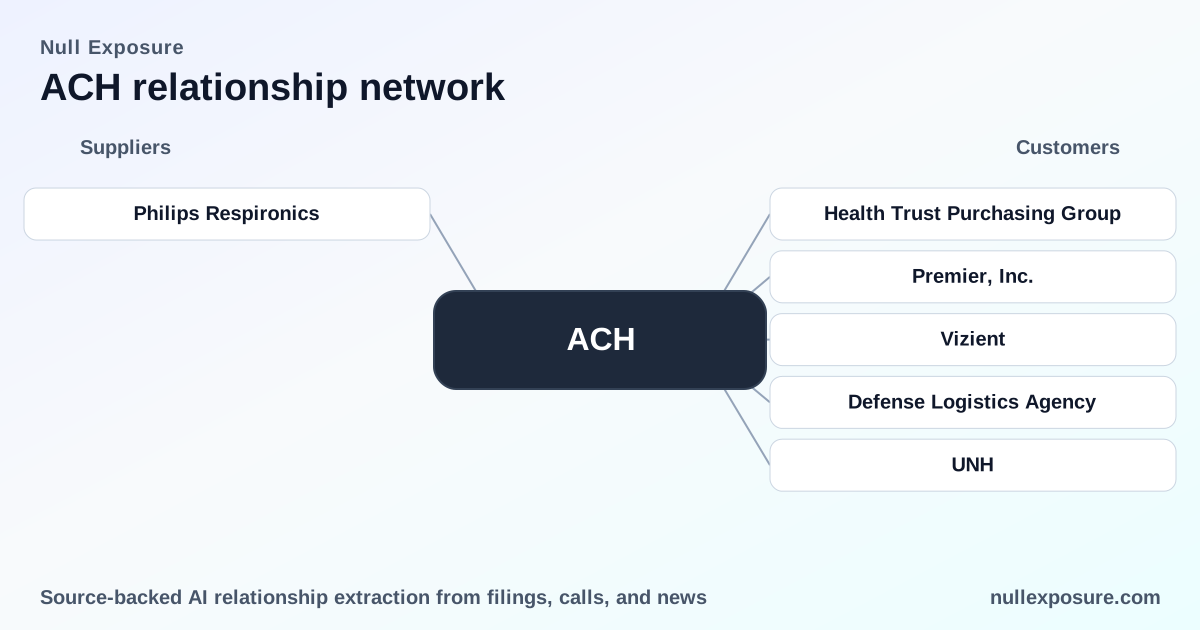
Accendra Health (ACH): Supplier Footprint and Where Philips Respironics Fits
Accendra Health is a medical-distribution operator that monetizes through the sale and after-market servicing of patient equipment and consumables, collecting margins on product movement and program fees from manufacturers. The firm's economics depend on narrow distribution margins, annual manufacturer programs and concentrated supplier sourcing, making supplier contracts and recall exposure direct drivers of near-term cash flow and operating risk.
For an owner/operator or researcher evaluating supplier risk, this profile synthesizes the company disclosures and supplier references you need to prioritize diligence. For a concise view of supplier relationships and risk signals, visit https://nullexposure.com/.
How Accendra’s supplier posture shapes value capture
Accendra runs a classic distribution business: buy, store, distribute, and service medical equipment and supplies. Public disclosures and supplier excerpts show a mix of characteristics that define the operating model:
- Short-term contracting posture: Accendra discloses that manufacturer programs are generally negotiated on an annual basis, which creates recurring renegotiation risk and renews pricing and service terms yearly. This is a structural feature of the company's commercial model and influences bargaining dynamics with large suppliers.
- High supplier concentration: The company states that products from its ten largest domestic suppliers represented roughly 37% of consolidated net revenue in 2024, underscoring meaningful counterparty concentration and supplier bargaining power.
- Mature, strategic relationships with large enterprises: Filings emphasize long-term distribution relationships with major healthcare manufacturers and the use of large enterprise suppliers and third-party service providers, creating dependency on a small set of influential counterparties.
- Operationally mixed signals on inventory risk: The company reports that excess and obsolete inventory adjustments are not material to the Patient Direct segment, indicating current inventory provisions are limited even as top-supplier concentration increases exposure to single-vendor shocks.
These points are drawn from company disclosures and supplier-risk language in the FY2024 filing and related materials. For further vendor mapping and exposure analysis, see https://nullexposure.com/.
What the filings say about Philips Respironics
Philips Respironics is explicitly referenced in Accendra’s FY2024 disclosure as a supplier-related item tied to returned equipment from prior recalls. The company reported the net book value of patient service equipment sales and dispositions that were adjusted for returned equipment to Philips Respironics — $34 million in 2024 (compared with $36 million in 2023 and $22 million in 2022). According to Accendra’s FY2024 Form 10‑K, these figures reflect the financial impact of returned equipment tied to the Philips recall process.
A separate supplier-risk excerpt in the company materials references the June 2021 voluntary recall by Philips related to polyurethane foam in certain respiratory devices, which companies in the distribution chain cite when describing product recall exposure. This historical recall is part of the risk backdrop investors must consider when assessing the Philips relationship and downstream servicing obligations.
Source: Accendra Health FY2024 Form 10‑K (reference to Philips Respironics equipment returns and historical recall discussion).
Every supplier relationship disclosed (concise investor-facing coverage)
- Philips Respironics — Accendra records equipment disposals and returns tied to Philips Respironics, with $34 million of net book value impacted in FY2024, reflecting ongoing effects from previously recalled equipment; the filing also references the industry-level June 2021 Philips recall in supplier-risk discussions (FY2024 company 10‑K).
This report includes every supplier mention found in the company’s supplier-scope disclosures for ACH; the Philips Respironics reference is the only explicit counterparty named in the source results.
Constraints and what they mean for investors and operators
The company-level constraints pulled from filings create a readable picture of how Accendra conducts supplier relationships and where operational vulnerabilities sit:
- Contract duration and leverage: The firm negotiates manufacturer programs annually, which increases the frequency of pricing and service-term resets and can compress margins if large suppliers press for better economics. This is a company-level commercial reality rather than a single-vendor idiosyncrasy.
- Supplier size and profile: The supplier base is dominated by large enterprise manufacturers, which gives those suppliers negotiating leverage and makes Accendra sensitive to supplier strategic shifts.
- Concentration equals material exposure: With the ten largest domestic suppliers contributing ~37% of consolidated revenue, supplier disruption or adverse contract repricing would be material to consolidated results.
- Inventory and obsolescence signal: The company reports that excess and obsolete inventory adjustments are not material to the Patient Direct segment, which reduces the probability of large, unpredictable write-downs tied to obsolescence in the near term.
- Relationship maturity and continuity: Filings characterize many supplier relationships as long-standing and mature, supporting operational continuity but not eliminating short-term contract risk due to annual negotiation cycles.
- Service-provider roles: Accendra discloses reliance on third-party vendors for data security and logistics (contract carriers and parcel services), which creates a separate class of operational risk around third-party IT controls and fulfillment continuity.
Where a constraint excerpt explicitly names Philips, the manufacturer role and historical recall are attributable to that relationship; other constraints are presented as company-level signals.
Investment implications and recommended diligence
The combination of annual manufacturer programs, high supplier concentration and mature ties to large manufacturers is a risk profile with both defensive and offensive considerations:
- Upside lever: Tight control of distribution economics and strong relationships with large manufacturers can sustain scale advantages in procurement and fulfillment.
- Downside trigger: A major supplier recall, contract re-pricing or failure of a large service provider could cause immediate margin pressure or higher-than-expected returns expenses.
- Operational focus: Prioritize monitoring of manufacturer program renewals, warranty and return reserves, and counterparty insurance/indemnity coverage.
For immediate action, operators and investors should:
- Confirm the current contractual cadence and renewal mechanics with top suppliers, especially Philips Respironics.
- Review recall-related reserves and historical return patterns tied to Philips and other major vendors.
- Audit third-party logistics contracts and information-security attestations to understand service-provider concentration and resilience.
For more structured supplier exposure analysis and a practical review checklist, visit https://nullexposure.com/.
Final read: where this leaves risk-adjusted value
Accendra’s supplier profile is a classic distribution playbook: material concentration with annualized manufacturer programs and mature, high-dependency relationships with large enterprises. These attributes support scale but require active vendor management and vigilant reserve accounting to protect margins. The explicit Philips Respironics reference in the FY2024 filing is the primary named supplier exposure investors must model into downside scenarios and insurance/recall contingencies.
If you are building an investment memo or operational playbook around ACH exposure, prioritize contract renewal mechanics, recall liability history, and service-provider robustness. For a comprehensive supplier exposure toolset and deeper supplier-level reporting, go to https://nullexposure.com/.