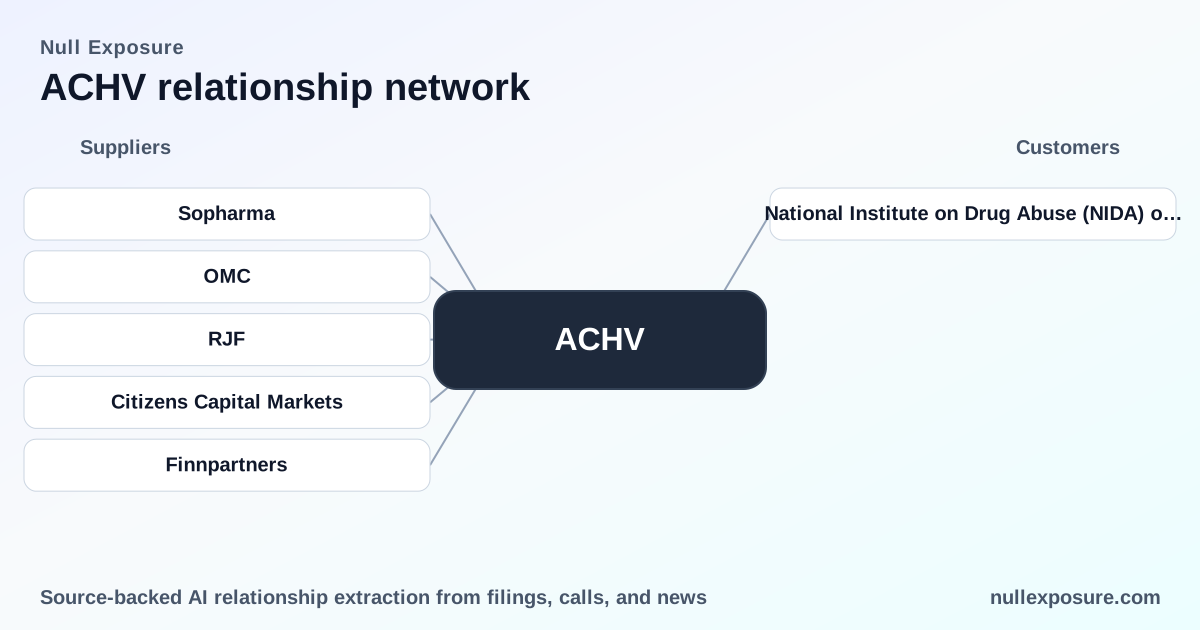
ACHV: Supplier posture and commercial readiness — what investors need to know
Achieve Life Sciences develops and plans to commercialize cytisinicline, an oral smoking‑cessation therapeutic it in‑licensed and currently sources from a single third‑party manufacturer; the company monetizes by pursuing U.S. and international regulatory approval and, upon approval, selling prescription product through commercial partners while relying on contract manufacturing and outsourced commercialization services. Achieve is pre‑revenue and highly supplier‑dependent today; its path to cash flow is driven by regulatory success, scale manufacturing arrangements, and commercialization contracts. Explore supplier signals and partnership implications at https://nullexposure.com/.
How Achieve’s operating model centers on one supply relationship
Achieve built its operating model around an in‑license of cytisinicline and a companion supply agreement with Sopharma AD. The company currently does not manufacture internally; it relies on third parties for API and finished product and explicitly states Sopharma is the exclusive supplier for clinical materials. That contracting posture creates both a near‑term execution dependency and a long lead for any commercialization ramp.
Key characteristics of this model:
- Contracting posture: Licensing plus exclusive supply; Achieve is a licensee with rights to use and sublicense certain trademarks and data it acquired under the Sopharma license agreement.
- Concentration: High — production and clinical supply are concentrated with Sopharma today.
- Criticality: Material to critical — regulatory approval, scale‑up and commercial timing are tied to third‑party manufacturing performance.
- Maturity: Active and long‑term — the supply agreement term has been extended through 2037 for defined territories, indicating a multi‑year reliance on Sopharma for product supply.
If you want a consolidated view of supplier exposure and partner roles, visit https://nullexposure.com/ for a supplier‑centric due diligence view.
Relationship roundup — every partner mentioned in filings and coverage
Below are each of Achieve’s named counterparties in the supplier scope, with plain‑English summaries and source context.
- Sopharma — Achieve in‑licensed cytisinicline from Sopharma and Sopharma is the exclusive supplier of cytisinicline and cytisinicline API under a license and supply arrangement, which the company uses for clinical materials and has extended through 2037 for covered territories. Source: Achieve’s FY2024 Form 10‑K filing (Sopharma License and Supply Agreement) and company disclosures (FY2024–FY2025).
- Sopharma (legal dispute mention) — Recent press coverage notes Achieve is in a legal dispute with its original supplier, Sopharma, while also indicating Achieve named alternate suppliers in its FDA submission. Source: StockTwits news report citing market commentary (March 2026).
- Omnicom Group / Omnicom — Achieve selected Omnicom as a strategic innovation partner and agency of record to prepare commercialization materials and launch readiness in the event of FDA approval; Omnicom is positioned for marketing and commercialization planning. Source: Press coverage and SEC‑filing excerpts reported in March 2026 (news aggregation of SEC filing).
- Raymond James — Raymond James served as an underwriter on a recent financing offering alongside Citizens Capital Markets, supporting Achieve’s near‑term capital needs and settlement activity. Source: Underwriting disclosure in aggregated SEC filing excerpts (reported March 2026).
- Citizens Capital Markets — Named as a co‑underwriter with Raymond James for the offering that settled in mid‑2025, indicating institutional distribution support for Achieve’s financing. Source: Same underwriting disclosure (reported March 2026).
- Finnpartners — Mention of Finnpartners appears in public media contact records and related press materials; Achieve has utilized external communications resources consistent with PR/IR support functions. Source: Media contact excerpts and reports (FY2022 media release context).
What the constraints tell investors about risk and optionality
The company’s constraint signals, pulled from its filings, translate into actionable investment considerations:
- Licensing and exclusive supply governance: Achieve’s principal contract structure is a license plus a supply agreement with Sopharma; the license grants access to manufacturing, efficacy and safety data, and limited IP rights in Europe. This means Achieve’s freedom to operate and its commercialization timeline are contractually bounded. (Company‑level and Sopharma‑named excerpts, FY2024 filings.)
- Long‑term exclusive supply through 2037: The amended supply agreement extends exclusive purchase obligations and Sopharma’s supply commitment through 2037 for the licensed territories, embedding multi‑year lock‑in and supplier concentration risk. (Sopharma‑named excerpt.)
- Manufacturer role and operational concentration: Sopharma functions as contract manufacturer and supplier for API and finished product for clinical trials; Achieve plans to engage additional CMOs for commercial scale if approved. This structure forces Achieve to manage scale‑up risk externally rather than internally. (Sopharma‑named excerpts.)
- Materiality and criticality: Filings characterize supplier failures as potentially material or critical to commercialization and sales. While past payments to Sopharma were described as immaterial to date, the operational impact of supply interruptions would be significant. (Company‑level excerpts.)
- Geographic and regulatory footprint: Sopharma’s manufacturing is EMEA‑based (Bulgaria) in EU cGMP facilities, which is relevant for regulatory inspections, cross‑border logistics, and timing for U.S. commercialization. (Sopharma‑named excerpt.)
- Government engagement signal: Achieve disclosed an NIH/NIDA grant to evaluate cytisinicline for e‑cigarette cessation, which signals public‑sector research funding and potential non‑dilutive support in development stages. (Company‑level excerpt.)
These constraints collectively point to a business model that is capital‑intensive, execution‑dependent on one supplier in the near term, and contingent on successful regulatory and commercial partnerships.
Investment implications and operational risk profile
For investors and operators evaluating supplier relationships, the headline conclusions are:
- Supplier concentration is the principal execution risk. Sopharma’s exclusive supply role and the extended term through 2037 create a single point of failure for clinical continuity and initial commercialization. Achieve’s contingency depends on negotiating alternative CMOs and managing potential legal disputes.
- Commercial readiness is being built externally. The Omnicom engagement and the placement underwriters show Achieve is funding and assembling commercialization capabilities before approval — a positive for go‑to‑market timing but a cost burden while pre‑revenue.
- Financing and partnerships de‑risk early execution but not supply risk. Underwriting by Raymond James and Citizens Capital Markets provided liquidity; marketing and PR partners support launch planning, yet manufacturing scale remains subject to third‑party performance and regulatory inspections.
Consider these action points: validate Sopharma capacity and inspection history, review dispute documentation and remedies, and confirm ramp plans with alternative CMOs and commercialization vendors.
If you want a deeper supplier risk scorecard and comparative peer analysis, start here: https://nullexposure.com/.
Final takeaways and next steps
Achieve’s value realization is a two‑step process: secure regulatory approval for cytisinicline, and then execute a rapid, reliable manufacturing and commercialization scale‑up largely dependent on third‑party partners. The Sopharma relationship embodies both the company’s strategic advantage (access to product and data) and its largest operational vulnerability (exclusive supply concentration). Investors should press management on contingency plans, dispute exposure, and timelines for diversifying manufacturing capacity.
For a focused supplier due diligence report and ongoing monitoring of counterparty developments, visit https://nullexposure.com/ and subscribe for supplier‑first intelligence tailored to investors and operators.