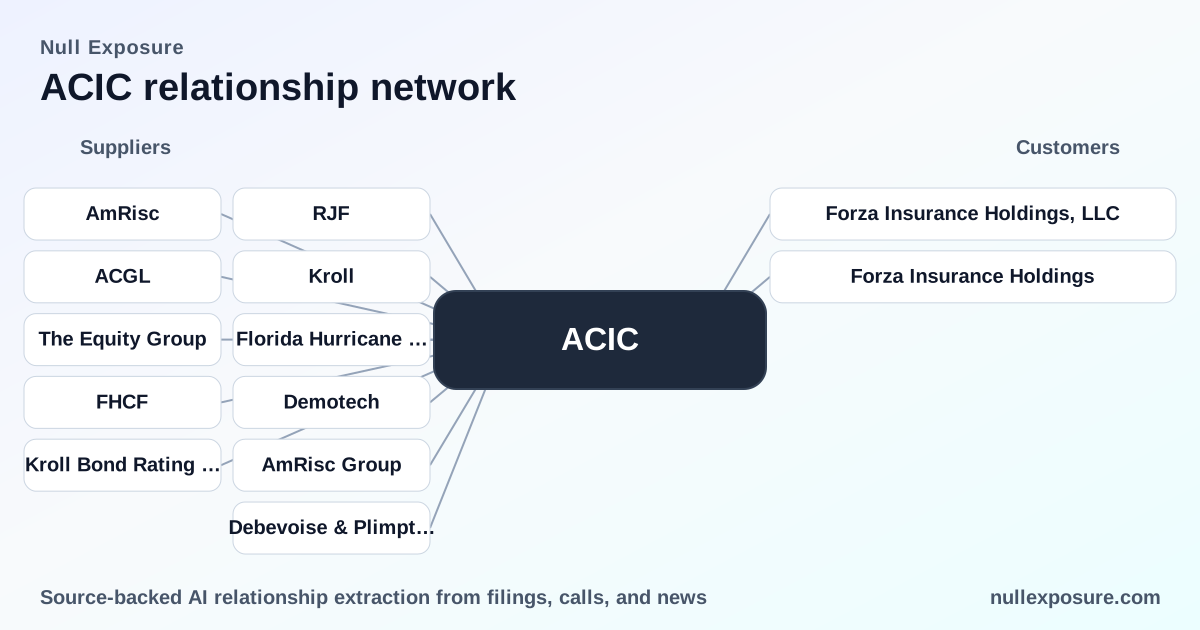
American Coastal Insurance Corp (ACIC): A supplier-focused relationship map for investors
American Coastal Insurance Corporation underwrites property & casualty risk with a concentrated distribution and reinsurance strategy and monetizes through premium retention on hurricane-exposed portfolios, selective quota-share arrangements, and disciplined capital returns to shareholders. The company generates operating leverage from concentrated distribution with AmRisc for commercial lines, offsets catastrophe exposure with short‑term reinsurance and government reimbursements, and uses strategic divestitures and dividends to crystallize value. Market capitalization and recent profitability metrics support an active capital-return posture (Market Cap ~$554m; Profit Margin ~32%; Dividend $0.75/share declared FY2025). For a broader supplier and counterparty intelligence view, visit https://nullexposure.com/.
How ACIC sources risk and protects the balance sheet
American Coastal leans on a combination of third‑party distribution, private and quota-share reinsurance, and the Florida Hurricane Catastrophe Fund to control loss volatility. Reinsurance arrangements are short‑term and central to the company’s catastrophe management, with explicit annual structures for CAT aggregate and per‑event limits and material premiums paid to secure those layers. Company disclosures show a mix of multi‑million dollar program costs (examples include AOP and CAT aggregate contract costs disclosed in FY2025–FY2026 reporting) and reliance on government‑linked reimbursement programs in Florida.
- Short contracting posture: reinsurance is prospectively negotiated on an annual basis and priced each renewal cycle (company filings, FY2025).
- Balance‑sheet protection is material: reinsurance and FHCF participation are described as essential to catastrophe risk management (company filings, FY2025).
- Concentrated distribution: a single managing general agent supplies a very large share of commercial premium (see relationship map below).
For additional supplier analytics and deeper counterparty traces, check the home page at https://nullexposure.com/.
Relationship map — counterparties and what they do for ACIC
Below are the counterparties referenced in public reporting and press coverage; each entry is a concise, plain‑English description with source context.
Raymond James & Associates (RJF)
Raymond James served as ACIC’s exclusive financial advisor on the sale of personal‑lines subsidiary Interboro, supporting the run‑off and strategic portfolio reallocation. Source: Reinsurance News and InsuranceBusiness coverage of the Interboro divestiture (reported March 2026).
Debevoise & Plimpton LLP
Debevoise & Plimpton acted as legal counsel on the Interboro sale and related transaction work, supporting ACIC’s divestiture execution and regulatory documentation. Source: Reinsurance News and InsuranceBusiness transaction reports (FY2025–FY2026).
Demotech
Demotech granted ACIC a Financial Stability Rating® of “A, Exceptional”, providing independent validation of balance‑sheet stability and underwriting capacity for market counterparties. Source: Company press release aggregated on The Globe and Mail and QuiverQuant (FY2025).
Kroll / Kroll Bond Rating Agency
Kroll assigned an A‑ insurance financial strength rating with a Positive outlook, signaling strong creditworthiness in the specialty P&C market and supporting wholesale placement dynamics. Source: Company press release and related press aggregation (The Globe and Mail; FY2025). The Kroll Bond Rating Agency also appears in coverage reiterating these upgrades (Reinsurance News, FY2025).
AmRisc Group / AmRisc
AmRisc is ACIC’s exclusive distribution partner for Florida condominium association business and is also the source of 100% of ACIC’s commercial lines according to company disclosures — a critical concentration that drives origination. AmRisc also supplied access to E&S portfolios and incremental market share (ACIC assumed a 6% position in AmRisc’s E&S portfolio in FY2026 coverage). Source: Company press releases and CityBiz / TradingView reporting (FY2025–FY2026).
Florida Hurricane Catastrophe Fund (FHCF) / FHCF
ACIC elected 90% reimbursement coverage under the FHCF Reimbursement Contract effective June 1, 2025, using the state program as a primary backstop for Florida hurricane loss exposures. Source: Reinsurance News and Artemis background on the FY2025 renewals (FY2025).
Arch Q/S (Arch Quota-Share)
ACIC placed a 15% quota‑share coverage within its reinsurance tower that disclosures cite as the Arch quota‑share layer, providing proportional risk transfer and capital relief on selected lines. Source: Artemis reporting on mid‑2025 reinsurance renewals (FY2025).
The Equity Group
The Equity Group is referenced in investor relations contact and IR distribution support, linking ACIC’s investor communications and market outreach operations. Source: Company schedule and press release information (FY2026).
Constraints and what they signal about ACIC’s operating model
The public evidence set describes several structural constraints that shape ACIC’s commercial and supplier posture. These are company‑level signals unless an excerpt explicitly names a counterparty.
- Contracting posture — short‑term reinsurance: ACIC’s reinsurance agreements are prospectively negotiated and renewed annually; this creates pricing and placement cyclicality but preserves flexibility to adjust limits and attachments each year (company disclosures, FY2025).
- Concentration risk and critical dependencies: the company sources 100% of commercial lines from AmRisc, a concentration that is both a distribution strength and a single‑counterparty dependency — this is explicitly stated in company excerpts and should be treated as a key operational risk for underwriters and investors.
- Spend profile: reinsurance program costs cluster in the multi‑million dollar band; examples in filings show program line items ranging from low millions for specific CAT layers to roughly $11.9m for certain AOP CAT coverage, and other vendor obligations in the $1m–$2m range for underwriting and claims systems. These figures position ACIC’s external spend in the $1m–$100m band across categories (company filings, FY2025–FY2026).
- Service provider relationships: ACIC maintains vendor obligations for underwriting tools, policy administration, and claims systems; those vendors are treated as service providers with contractual minimums and term commitments in filings (company filings, FY2025).
Investor takeaway: the firm is operationally efficient with concentrated distribution and disciplined reinsurance, but concentration with AmRisc and reliance on short‑term reinsurance create asymmetric execution risk that should be priced into credit and partnership decisions.
Investment implications and action points
American Coastal’s strategy combines concentrated, high‑quality distribution with active reinsurance and selective capital returns — a commercially coherent model that amplifies underwriting returns while exposing the firm to counterparty and renewal cyclicality. Key items for investors and counterparties to monitor are renewal pricing on the core cat program, FHCF election terms, and any change in the AmRisc distribution arrangement.
For proprietary supplier intelligence and to map these counterparty exposures into portfolio risk models, go to https://nullexposure.com/.
If you are evaluating ACIC as a supplier partner or investment target, revisit the company’s FY2025–FY2026 filings and the transaction announcements summarized above, and consider a targeted diligence on AmRisc dependency and annual reinsurance placement outcomes. For more supplier-level research and ongoing monitoring, visit https://nullexposure.com/.