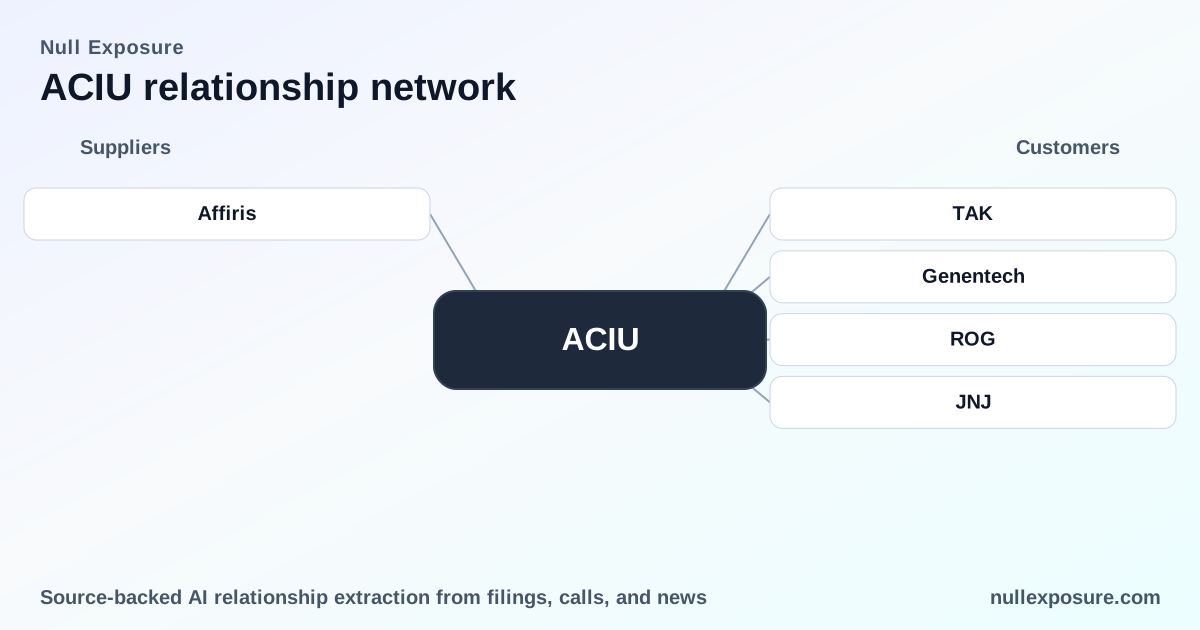
AC Immune (ACIU): Strategic supplier posture and what the Affiris deal tells investors
AC Immune is a clinical-stage biopharmaceutical company that discovers and develops therapeutics and diagnostics for neurodegenerative diseases driven by protein misfolding. The company monetizes through milestone-driven licensing and partnership revenues, targeted asset acquisitions to expand its pipeline, and equity-market financing to fund late-stage development; commercialization economics remain prospective given limited product revenue and a small recurring revenue base. Investors should view ACIU as a research-heavy, partnership-centric biotech whose value hinges on pipeline de-risking, selective M&A, and the cadence of collaborator milestones. Learn more about supplier and partner risk intelligence at https://nullexposure.com/.
Quick financial snapshot and what it signals about supplier relationships
AC Immune is modestly capitalized for a clinical-stage biotech: market capitalization roughly $315 million, trailing revenue of $3.6 million, and negative EBITDA of $67.5 million (TTM). These figures indicate a cash-burning R&D model that relies on external capital and partner funding rather than product receipts. High insider ownership (about 37.5%) and relatively low institutional ownership (about 25.5%) concentrate control and leave financing strategy—licensing, collaborations, and targeted acquisitions—central to execution.
The financial profile produces two practical supplier-posture signals:
- Contracting posture is acquisitive and partnership-focused: the company uses asset deals and collaborations to fill clinical-stage gaps rather than relying solely on internal discovery.
- Supplier criticality is high and concentrated: with limited internal revenue, a handful of partner relationships and acquired assets materially affect development timelines and commercialization prospects.
How AC Immune structures value capture (operating model explained)
AC Immune structures revenue and value capture across three levers:
- Licensing and milestone receipts from collaborators for candidates in development.
- Strategic acquisitions that add clinical-stage assets and potentially short-cut internal development timelines.
- Equity and grant financing to fund trials until a partner or product generates sustainable revenue.
This operating model produces several observable business-model characteristics: high concentration of critical suppliers (partners and licensors), strategic contracting with milestone/payment-heavy terms, and an execution profile highly sensitive to clinical readouts and regulatory timelines. Investors should price a premium on successful readouts and a discount for execution risk inherent to clinical-stage biotech.
The Affiris relationship: acquisition of a Parkinson’s vaccine program
Affiris — AC Immune acquired Affiris’s alpha-synuclein portfolio, including the PD01 active vaccine candidate, and took a related cash equity position as part of the transaction. According to a company release on July 27, 2021, the deal transferred a clinically validated Parkinson’s program to AC Immune and included an equity investment led by Athos Service GmbH. (GlobeNewswire, July 27, 2021).
Why the Affiris deal matters to investors
The Affiris acquisition illustrates AC Immune’s strategic playbook: acquire de-risked clinical assets to broaden therapeutic coverage and accelerate development timelines. The PD01 vaccine complements AC Immune’s alpha-synuclein franchise and increases optionality across Parkinson’s therapeutic modalities. This is an operational lever to create value outside of uncertain discovery timelines.
Key investor implications:
- Pipeline diversification: the deal reduces single-asset concentration by adding a clinically validated vaccine candidate.
- Capital allocation signal: management is willing to deploy M&A and equity transactions to source assets rather than solely funding internal discovery.
- Partnering dynamics: the structure implies a willingness to take equity positions alongside asset purchases, aligning incentives with lead investors.
Explore deeper supplier relationship profiles and partner risk analytics at https://nullexposure.com/.
Constraints and operating-model signals (company-level takeaways)
The reviewed records contain no explicit supplier constraint disclosures. Presenting that as a company-level signal:
- No disclosed contractual constraints: absence of explicit constraint language in the records provided suggests AC Immune does not publish supplier restrictions or structured dependency disclosures in those sources.
- Maturity and documentation posture: the company’s public communications emphasize asset transactions and clinical progress rather than granular supplier contractual detail, consistent with clinical-stage biotechs that prioritize R&D milestones publicly.
- Concentration and criticality: independently of formal constraints, supplier/partner concentration is an inherent operational risk given the small revenue base and reliance on partnerships and acquisitions.
These signals should be treated as part of the qualitative assessment for counterparty and supplier risk when evaluating ACIU exposure.
Risks and upside drivers linked to supplier relationships
- Upside drivers: successful clinical data from acquired or partnered assets and milestones or licensing payments from collaborators will directly expand near-term revenue potential and validate the acquisition strategy.
- Principal risks: operational concentration on a small number of critical relationships and a cash-burning profile that forces continued reliance on capital markets or partnership financings, which can compress equity valuations if timelines slip.
Investors should model scenario outcomes that emphasize milestone timing and the likelihood of additional partnership-driven non-dilutive funding.
Practical investor actions
- Monitor clinical milestones for PD01 and other alpha-synuclein assets as direct value inflection points tied to the Affiris transaction.
- Watch for licensing or collaboration announcements that convert scientific progress into milestone cash flows.
- Reassess financing runway and dilution risk ahead of expected trial readouts and potential commercialization inflection points.
For concise monitoring tools tailored to supplier and partner-driven bioscience exposure, visit https://nullexposure.com/.
Bottom line
AC Immune operates as a partnership- and acquisition-led clinical biotech whose valuation is highly dependent on pipeline progression and the timely conversion of collaborations into milestone revenue. The Affiris acquisition is a concrete example of management deploying M&A to accelerate clinical breadth and de-risk specific therapeutic approaches. For investors evaluating supplier relationships, focus on milestone timelines, partner creditworthiness, and the company’s next financing steps as the primary levers that drive value realization.