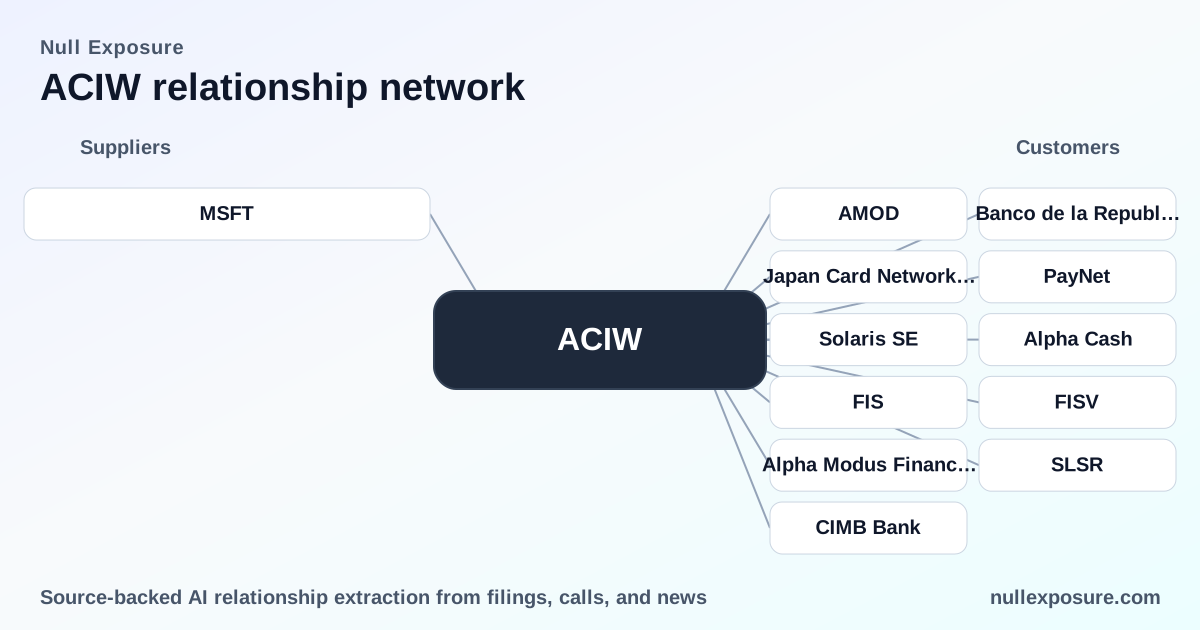
ACI Worldwide (ACIW): Why the Microsoft Cloud Tie-Up Changes the Supplier Map
ACI Worldwide is a payments-software provider that monetizes through a mix of multi-year licenses, SaaS subscriptions, and transaction-related services to banks, merchants and billers. The company captures value both through recurring software revenue and variable per-transaction economics, which gives it high operating leverage as volumes scale; ACI reported Revenue TTM of $1.76B with an Operating Margin of 23.1%, and a market capitalization near $4.08B. For investors and procurement teams, the key question is how supplier relationships — especially cloud and platform partners — translate into revenue growth, margin pressure from processing costs, and programmatic risk. Learn more at https://nullexposure.com/.
How to read the Microsoft headlines: validation plus operational exposure
ACI’s recent press coverage centers on a new UK retail-bank deployment of its Connetic platform delivered on Microsoft’s cloud. This is a strategic win: bringing SWIFT, CHAPS and Faster Payments onto a single cloud-native stack is both a sales reference and a proof-point for enterprise modernization. Public coverage explicitly highlights that Microsoft’s cloud powers the deployment and enables AI-driven fraud prevention, which accelerates ACI’s narrative into real-time and cross-border payments modernization.
Microsoft — new UK retail-bank Connetic deployment (SimplyWall, Mar 9, 2026)
A SimplyWall article reported that the win unifies major payment rails and layers AI-driven fraud prevention on a Microsoft-powered SaaS infrastructure, positioning ACI to sell modern, cloud-native payments operations to large banks. Source: https://simplywall.st/stocks/us/software/nasdaq-aciw/aci-worldwide/news/did-acis-2026-revenue-guidance-and-new-uk-connetic-win-just/amp
Microsoft Corporation — MarketScreener coverage of the UK deployment (Mar 9, 2026)
MarketScreener framed the deployment as evidence of market confidence in ACI’s next‑generation platform, explicitly calling out that the solution is “Powered by Microsoft's cloud capabilities,” which supports ACI’s ability to speed customer modernization and unlock growth. Source: https://www.marketscreener.com/news/aci-worldwide-inc-announces-uk-deployment-as-uk-banks-can-now-unite-swift-chaps-and-faster-paymen-ce7e5dd9d98cf724
Microsoft — regional reference customer lifts cloud payments story (SimplyWall, Mar 9, 2026)
A second SimplyWall piece noted that a major UK retail bank consolidating SWIFT, CHAPS and Faster Payments on Connetic — backed by Microsoft Cloud — gives ACI a high-profile reference in a market where real-time and cross-border payment capabilities are strategic priorities. Source: https://simplywall.st/stocks/us/software/nasdaq-aciw/aci-worldwides-uk-connetic-win-puts-cloud-payments-story-to/amp
Supplier constraints that define the operating model
ACI’s public disclosures and cost breakdowns flag several company-level constraints that shape supplier risk and negotiating posture:
- Long-term contracting posture: Company filings reference scheduled payments tied to multi-year license agreements for internal-use software. This indicates ACI operates with multi-year commitments that stabilize revenue but also create long-lived contractual obligations on the balance sheet.
- Service-provider cost structure: ACI functions primarily as a service provider; cost of revenue explicitly includes SaaS/PaaS service costs, payment card interchange and third-party processing fees, and cloud computing fees. This underscores that variable transactional costs are a core component of gross margins.
- Services segment exposure: Public excerpts cite increases driven by payment card interchange and cloud computing fees (notably a $48.2M rise in interchange/processing and an $8.0M increase in cloud fees in a reported period), which signals margin sensitivity to both transaction volumes and third‑party cloud pricing.
Together these signals show a company that sells durable contracts but runs a cost base that is partially variable and dependent on third-party providers and payment-network economics. Investors should interpret these constraints as structural characteristics — steady contract revenues on one side, and meaningful supplier-driven cost volatility on the other.
Find practical diligence resources at https://nullexposure.com/ to map supplier exposures against contract terms and SLAs.
What this means for investors: upside, operational risk, and monitoring
- Upside: Microsoft-backed Connetic deployments accelerate sales cycles with large banks and supply a visible reference that helps cross-sell other modules (fraud, reconciliation, real-time payments). This aligns with ACI’s go‑to‑market narrative and supports organic revenue growth in Europe and cross-border segments.
- Operational risk: Cloud dependency and processing-cost pass-throughs create two-way exposure — while cloud enables faster onboarding and reduced on-premise maintenance, it also concentrates infrastructure risk (availability, security, pricing). Meanwhile, interchange and processor fees are volume-driven and can compress margins in stressed volume periods.
- Contract maturity and negotiating leverage: Long-term licenses reduce churn and increase lifetime value, but also lock ACI into future cost structures and implementation timetables; vendor SLAs and migration terms to cloud partners become critical negotiation levers for clients and investors assessing downside scenarios.
Key financial context: ACI trades at a Forward P/E of 12.42 with an Analyst Target Price around $64, signaling that the market prices growth prospects and margin expansion into the valuation. Monitor quarterly disclosures for incremental references to cloud vendor SLA terms, interchange pass-through mechanics, and any explicit revenue recognition tied to large Connetic rollouts.
Practical due diligence checklist for supplier exposure
- Validate whether major cloud relationships (e.g., Microsoft) are governed by preferred‑vendor agreements, volume discounts, or pass-through pricing.
- Obtain clarity on interchange and processor fee mechanisms in contracts — confirm which party bears rate changes.
- Review multi‑year license schedules and termination clauses to quantify stranded costs or accelerated payments.
- Request operational runbooks and incident history tied to cloud outages to evaluate continuity risk.
If you want a structured supplier exposure report aligned to these checks, start here: https://nullexposure.com/.
Bottom line
The Microsoft cloud references are a meaningful strategic validation for ACI’s Connetic platform and materially improve ACI’s go‑to‑market credibility in realistic modernization cycles. However, investors must balance that upside against supplier-driven margin pressure — interchange and cloud costs are recurring, variable, and documented as material line items. For investment committees and procurement teams, the right framework is to treat these relationships as both growth enablers and operational dependencies: win the sales narrative while rigorously controlling contract terms, SLAs and pass‑through mechanics.
For tailored supplier intelligence and to map these exposures across your portfolio, visit https://nullexposure.com/.