ACM Research (ACMR): supplier relationships that define supply risk and upside
ACM Research develops, manufactures and sells single-wafer wet cleaning equipment for embedded chips and monetizes through capital-equipment sales and aftermarket support, with meaningful revenue scale (Revenue TTM ≈ $901m) and mid-30s trailing P/E. The quality and structure of ACMR’s supplier relationships—single-source subassemblies, equity investees that double as producers, and APAC-centric manufacturing—drive both margin leverage and concentrated operational risk. For a focused supplier-risk assessment and ongoing monitoring, visit https://nullexposure.com/.
Why suppliers are the operational fulcrum for ACMR
ACMR’s products rely on precision subassemblies—robotic delivery systems, megasonic transducers and valves—that are not commodity items and are often sourced from a narrow set of suppliers. That narrowness reduces procurement flexibility and increases execution sensitivity to supplier disruptions, export controls and currency exposure. The FY2024 10‑K and related disclosures enumerate the firm’s supplier posture and the specific counterparties that matter.
The supplier map you need to know now
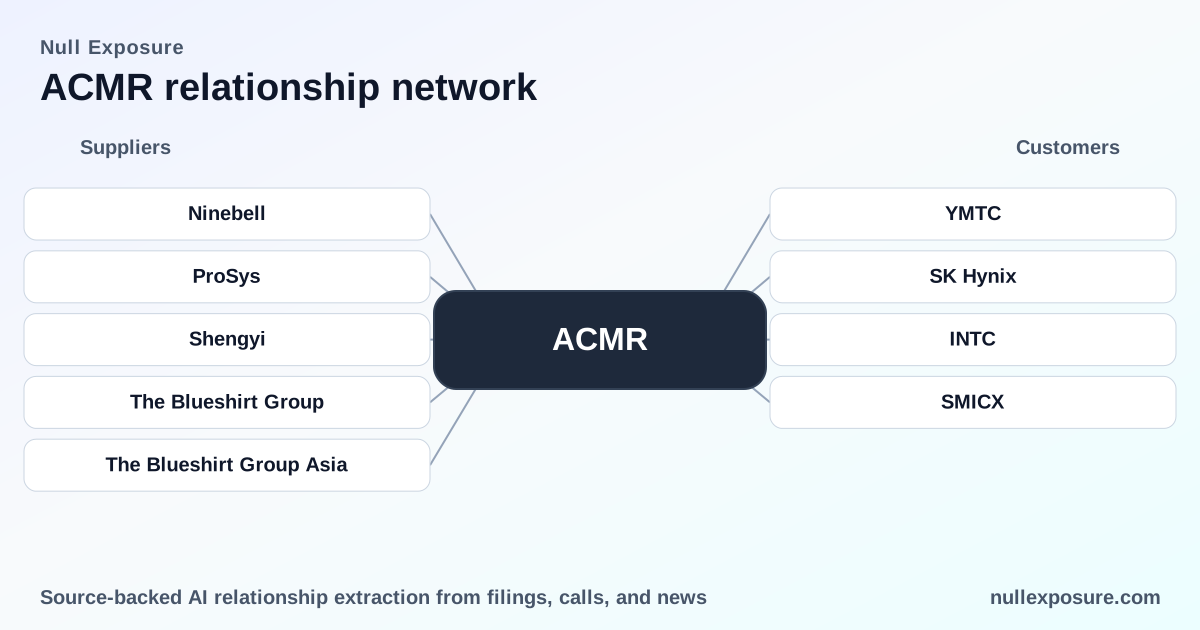
Below I cover every relationship listed in the public supplier results and what each means in plain language.
-
Ninebell — principal supplier and equity partner. Ninebell is an equity investee of ACM and serves as the company’s principal supplier of robotic delivery system subassemblies used in ACMR’s single‑wafer cleaning tools. This linkage creates operational alignment but concentrates critical subassembly supply. According to ACMR’s FY2024 10‑K, Ninebell is both an equity investee and primary supplier of robotic delivery subsystems (FY2024 10‑K).
-
ProSys — sole supplier of a key subassembly. ProSys is identified in the FY2024 filing as the sole supplier of megasonic transducers, a necessary subassembly for ACMR’s capital equipment; ACMR flags the risk that ProSys’s manufacturing delays or shutdowns could disrupt deliveries. The company describes ProSys as a sole supplier of megasonic transducers (FY2024 10‑K).
-
Shengyi — equity investee and China-based component supplier. Shengyi is an equity investee of ACM Shanghai and supplies components in mainland China for ordinary production; this creates an intra-group supply relationship that bolsters control but concentrates manufacturing geographically. The FY2024 10‑K names Shengyi as an equity investee and component supplier in mainland China (FY2024 10‑K).
-
The Blueshirt Group — investor and media contact in the U.S. market. ACM Research’s operating subsidiary lists The Blueshirt Group (U.S.) for investor and media inquiries, providing an external communications channel for investor relations and U.S. outreach (news release, FY2025).
-
The Blueshirt Group Asia — PR contact for China region. ACM Research Shanghai lists The Blueshirt Group Asia as the investor/media contact in China, centralizing regional investor communications for the APAC operation (news release, FY2025).
What the constraints tell investors about ACMR’s operating model
ACMR’s filings and disclosures provide layered signals about how the company runs its supply chain and where investors should focus.
- Contracting posture: short-term purchase-order relationships. ACMR states that certain suppliers operate without long-term contracts and are transacted through purchase orders, which creates price and availability exposure and limits long-term procurement commitments (company filing language).
- Geographic concentration: heavy APAC manufacturing and payments. The company conducts the majority of product development and manufacturing in mainland China, with additional subsystem production in Korea, and transacts primarily in RMB and KRW—a structure that concentrates execution risk in APAC currency and regulatory environments (FY2024 10‑K).
- Global export-control exposure. ACMR cites BIS Entity List designations that prohibit worldwide furnishing of controlled U.S. technologies to ACM Shanghai and ACM Korea; those designations create a global supplier shock if enforced across the supply chain (company filing note on export controls).
- Criticality and concentration: single‑source risk for essential components. ACMR depends on a limited number of suppliers, including single‑source providers, for critical components and subassemblies; the company explicitly identifies this as a business-disrupting risk (FY2024 10‑K).
- Relationship roles: manufacturer and seller alignment. Multiple suppliers are described as manufacturers and, in some cases, equity investees—an operational pattern that both secures supply and concentrates counterparty dependence (FY2024 10‑K).
Investment implications: risk, optionality and monitoring priorities
ACMR’s supplier structure creates a classic trade-off for capital‑equipment vendors: vertical alignment that supports margin and time-to-market, versus concentration that amplifies disruption risk. Key implications:
- Concentration risk is elevated because critical subsystems come from single suppliers; supplier failure or export-control escalation would have outsized revenue and delivery impacts.
- Equity investees (Ninebell, Shengyi) function as quasi-integrated suppliers; this reduces misalignment but increases exposure to group-level regulatory actions affecting ACM Shanghai or ACM Korea.
- Currency and APAC operational concentration justify close monitoring of RMB/KRW exposure, regional labor and logistics conditions, and BIS/Entity List developments.
For active monitoring and supplier intelligence on ACMR, see https://nullexposure.com/ for subscription options and reporting tools.
What operators and investors should watch next
Operational indicators that will lead price and delivery outcomes for ACMR include:
- Public filings and 8‑K disclosures for any changes in supplier contracts or the designation of alternate sources.
- Regulatory updates on BIS Entity List actions affecting ACM Shanghai or ACM Korea and any resulting supplier repricing or substitution costs.
- Lead-time and backlog disclosures; an increase in working capital tied to supplier delays signals execution risk.
- Changes to investor communications channels or PR contacts—The Blueshirt Group and The Blueshirt Group Asia are listed as investor/media contacts for ACM Research Shanghai and are the first place ACM will route public messaging about supply issues (news release, FY2025).
Mid-cycle investors should track these indicators against the company’s margin and backlog disclosures three to four quarters ahead of delivery cycles.
Actionable next steps for due diligence
- Request clarity on contract lengths and termination clauses for ProSys, Ninebell and Shengyi in investor calls; short-term purchase orders increase execution risk.
- Stress-test supply continuity under an export-control shock and model incremental procurement costs if single-source parts must be replaced.
- Monitor PR and investor-relations activity routed through The Blueshirt Group contacts as an early-warning channel for supplier-related announcements (news release, FY2025).
For a supplier-risk briefing tailored to your investment or operational horizon and regular monitor feeds, visit https://nullexposure.com/.
Bottom line
ACMR captures margin through specialized equipment and close ties to key suppliers—some of which are equity partners—creating operational advantage but concentrated supplier risk. Investors should value the upside inherent in vertical alignment while pricing the non-trivial probability of disruption from single-source suppliers, APAC concentration and export-control dynamics. For ongoing supplier surveillance and tailored alerts, go to https://nullexposure.com/.