Accenture (ACN) as a Supplier Partner: Strategic buys, AI tie‑ups, and what they mean for operators and investors
Accenture monetizes by selling high‑margin consulting, systems integration and managed services to large enterprises while expanding recurring revenue through cloud and software subscriptions and targeted acquisitions. The firm combines professional services fees with scale in managed platform offerings and now pursues data- and network‑intelligence assets that convert information into cross‑sellable solutions. For investors and procurement leaders, Accenture is a capitalized buyer that broadens client value propositions via bolt‑on M&A and multi‑year AI partnerships, shifting its mix toward subscription and platform economics.
Explore deeper supplier intelligence at https://nullexposure.com/.
How Accenture operates and where revenue comes from
Accenture operates as a global professional services firm with three principal levers of monetization: project‑based consulting and implementation fees, long‑duration outsourcing/managed service contracts, and growing software and cloud subscription revenues. The company reported roughly $70.7 billion in trailing revenue, sustained operating margins near 17%, and a market capitalization above $120 billion, which funds both recruitment and acquisitive expansion. Its corporate posture is to buy capability where speed to market matters—especially in AI, network analytics, and managed intelligence—and to fold those capabilities into cross‑enterprise offerings sold to large clients.
Accenture’s balance between one‑time project revenue and recurring commitments is shifting. The company disclosed multi‑billion dollar non‑cancelable commitments tied to cloud hosting and software subscriptions as of August 31, 2025, signaling a deliberate movement into subscription‑style economic exposure and longer cash‑flow visibility.
What the recent relationship signals tell investors
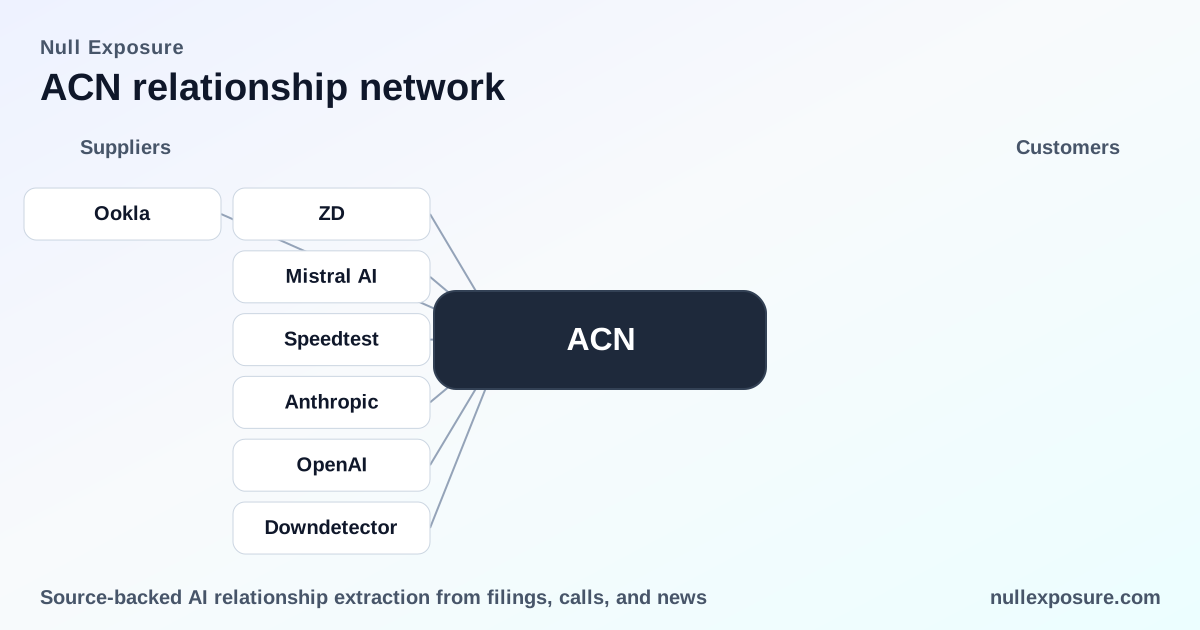
Accenture’s public relationships in the current reporting window show a two‑pronged strategy: acquiring data and network assets to own differentiated information flows, and partnering with AI platform specialists to accelerate productization of those assets for clients. That combination increases customer stickiness but raises execution and margin‑press risk as clients compare third‑party AI pricing and capabilities.
See more company relationship analysis at https://nullexposure.com/.
Ziff Davis — purchase of the Connectivity division (Ookla assets)
Accenture agreed to acquire Ziff Davis’s Connectivity division, the business that houses Ookla and related properties, for approximately $1.2 billion in cash, a transaction widely reported in early March 2026. This purchase transfers Speedtest, Downdetector and parent Ookla into Accenture’s portfolio to bolster network intelligence and benchmarking capabilities for enterprise and telco clients (reported by WKZO on March 3, 2026; additional coverage at Finviz and Pulse2: https://wkzo.com/2026/03/03/ziff-davis-to-sell-connectivity-division-to-accenture-for-1-2-billion/ and https://pulse2.com/ziff-davis-1-2-billion-sale-of-connectivity-division-to-accenture/).
Ziff Davis Inc — market reaction and deal context
Market coverage captured a strong investor response to the sale: Ziff Davis Inc shares spiked after the announcement, underscoring the transaction size relative to Ziff Davis’ market value and highlighting strategic realignment away from connectivity assets (Finviz coverage, March 2026: https://finviz.com/news/328647/why-is-ziff-davis-zd-stock-soaring-today).
Ookla — asset transfer into Accenture
Accenture will take ownership of Ookla, the measurement and benchmarking company behind Speedtest, integrating its datasets and testing infrastructure into services that can be sold to telcos and enterprises for network performance benchmarking and managed offerings (reported by Engadget, March 2026: https://www.engadget.com/cybersecurity/downdetector-and-speedtest-have-been-sold-for-over-1-billion-201741894.html).
Speedtest — product-level capability added
Speedtest’s global testing platform provides a turnkey telemetry feed Accenture can operationalize for network SLAs, service assurance, and client benchmarking, converting a consumer‑facing utility into enterprise data products (Engadget coverage, March 2026: https://www.engadget.com/cybersecurity/downdetector-and-speedtest-have-been-sold-for-over-1-billion-201741894.html).
Downdetector — incident monitoring and signal enrichment
Downdetector’s outage and incident tracking augments real‑time service‑health monitoring for Accenture’s managed services and could be used to improve support economics and customer retention through faster remediation (reported by Engadget, March 2026: https://www.engadget.com/cybersecurity/downdetector-and-speedtest-have-been-sold-for-over-1-billion-201741894.html).
Mistral AI — multi‑year collaboration on enterprise AI
Accenture entered a multi‑year collaboration with Mistral AI to co‑develop enterprise‑grade AI solutions; this partnership accelerates Accenture’s productization of advanced AI models while preserving flexibility to source from multiple providers (Sahm Capital commentary, March 4, 2026: https://www.sahmcapital.com/news/content/accenture-targets-ai-and-network-intelligence-to-reshape-long-term-growth-2026-03-04).
Anthropic and OpenAI — external model sourcing and go‑to‑market alliances
Public reporting highlights Accenture’s use of multiple external AI partners, including Anthropic and OpenAI, in commercial offerings and go‑to‑market arrangements; these partnerships support Accenture’s strategy to resell and implement third‑party LLM platforms while packaging governance, deployment and integration as premium services (Sahm Capital and Fortune reporting, Feb–Mar 2026: https://www.sahmcapital.com/news/content/accenture-targets-ai-and-network-intelligence-to-reshape-long-term-growth-2026-03-04 and https://fortune.com/2026/02/24/ibm-anthropic-treatment-vibe-coding-panic-cobol-cowboys/).
Company‑level constraints and what they imply for suppliers and buyers
Accenture’s public disclosures provide actionable signals about its operating model:
- Contracting posture: Accenture holds large non‑cancelable commitments for cloud hosting, software subscriptions and managed services (disclosed as of August 31, 2025). This indicates a tendency toward long‑term, subscription‑style contracts with service providers rather than short, ad‑hoc purchasing.
- Counterparty profile: The firm deals primarily with large enterprise counterparties and financial institutions for credit and procurement relationships, indicating high standards for vendor financial stability and compliance.
- Buyer role and spend scale: Accenture is a major buyer, with evidence of commitments and line items consistent with >$100 million spend bands in aggregate; procurement teams should expect formal contracting, SLAs, and negotiated termination terms.
- Operational maturity: The combination of recurring commitments and acquisitions into data and AI capabilities signals a mature operating model that prioritizes scale, integration capability, and conversion of acquired assets into sellable managed services.
These constraints are company‑level signals; they describe Accenture’s sourcing behavior and capital allocation choices rather than any single vendor.
Investment and operator takeaways
- Strategic inorganic moves are targeted: The $1.2 billion Connectivity acquisition brings proprietary measurement infrastructure that strengthens Accenture’s managed network and telco offerings—this is a capability buy that creates cross‑sellable enterprise products.
- AI partnerships lower build time but increase supplier complexity: Partnerships with Mistral, OpenAI, and Anthropic speed product launches but concentrate execution risk and cost scrutiny when clients benchmark alternative AI providers.
- Procurement must prepare for scale and formality: Suppliers engaging Accenture should be prepared for long‑term subscription contracts, rigorous SLAs, and enterprise procurement processes consistent with high spend profiles.
Learn how these relationship signals affect supplier risk and opportunity at https://nullexposure.com/.
Accenture’s combination of platform buys and multi‑partner AI sourcing is a deliberate push to own both the data feed and the deployment channel. For investors, that strategy commoditizes consulting hours into recurring product revenue over time while elevating integration and execution as the primary sources of value capture. For operators building vendor strategies, Accenture is a sophisticated, capitalized buyer that requires proven scalability, data governance, and flexible commercial models. Explore our supplier risk services and ongoing coverage at https://nullexposure.com/.