ACNB Corporation: supplier posture, funding relationships, and what investors should price in
ACNB Corporation is a regional financial holding company that monetizes primarily through interest margin on loans and securities, complemented by fee income from wealth management and insurance services. The bank’s commercial profile blends retail and commercial lending with non-interest revenue streams; capital structure choices — including subordinated notes and short-term borrowings — are deliberate levers for liquidity and regulatory capital management. For investors assessing supplier and counterparty exposure, the focus is on funding counterparties (notably FHLB liquidity lines), long-term subordinated capital, and third‑party wealth-service providers. Learn more about how we track supplier signals at https://nullexposure.com/.
Why supplier and counterparty signals matter for a regional bank
A regional bank’s economic stability rests on three operational pillars: funding, capital, and outsourced services. ACNB’s public disclosures and filings reveal a funding posture that mixes short-term FHLB borrowings for day-to-day balance-sheet management with longer-term subordinated notes used to support regulatory capital. Outsourcing of brokerage and wealth functions to a third-party broker‑dealer reduces operating complexity but creates dependency on an unaffiliated service provider for fee revenue and client servicing. Collectively, these relationships shape counterparty risk, funding flexibility, and the bank’s ability to support loan growth or weather deposit volatility.
- Contracting posture: Evidence of long-dated subordinated notes (10-year structure) indicates capacity to raise long-term capital, lowering refinancing risk on the liability side.
- Concentration and criticality: Short-term borrowings from government-sponsored entities are critical for liquidity management; loss of access would materially affect funding flexibility.
- Maturity profile: The mix of short-term FHLB use and long-term subordinated debt reflects a deliberate laddering approach to maturities and capital permanence.
According to ACNB disclosures, subordinated note issuances were completed on March 30, 2021, and short-term financing activity was highlighted in the FY2026 results. These are company-level signals that illuminate the bank’s operating model and funding choices.
The complete supplier list investors need to see
Below I cover every supplier/counterparty relationship surfaced in the results and summarize the investor-relevant point for each.
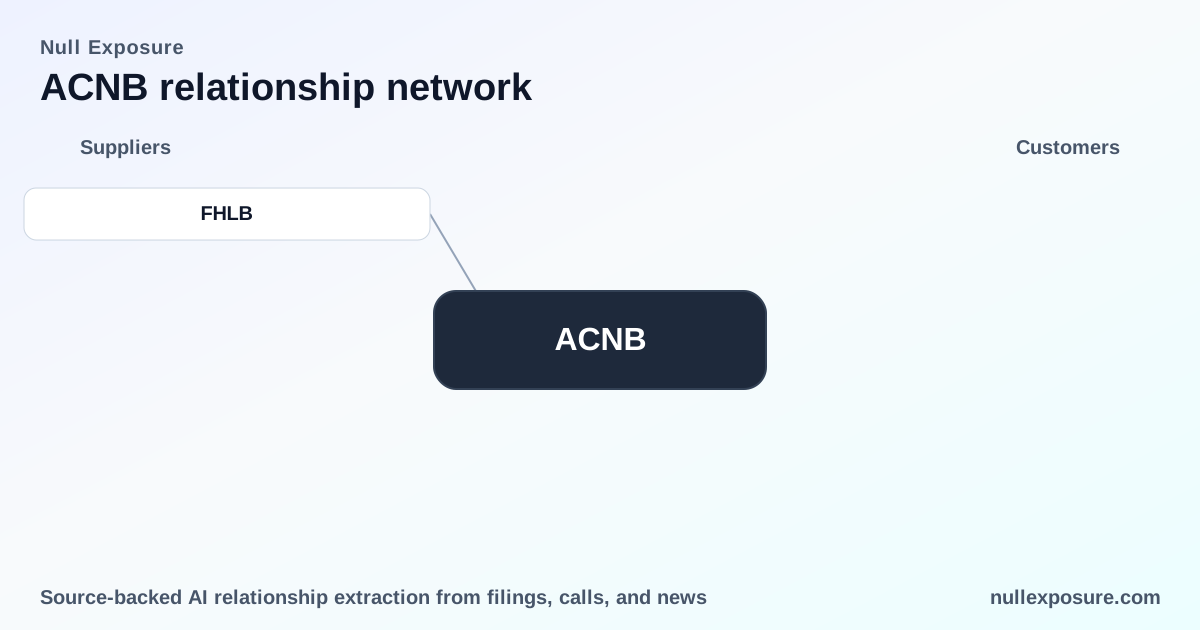
- FHLB — ACNB increased total borrowings driven primarily by short-term FHLB borrowings for general balance sheet management, indicating active use of Federal Home Loan Bank advances as a liquidity tool; this was disclosed in the company’s January 22, 2026 financial release reporting FY2025/2026 results (published via GlobeNewswire).
Source: ACNB press release, January 22, 2026, reporting fourth-quarter and 2025 results on GlobeNewswire.
(Those two GlobeNewswire entries in the results reference the same disclosure about FHLB borrowings; the salient investor takeaway is the bank’s reliance on short-term FHLB advances as part of day-to-day balance-sheet management.)
What the constraint signals tell investors about ACNB’s operating model
ACNB’s constraint excerpts point to several consistent corporate-level signals that shape supplier risk and operational resilience:
- Long-term contracting capability: ACNB issued $15.0 million of 4.00% fixed-to-floating subordinated notes due March 31, 2031, under note purchase agreements executed March 30, 2021. That issuance is evidence of the bank’s ability to access long-dated capital markets to meet regulatory capital objectives and reduce near-term refinancing pressure. (Company disclosure dated March 30, 2021.)
- Government counterparty exposure: The bank holds securities and transacts with U.S. government and agency counterparties for investment and funding purposes; these instrument classifications and valuations are included in ACNB’s fair value disclosures. This reinforces the importance of stable access to government-sponsored liquidity channels. (Company financial disclosures.)
- Service-provider dependence for wealth/brokerage: ACNB’s wealth advisory and retail brokerage services are delivered through an unaffiliated broker/dealer third-party provider, and the bank maintains unsecured correspondent lines for overnight federal funds borrowing. These service relationships are operationally material because they support non-interest revenue and short-term liquidity operations. (Company disclosures on wealth services and credit lines.)
Taken together, these constraints signal a balanced but materially interdependent operating model: long-term subordinated capital reduces capital risk, while short-term FHLB funding and third-party brokerage relationships concentrate operational and funding counterparties.
Practical implications for investors and operators
- Liquidity risk management: The bank’s use of short-term FHLB advances is a normal and efficient liquidity tool, but it makes ACNB sensitive to changes in access to GSE funding markets. Monitor FHLB advance levels versus deposit and loan trends in quarterly filings.
- Capital durability: The subordinated notes extend capital maturity and support regulatory ratios; investors should note the fixed-to-floating structure as it affects interest expense and sensitivity to rate cycles.
- Operational dependency: Outsourced brokerage for wealth management reduces staffing and compliance burden but creates vendor concentration risk; contract terms, termination rights, and service continuity provisions are material to fee income stability.
If you want a concise supplier risk scorecard for ACNB or comparable regional banks, visit https://nullexposure.com/ for structured supplier intelligence and ongoing monitoring.
Investor checklist and next steps
- Review ACNB’s next 10-Q/10-K filings for movements in FHLB borrowings and subordinated debt amortization or call provisions.
- Confirm the contractual terms and service-level protections with the third‑party broker/dealer used by ACNB Wealth Management, since this supports recurring fee revenue.
- Track deposit trends relative to short-term borrowings to assess the bank’s reliance on market funding versus core deposits.
For a deeper supplier-risk briefing and alerts tied to ACNB counterparties, go to https://nullexposure.com/ — the platform that compiles supplier, counterparty, and constraint signals into investor-ready intelligence.
Bottom line: ACNB’s funding and supplier footprint is conventional for a regional banking franchise — a mix of short-term GSE liquidity and long-term subordinated capital paired with third‑party delivery of wealth services — but the combination creates concentrated counterparties that investors must monitor across funding cycles and interest-rate environments.