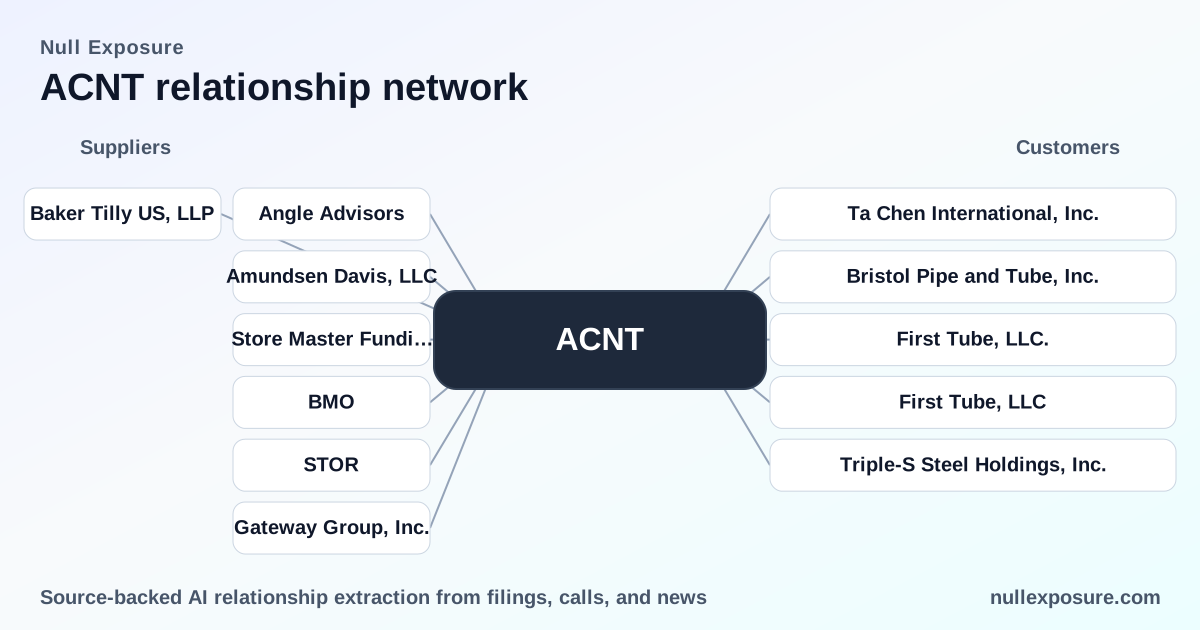
Ascent Industries Co. (ACNT) — supplier relationship briefing for investors
Ascent Industries Co. manufactures and sells specialty metals and chemicals and monetizes through product sales, manufacturing services and selective asset transactions (notably sale-leaseback activity). The company ties operating cash flow to manufacturing throughput while using real‑estate finance and a revolving credit facility to manage liquidity and capital structure, and it engages external advisors and service providers to execute divestitures and investor relations. For capital markets and counterparty risk assessment, the supplier‑and‑service map below identifies counterparties that influence cash flow timing, lease obligations and financing flexibility. Learn more or run deeper supplier checks at https://nullexposure.com/.
How Ascent runs the business and why these relationships matter
Ascent operates as a capital‑intensive manufacturing company with two notable structural features. First, lease and real‑estate financiers are a central part of its operating posture: multiple sale‑leaseback arrangements and a Master Lease with Store Master Funding XII, LLC (an affiliate of Store Capital) materially affect rent expense, plant access and refinancing options. Second, bank financing and amendments to the credit facility directly govern near‑term liquidity; lender consents and waivers are active levers in Ascent’s covenant management.
Contracting posture: Ascent uses long‑term leases and a revolver/term loan structure rather than owning all production assets, which centralizes counterparty and legal lease risk with its landlord(s) and lender group.
Supplier concentration vs. criticality: the company reports a high concentration of raw material spend with top suppliers (approximately 92% of purchases concentrated in the top five by spend), but asserts materials are available from multiple sources — a company‑level signal that concentration exists but procurement flexibility is presented as manageable.
Maturity and outsourcing: Ascent routinely engages external advisors for transactions (investment bank, legal, IR) and shifts auditors, indicating a reliance on third parties for governance, capital markets access and disclosure.
Relationship map — who Ascent works with (and why it matters)
Angle Advisors
Angle Advisors served as Ascent’s exclusive investment banking advisor on the sale of Bristol Metals LLC, guiding the transaction execution in FY2025. According to Angle Advisors’ announcement, they acted as the exclusive investment banking advisor to Ascent on that sale (FY2025).
Amundsen Davis, LLC
Amundsen Davis acted as legal advisor to Ascent for the Bristol Metals sale; a CityBiz report notes Angle Advisors as financial advisor and Amundsen Davis as legal counsel on the transaction (FY2025).
Store Master Funding XII, LLC (Store) / Store Capital Corporation
Ascent’s leased plants and facilities derive substantially from a Master Lease with Store Master Funding XII, LLC, an affiliate of Store Capital; the company amended that arrangement through 2025 and completed a lease assignment of the former Munhall facility while entering a Seventh Amended and Restated Master Lease to reduce rent (reported in Ascent’s FY2026 Form 10‑K). This landlord relationship is contractually critical for plant access and fixed rent obligations (FY2026).
BMO Bank N.A.
BMO Bank N.A. is the administrative lender under Ascent’s credit facility and the counterparty on a Sixth Amendment and omnibus loan amendment and limited waiver, recorded in the company’s FY2026 filings; amendments with BMO govern covenant relief and borrowing terms. Ascent has publicly referenced a credit facility amendment with BMO in press disclosures (FY2025–FY2026).
Gateway Group, Inc.
Gateway Group, Inc. provides investor relations support and is listed as the contact for Ascent’s investor communications, including conference participation and earnings‑call notices (references appear in FY2024–FY2025 press materials). Gateway functions as the external IR intermediary responsible for market communications and investor engagement (FY2024–FY2025).
Baker Tilly US, LLP
Baker Tilly US, LLP is the independent auditor that has served Ascent since 2023, with the FY2026 10‑K including Baker Tilly’s signature on the audit reporting; this signals the current external assurance provider for financial statements (FY2026).
What the relationships imply for investors
- Lease/landlord risk is elevated and visible. The Master Lease with Store (and recent amendments and assignments) positions Store as a counterparty whose negotiation posture directly affects Ascent’s operating cost base and optionality — a critical lever for cash flow and restructuring.
- Credit facility governance is live and material. The Sixth Amendment with BMO demonstrates active covenant management; future covenant actions or lender negotiations will materially influence capital allocation and share repurchase capacity.
- Transaction capability and market access are outsourced to advisors. Use of Angle Advisors and Amundsen Davis for the Bristol Metals sale shows Ascent leverages boutique advisory and legal expertise to execute divestitures and reshape the asset base.
- Investor communications and audit succession are disciplined. Gateway Group handles IR, and Baker Tilly provides audit coverage since 2023; both roles reduce execution risk on disclosure and investor engagement but require monitoring for continuity and independence issues.
Explore supplier and counterparty exposure with targeted screens and detailed counterparty profiles at https://nullexposure.com/.
Constraints and company‑level signals you should track
- Materiality/concentration: Ascent reports that ~92% of raw material purchases are concentrated in the top five suppliers, yet it states raw materials are available from multiple independent sources and that loss of a supplier would not be materially adverse. This is a mixed signal: high spend concentration coexists with asserted sourcing flexibility, so investors should treat procurement as a potential concentration risk that is currently manageable but sensitive to market shocks or single‑source arrangements.
- Service provider dependence: a constraint excerpt references Moss Adams, LLP as a prior independent registered public accounting firm; while the current auditor is Baker Tilly (since 2023), the mention of multiple auditors over recent years is a signal to watch audit continuity and governance stability as part of baseline due diligence.
Risk checklist and monitoring items
- Confirm the economic terms and expiration profile of the Master Lease (Store) and monitor any further lease assignments or rent concessions. Landlord economics are directly material to EBITDA and free cash flow.
- Track covenant metrics and amendment frequency under the BMO facility; any incremental waivers or tighter covenants will affect capital returns.
- Validate procurement counterparty lists and whether the “92% top‑five” concentration is with global distributors or single‑site producers; supplier failure scenarios should be stress‑tested.
- Monitor advisor engagement cadence for future asset sales and any audit firm rotation disclosures.
For investors evaluating counterparty risk and supplier concentration, additional analytical tools and supplier‑relationship scoring are available at https://nullexposure.com/.
Conclusion — Ascent’s supplier and service network combines concentrated procurement spend with pivotal financing and lease partners; the landlord (Store) and lender (BMO) are the most consequential counterparties for cash‑flow and restructuring outcomes, while advisors and auditors shape execution and disclosure. Active monitoring of lease amendments, credit‑facility amendments, supplier sourcing substitutions and auditor continuity should be central to any investment thesis. Visit https://nullexposure.com/ to commission a tailored counterparty risk summary or to deep dive on any of the relationships noted above.