Alpha Cognition (ACOG) — supplier posture, partner risk and what investors should price in
Alpha Cognition operates as a clinical-stage biopharmaceutical company focused on therapies for neurodegenerative disease, monetizing today through licensing and partnership arrangements, investor communications and capital markets activity, and long-term value creation tied to clinical advancement of lead assets (including ACOG-100). The company outsources nearly all manufacturing and trial execution to third parties and leverages external advisory and investor-relations firms to manage market-facing activities — a supplier-heavy operating model that concentrates operational risk in a small set of external partners. For investors evaluating supplier relationships, the questions are straightforward: how durable are those supplier arrangements, how concentrated is the geography of supply, and how materially dependent is development and commercial execution on a handful of external vendors. Learn more at https://nullexposure.com/.
Supplier posture in plain terms: outsourced development, critical manufacturers, external advisors
Alpha Cognition’s operating model is built around external specialization. The company does not manufacture internally and relies on:
- Contract manufacturing organizations (CMOs) in Taiwan and U.S. tablet/nasal spray manufacturers for active pharmaceutical ingredient and finished product production.
- Contract research organizations (CROs) and clinical sites across APAC, EMEA and North America to execute GLP/GCP studies and pivotal BABE trials.
- Third-party advisors and investor-relations firms for capital markets and business development work.
These arrangements create a long-term contracting posture for advisory services (for example, a three-year consulting agreement with Spartan Capital Securities), licensing-driven IP ownership (exclusive in-licenses for ALPHA-1062 and ALPHA-0602), and geographic concentration for manufacturing in APAC (notably Taiwan) with backup capabilities in North America and Europe. Company disclosures list Taiwanese partners as critical to the supply chain and characterize third-party CROs and CMOs as material to trial execution and product supply. These are company-level signals drawn from public filings and regulatory disclosures.
Key operating implications:
- Concentration risk: manufacturing clustered in Taiwan increases geopolitical and logistics sensitivity for clinical and eventual commercial supply.
- Execution risk: reliance on external CROs and CMOs shifts regulatory and timing risk to counter-parties whose failure would materially affect timelines and costs.
- Contract structure: the mix of long-term consulting arrangements and exclusive licensing deals creates both runway for business development and lock-in against rapid resourcing changes.
If you want a quick supplier-risk briefing tailored to institutional diligence, visit https://nullexposure.com/ for a structured report.
Publicly reported supplier/PR relationships — items in the record
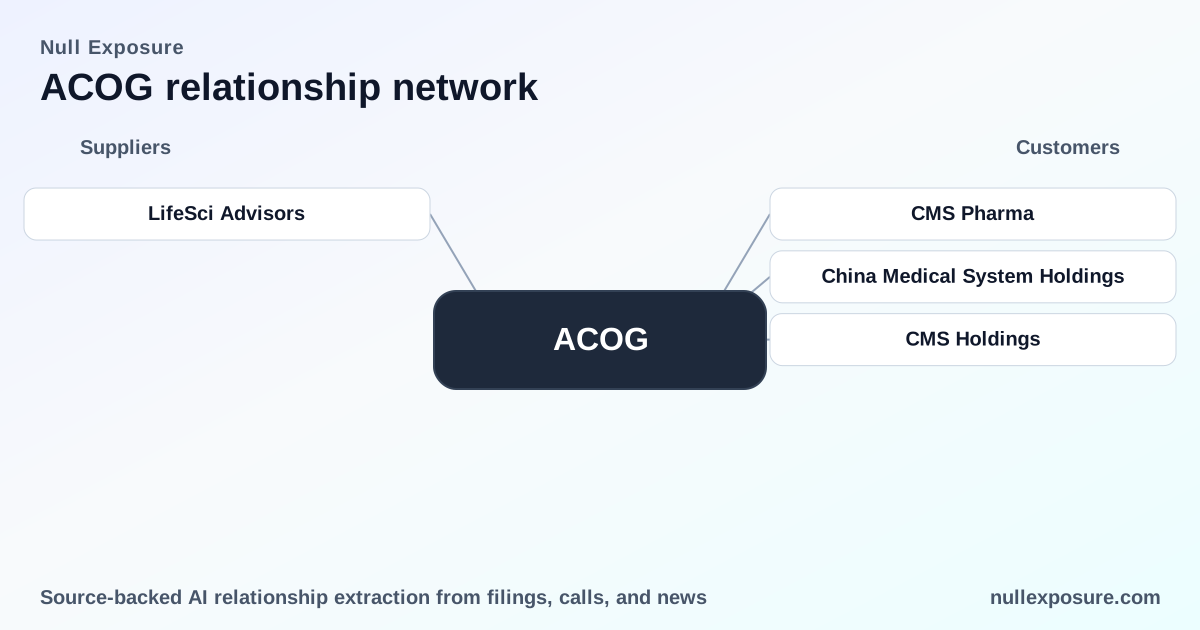
The public record in our pull lists two press items that identify LifeSci Advisors as an investor relations/press contact for Alpha Cognition; both are discrete supplier touchpoints and useful evidence of the company’s external communications strategy.
-
LifeSci Advisors is listed as the investor relations contact in Alpha Cognition’s BioSpace press release announcing the first patient enrolled in the Beacon real‑world effectiveness study, dated March 9, 2026. The release uses LifeSci Advisors for media and investor outreach, indicating an active outsourced IR arrangement. Source: BioSpace press release, March 9, 2026 — https://www.biospace.com/press-releases/alpha-cognition-announces-first-patient-enrolled-in-beacon-real-world-effectiveness-study
-
LifeSci Advisors is again recorded as the IR contact in a Yahoo Finance distribution covering an issuance of additional securities (press release language), also published March 9, 2026, demonstrating consistent use of the same external communications supplier for capital events and regulatory disclosures. Source: Yahoo Finance press release distribution, March 9, 2026 — https://finance.yahoo.com/news/alpha-cognition-announces-issuance-additional-133000180.html
Both items confirm an ongoing commercial relationship with LifeSci Advisors for investor communications; that relationship is operational (press and IR execution) rather than clinical or manufacturing in nature.
Company-level constraints and what they mean for supplier risk
Alpha Cognition’s public filing excerpts surface several constraints and recurring themes that shape supplier risk and strategy:
-
Long-term advisory contracts: The company entered a three‑year consulting services agreement with Spartan Capital Securities (Spartan) on May 30, 2023, for business development and capital-raising support. That agreement signals a deliberate strategy to outsource strategic investor-facing functions across a defined multi-year term (company filing disclosure).
-
Licensing dependence: Historical license agreements (Memogain/ALPHA-1062 in 2015; Progranulin/ALPHA-0602 in 2020) give Alpha Cognition exclusive rights to core assets, establishing IP boundaries and downstream licensing obligations rather than internal discovery as the primary IP source.
-
Geographic manufacturing concentration: The company identifies Taiwan as the site for its sole manufacturing location for a named product and uses Taiwanese CMOs for API production, with U.S. partners for finished-dose forms; clinical work has included sites in India and the Netherlands. This mix yields APAC concentration with North American and EMEA touchpoints.
-
Material and critical third parties: Filings explicitly state that certain third‑party suppliers are material and that Taiwanese manufacturing partners are critical to supply continuity; loss or noncompliance by these partners would materially and adversely affect operations.
-
Role composition: Supplier roles are heavily weighted to manufacturers and service providers (CROs, CMOs, IR/advisory); the company lacks internal manufacturing capabilities and operates in an active supplier stage where relationships are executed continuously.
These are company-level signals drawn from the firm’s regulatory disclosures and are not attributed to any single press citation unless explicitly named in the excerpt.
Investment implications: what to stress-test in diligence
For investors underwriting clinical progress or an eventual commercialization plan, supplier relationships are a live source of value and downside.
-
Stress-test supply continuity: Validate CMO capacity, alternative sources for API and finished-dose production, and inventory buffers for pivotal readouts. Taiwan-based manufacturing is a concentration that requires explicit contingency plans.
-
Validate contractual terms: Long-term advisory contracts (Spartan) and exclusive licenses create both runway and fixed obligations; analyze termination clauses, exclusivity windows, milestone commitments, and cost structures.
-
Operational control and oversight: Because CROs and CMOs execute GLP/GCP studies and critical batch production, investor diligence must confirm audit access, quality metrics, and regulatory inspection readiness.
-
Market signaling from IR relationships: Repeated use of a single IR firm for clinical and financing news indicates centralized message control — useful for consistent market access but also a potential single point of failure in investor communications.
Alpha Cognition’s current financial profile (negative EBITDA and EPS, small market capitalization and concentrated float) makes supplier continuity a near-term driver of valuation; delays or supplier noncompliance would have disproportionate impact on timelines and financing needs. Prioritize supplier contract review as part of any material investment decision.
If you want supplier-focused diligence templates and risk matrices tailored to Alpha Cognition, download our briefing at https://nullexposure.com/.
Bottom line
Alpha Cognition’s business model is explicitly outsourced: clinical execution, manufacturing and investor communications are supplier-driven and concentrated geographically and by vendor type. That structure accelerates development cost efficiency but transfers significant operational and regulatory risk to external partners. For institutional investors, the actionable steps are to (1) obtain copies of key CMO and CRO contracts, (2) verify contingency and quality clauses for Taiwan-based manufacturing, and (3) review advisory/IR agreements for fundraising implications. Supplier diligence is not optional — it is central to any thesis that hinges on timely clinical progress or near-term commercialization.
For tailored supplier risk workups and contract redline checklists, visit https://nullexposure.com/ and request a dedicated briefing.