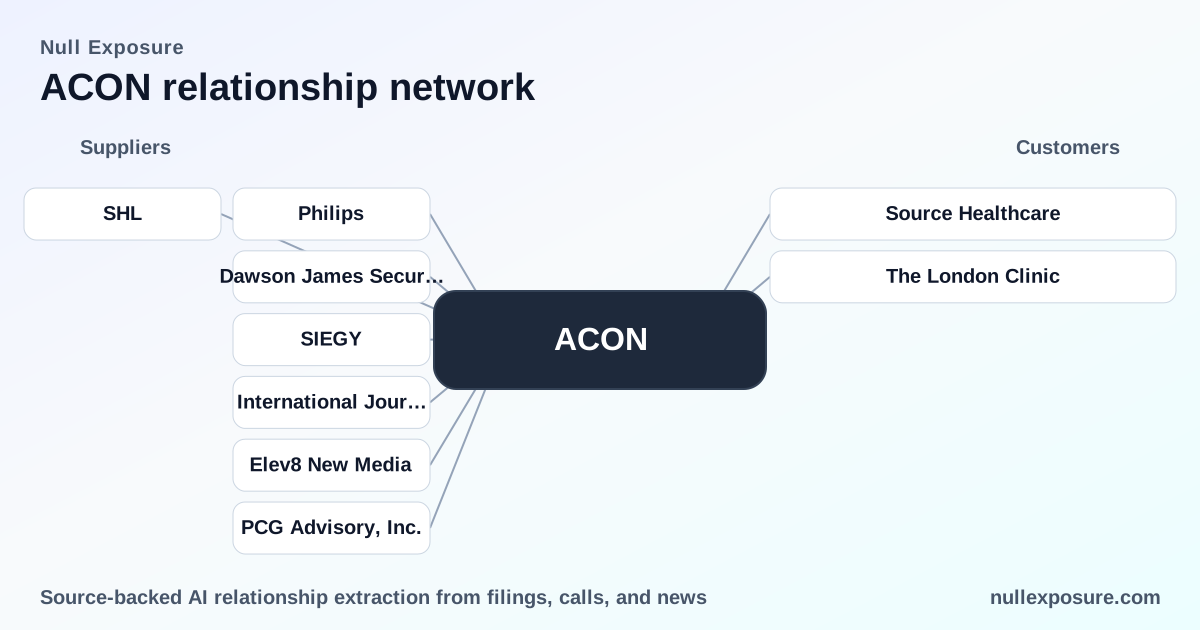
Aclarion Inc (ACON) — supplier relationships, dependencies, and investment implications
Aclarion monetizes proprietary MR post-processing software and diagnostic insights by licensing intellectual property, selling clinical services, and partnering with MR scanner vendors to embed its non‑invasive diagnostic workflows into musculoskeletal care pathways. Revenue currently rests on a narrow installed‑base strategy tied to a small number of scanner platforms, supplemented by licensing income and occasional capital raises to extend runway. For a concise, investor-focused supplier map and risk scoring, visit https://nullexposure.com/.
How Aclarion’s operating model drives cashflow and concentration risk
Aclarion’s product is software that post‑processes MR data and delivers clinical insights; the company licenses IP, sells software or service access to clinics, and relies on third‑party MR scanner operators to produce compatible data. Commercial scale depends on expanding compatibility across scanner vendors and protecting an exclusive technology license, while short-term liquidity is supported through equity placements. The company’s public filings and press releases show high operational leverage: minimal revenue today, negative operating margins, and recurring dependency on external partners for data acquisition and deployment.
Detailed relationship roll‑call (each entry from the results)
Below I cover every relationship listed in the search results, with a short plain‑English takeaway and the source used.
Philips — (FY2024 10‑K)
Aclarion’s MR post‑processing software is compatible with MRS data from certain Philips scanner models and operating configurations, making Philips an essential vendor in its compatibility set. This is documented in Aclarion’s FY2024 10‑K filing.
Dawson James Securities, Inc. — (QuiverQuant news, Mar 2026)
Dawson James acted as the exclusive placement agent for Aclarion’s $10.4 million common‑stock financing intended to strengthen the balance sheet and extend operating runway, indicating the company relies on small‑cap placement agents for capital raises. The financing and agent role were reported by QuiverQuant in March 2026.
Dawson James Securities, Inc. — (StockTitan news, Mar 2026)
A StockTitan news item repeated that Dawson James served as exclusive placement agent for the March 2026 offering, reinforcing that the company used third‑party broker‑dealer distribution for its equity raise. (StockTitan, March 2026.)
Siemens — (StockTwits interview, Mar 2026)
Aclarion’s CEO stated the company is currently in the market only with Siemens scanners, a limitation that constrains addressable market until additional vendor compatibilities are added. This comment was captured in a March 2026 StockTwits article referencing the CEO interview.
Siemens — (StockTwits AMP, Mar 2026)
A separate StockTwits AMP link reproduced the CEO’s quote that the firm is “currently in the market only with Siemens scanners,” underscoring a single‑vendor commercial footprint as of early 2026. (StockTwits, March 2026.)
International Journal of Spine Surgery (IJSS) — (Yahoo Finance press release, FY2025)
Aclarion sponsored a Tech Update article published in a special pain issue of the IJSS, signaling marketing and thought‑leadership activity to drive clinical adoption among spine practitioners. The publication and sponsorship were announced via a Yahoo Finance press release in 2025.
Dawson James Securities, Inc. — (QuiverQuant duplicate, Mar 2026)
A second QuiverQuant mention also listed Dawson James as exclusive placement agent for the same financing, further documenting the role of that firm in Aclarion’s March 2026 capital raise. (QuiverQuant, March 2026.)
Elev8 New Media — (StockTitan, Mar 2026)
Elev8 New Media is referenced as a media contact on a corporate update, indicating PR and media services are outsourced as part of investor and public communications strategy. (StockTitan, March 2026.)
PCG Advisory, Inc. — (StockTitan investor contact, Mar 2026)
PCG Advisory is listed as an investor contact, reflecting outsourced investor relations and advisory support for Aclarion’s communications and capital‑markets engagement. (StockTitan, March 2026.)
SIEMENS — (FY2024 10‑K)
Aclarion’s FY2024 10‑K explicitly notes that its MR post‑processing products are compatible with certain SIEMENS scanners and operating configurations, making Siemens a critical scanner vendor for product use. (FY2024 10‑K.)
Siemens — (Newsable / AsianetNews, Mar 2026)
A March 2026 Newsable/Asianet News report quoted the CEO reiterating that the company is currently in the market only with Siemens scanners, confirming market commentary across multiple media outlets. (Asianet News, March 2026.)
PCG Advisory, Inc. — (StockTitan duplicate, Mar 2026)
A second StockTitan entry again lists PCG Advisory as investor contact for Aclarion, reinforcing outsourced investor relations and communications arrangements. (StockTitan, March 2026.)
What the constraints tell investors about operating posture and risk
Aclarion’s constraint signals describe the company‑level contracting posture and dependency profile:
- Licensing is core to the business model. The company holds an exclusive license from the Regents of the University of California with a minimum annual royalty and a 4% earned royalty on net sales, which creates predictable outflows tied to commercialization success (license excerpts in filings).
- Supplier and partner relationships are material. Multiple excerpts in filings state that failure of third parties — licensors, vendors, MR service providers — could materially affect the business, signaling high dependency on external execution.
- Service providers are an operational backbone. Aclarion routinely engages third parties for clinical studies and MR scanning services; standard vendor performance risks (timing, quality, configuration) are embedded in the operational model.
- Concentration and criticality on Siemens are explicit. The filings and public comments make Siemens a single‑vendor commercial reality today; one filing explicitly notes that a termination of the Siemens relationship would have a material adverse effect.
Collectively these constraints show a company with early‑stage commercialization, concentrated vendor exposure, contractual licensing obligations, and reliance on outsourced clinical and PR/IR services.
Investment implications — what investors and operators should watch
Aclarion is an early‑stage digital health company with high upside if vendor compatibility and clinical adoption scale, but material execution risk because current revenue is minimal, operating margins are deeply negative, and scanner compatibility is concentrated with Siemens (and selectively Philips per the 10‑K). Capital formation is episodic and dependent on boutique placement agents (Dawson James), reinforcing funding risk until sustainable revenue growth is achieved. Key investor watch points:
- Expand scanner compatibility (Philips, GE, Canon) to materially increase addressable market and reduce vendor concentration.
- Manifest recurring commercial contracts with hospital systems or imaging service providers to convert the licensing model into predictable revenue.
- Monitor cash runway and capital‑markets activity; the March 2026 $10.4M placement underscores ongoing dilution and financing dependence.
For a practical supplier‑risk scorecard and ongoing surveillance of Aclarion’s counterparties, see https://nullexposure.com/.
Bottom line and action items
Aclarion operates at the intersection of MR imaging and software licensing with high commercial concentration and material third‑party dependencies. Investors should treat Siemens and the UC license as structural determiners of value while tracking capital raises and vendor compatibility expansion as the primary levers for de‑risking the company. For continuous, investment‑grade supplier monitoring and relationship analytics, visit https://nullexposure.com/.
For tailored research support on Aclarion’s counterparty exposure or to commission a focused supplier risk report, go to https://nullexposure.com/.