ACP-P-A: Supplier relationships that shape cashflow reliability and operational risk
ACP-P-A is a publicly traded preferred security issued by an investment company that generates returns through a diversified portfolio spanning real estate, infrastructure and other growth sectors. The firm monetizes by managing asset-level income and distributing returns to equity and preferred holders, with operational continuity dependent on a small set of service providers that handle credit ratings, transfer agent functions and distribution mechanics. For investors, the critical question is whether those service relationships are stable, concentrated, and contractually resilient enough to protect distributions and liquidity. For a deeper review of counterparties and institutional nuance, visit https://nullexposure.com/.
How ACP-P-A’s business model ties to its service suppliers
ACP-P-A sits within a closed-end investment wrapper that requires ongoing operational support beyond portfolio management: credit ratings influence cost of capital, transfer agents and custodians enable distribution mechanics, and counterparty agreements determine how cash flows are processed and delivered to holders. The preferred security’s economics are therefore indirectly but materially linked to a handful of external providers whose roles are operationally critical rather than discretionary.
- Revenue conversion depends on reliable distribution processing — interrupted paying agent or custodian functions would interrupt cash delivery.
- Funding costs and investor perception are influenced by credit ratings — a formal rating provides market-level validation that affects yield spread.
For a concise hub of analysis and continuous updates on supplier exposure, see https://nullexposure.com/.
Concrete supplier relationships you should evaluate
Below I cover every relationship returned in the supplier search, with plain-English summaries and a short citation for each.
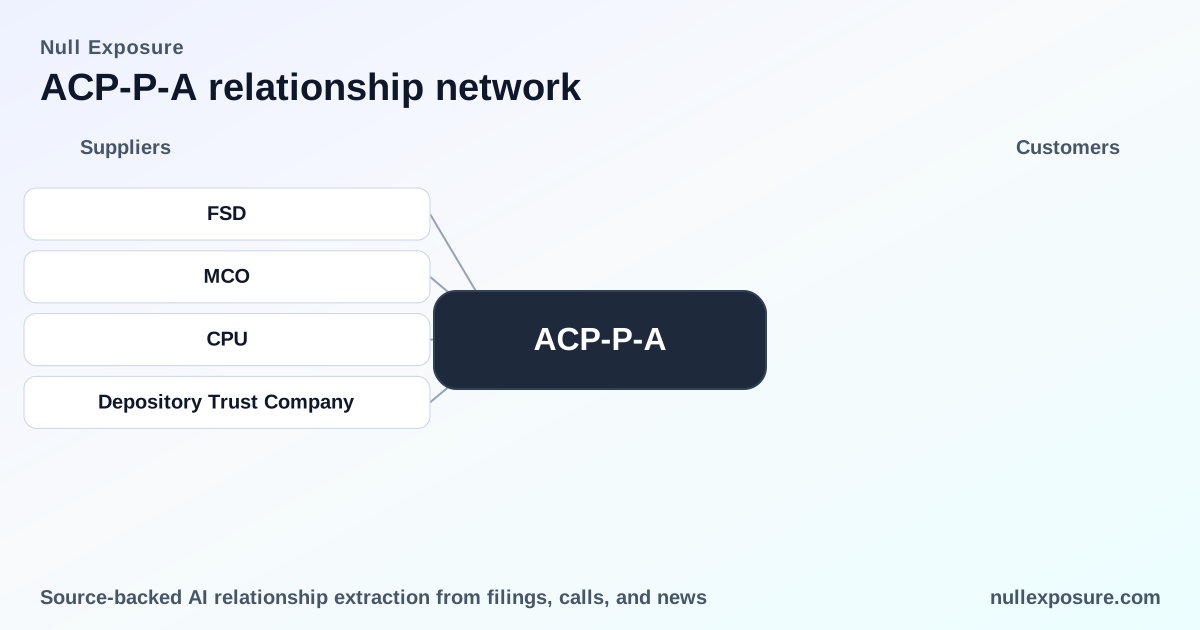
- First Trust High Income Long/Short Fund (FSD): ACP-P-A is referenced in connection with an asset acquisition from First Trust High Income Long/Short Fund; this indicates direct portfolio or transaction-level interactions that can alter asset mix and realized income. According to a FinancialContent report covering FY2024, abrdn Income Credit Strategies Fund announced an update and a tentative closing date for the acquisition of assets from First Trust’s FSD vehicle (FinancialContent, FY2024).
- Moody’s Investors Service, Inc. (MCO): The Series A mandatorily redeemable preferred shares issued by ACP are rated A2 by Moody’s, reflecting a formal credit assessment that affects pricing and investor demand. Moody’s involvement was noted in a December 19, 2025 issuer communication announcing the issuance and rating of the preferred shares (SahmCapital press release, FY2025).
- Computershare Investor Services (CPU): Computershare is being used for distribution elections and direct shareholder communications, enabling holders to elect cash or stock distributions — a core operational dependency for payout mechanics. An AccessWire distribution notice for abrdn U.S. closed-end funds described paperwork and election instructions handled through Computershare for the May 30, 2025 distribution (AccessWire, FY2025).
- Depository Trust Company (DTC): The Depository Trust Company is referenced as the mechanism through which broker-dealers must instruct cash election choices, making DTC a critical plumbing element for how fractional shares and cash elections are processed. An AccessWire statement about the same May 2025 distribution outlined DTC’s role in receiving broker/nominee instructions and coordinating cash payments (AccessWire, FY2025).
What the absence of explicit constraints signals (company-level view)
The data returned contains no explicit supplier constraints for ACP-P-A. Presenting that as a company-level signal: no contractual restrictions, termination notices, or escrow/forfeiture conditions were surfaced in the supplier feed. From an operational and commercial posture this implies:
- Contracting posture — standard institutional contracts are in place with established market providers rather than bespoke or highly restrictive supplier agreements.
- Concentration — supplier set is small but diversified across function (rating agency, transfer agent, depositary), which indicates moderate operational concentration: a handful of providers handle distinct critical tasks rather than a single vendor controlling multiple functions.
- Criticality — the identified suppliers are highly critical; a transfer agent or depositary outage directly affects distribution timing and shareholder settlement.
- Maturity — the counterparties named are large, mature institutions, signaling established processes and lower operational risk from novelty or scale limitations.
These company-level signals should be integrated into your diligence model: lack of disclosed constraints reduces informational friction, but the small number of critical suppliers increases operational dependency.
Investor implications: where to focus due diligence
- Validate the Moody’s rating and related reports to understand covenant triggers or rating drivers that could affect preferred valuation. The A2 rating is a valuation anchor; changes in rating drive yield repricing.
- Confirm continuity and SLAs with Computershare and DTC — timing and election mechanics are operationally material; request service-level descriptions and historical payment punctuality.
- Assess transaction impacts from the FSD asset acquisition on portfolio composition and income volatility; acquisition announcements can change realized yield and credit profile quickly.
Final perspective and actionable next steps
ACP-P-A’s operational health is anchored to a small set of large, conventional providers: a credit rating by Moody’s, distribution mechanics via Computershare and DTC, and portfolio activity tied to transactions such as the First Trust asset acquisition. That combination offers both stability (established counterparties) and concentration risk (few single points of failure) — a classic trade-off for closed-end structures that distribute income to preferred holders.
For investors and operators preparing engagement memos or covenant checks, prioritize document-level evidence of SLAs, rating agency reports, and recent distribution run-rates. If you want ongoing monitoring and a concise counterparty risk brief tailored to this security, start here: https://nullexposure.com/.
Bottom line: ACP-P-A’s payout reliability is less about internal portfolio strategy and more about execution by external vendors; understanding those vendors is the fastest path to assessing distribution risk. For tailored support or continuous supplier monitoring, visit https://nullexposure.com/.