ACR-P-C: Counterparty Map and What the March 2026 CLO Tells Investors
ACR-P-C functions as a preferred instrument within the ACRES Capital ecosystem, with value driven by the manager’s ability to warehouse and securitize middle‑market commercial real estate loans. The firm monetizes through externally managed asset management fees, credit spreads realized on originated loans, and capital markets execution — notably CLO issuance and structured note placement — that convert held mortgage assets into rated securities. For investors, the operational reality is simple: performance hinges on underwriting quality, access to capital markets, and the ratings/intermediary relationships that enable large CLO executions. Learn more about counterparty exposure and supplier relationships at https://nullexposure.com/.
Recent deal flow that defines the supplier map
In March 2026 ACRES executed a sizable CLO financing that crystallizes its counterparty set: the deal included rated Class A notes, explicit coupons tied to SOFR, and third‑party ratings from Moody’s and Fitch. According to a PR Newswire release on March 9, 2026, the offering included $589.7 million of Class A notes priced at SOFR+145 bps and rated Aaa(sf) by Moody’s and AAAsf by Fitch; other coverage of the transaction reports a weighted‑average cost of SOFR+168 bps across tranches. These pricing and rating dynamics are material for preferred holders because they determine issuance economics and the firm’s ongoing funding cost (PR Newswire, 9 March 2026; LongBridge coverage, March 2026).
Counterparties and service providers — line by line
-
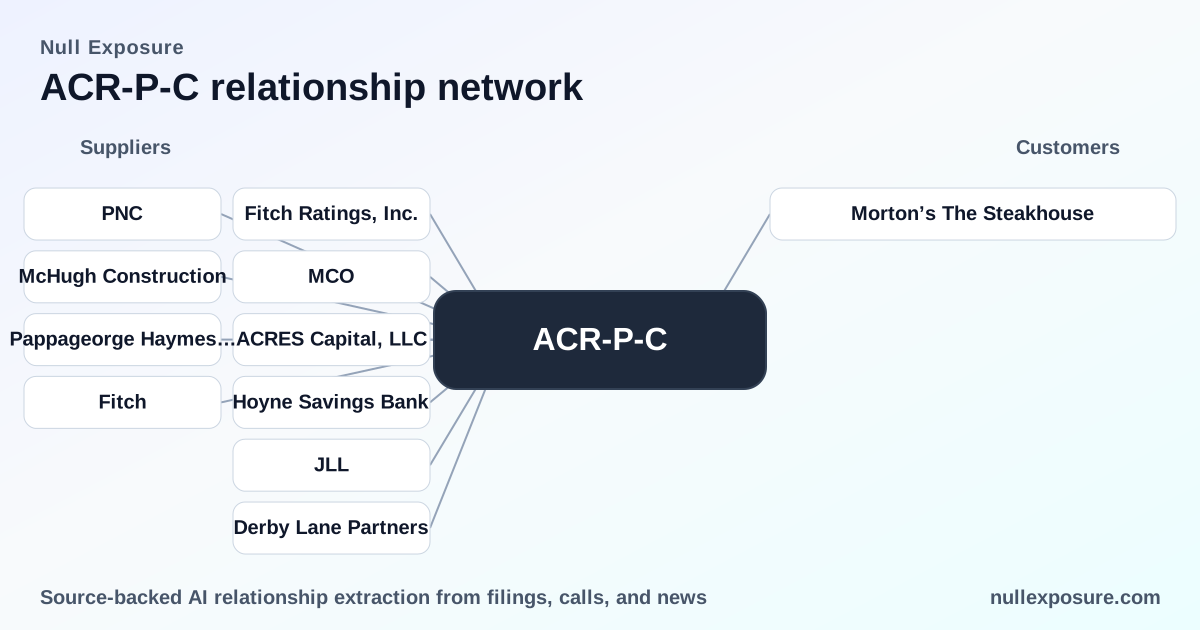
Fitch Ratings, Inc. provided a rating for the Class A notes (AAAsf). This external rating is a direct input to pricing and distribution appetite for the CLO issuance. Source: PR Newswire announcement, March 9, 2026.
-
Moody’s Investors Service, Inc. assigned an Aaa(sf) rating to the Class A notes, providing the senior credit opinion that underwrites institutional demand for the top tranche. Source: PR Newswire announcement and LongBridge coverage, March 2026.
-
ACRES Capital, LLC acts as the external manager; public filings and press releases reiterate that the company is externally managed by ACRES Capital, LLC, a subsidiary of ACRES Capital Corp., which focuses on middle‑market CRE lending and manages the originations that feed securitizations. Source: PR Newswire and StockTitan coverage, March 9, 2026.
-
Hoyne Savings Bank participated as a lender in a separate ACRES transaction financing a Chicago conversion project, providing an $11 million loan element of the capital stack. That relationship signals local bank lending exposure on specific projects within the portfolio. Source: ReBusinessOnline reporting, FY2025.
-
Derby Lane Partners furnished a $62.4 million senior loan for the Chicago office‑to‑multifamily conversion, placing it as a significant senior credit partner on that project. Source: ReBusinessOnline, FY2025.
-
JLL (Jones Lang LaSalle) acted in a placement/advisory capacity where an ACRES development team required debt placement, consistent with JLL’s capital markets role in loan distribution and structuring. Source: ReBusinessOnline, FY2025.
-
PNC Bank monetized more than $17 million in federal and state historic tax credits for a specific development, reflecting a structured tax‑credit monetization relationship that supports project economics. Source: ReBusinessOnline, FY2025.
-
McHugh Construction is the general contractor listed on the Chicago conversion project, indicating ACRES’s use of established construction partners for asset transformation and value‑add execution. Source: ReBusinessOnline, FY2025.
-
Pappageorge Haymes Partners served as the architect on the same Chicago conversion project, evidencing the use of experienced design partners on capital‑intensive redevelopment projects. Source: ReBusinessOnline, FY2025.
Each of these counterparties plays a discrete role across originations, construction, tax‑credit monetization and capital markets execution; collectively they shape financing cost, execution risk and timeline for asset conversion strategies.
What the relationship map implies about the operating model
Because constraints data is not itemized in public filings for this ticker, the following points are company‑level signals drawn from observable relationships and deal mechanics rather than specific contract excerpts:
-
Contracting posture: ACRES operates in an externally managed model, relying on ACRES Capital, LLC to originate, underwrite and package loans for securitization. That posture centralizes credit and execution control with a manager that must sustain capital‑markets relationships.
-
Concentration: Capital markets access is concentrated — a few rating agencies and institutional lenders dominate pricing (Moody’s/Fitch and lead lenders). This concentration means funding costs and distribution windows are sensitive to those relationships.
-
Criticality: Ratings and bank/placement partners are critical to liquidity. The senior tranches’ ratings determine investor demand and therefore issuance economics; construction and tax‑credit partners are operationally critical on project timelines but represent smaller slices of systemic funding risk.
-
Maturity: Use of CLOs and multi‑party capital stacks indicates a mature capital‑markets posture: the firm executes structured financings at scale and uses conventional bank lending, tax‑credit monetization, and construction outsourcing rather than in‑house construction or boutique funding.
These company‑level signals inform how investors should view cash flow durability and capital access for ACR‑linked securities.
Risk‑reward for investors and operators
-
Upside: Access to rated CLO markets provides scale and enhances liquidity, which supports a stable spread capture strategy when underwriting is conservative. Strong third‑party ratings on senior tranches reduce dislocation risk for preferred security holders.
-
Key risks: Concentration of funding relationships and ratings dependence is the single largest operational risk. A sustained change in rating agency methodology or a deterioration in placement bank appetite would materially raise funding costs and squeeze net interest margins. Project‑level execution risk (construction and development partners) is second‑order but directly affects asset performance if timelines or cost overruns occur.
For a deeper counterparty mapping and active surveillance of issuer‑supplier interactions, visit https://nullexposure.com/ to access the full supplier coverage and alerts.
Tactical next steps for allocators
- Stress test preferred cash flows under scenarios where CLO pricing widens by 50–75 bps and senior tranche placement slows; this isolates funding sensitivity.
- Monitor quarterly communications from ACRES Capital, LLC and ratings updates from Moody’s and Fitch as leading indicators of issuance capacity.
- Maintain a watchlist on bank and construction counterparties highlighted above for concentrated project exposure.
If you want continuous supplier monitoring or a tailored counterparty due‑diligence package for ACRES exposures, see our research portal at https://nullexposure.com/.
Bottom line
ACR‑P‑C’s investment case is a function of manager execution, ratings‑led funding economics, and the quality of a small network of critical counterparties. The March 2026 CLO demonstrates the firm’s ability to transact at scale with top ratings and institutional lenders, but it also crystallizes concentration risk around a handful of external agents. For active investors, the trade is between predictable distribution mechanics and the reliance on external ratings and placement partners — both of which deserve continuous scrutiny. For operational diligence and supplier tracking, visit https://nullexposure.com/ for ongoing coverage and alerts.