ACR-P-D: External management and capital-market dependence define the investment case
ACR-P-D is a listed preferred security whose economic value is driven by an externally managed issuer that sources returns through real‑estate finance and capital‑markets activity. The firm’s operating model centers on an external manager that originates and structures commercial real estate loans and CLOs, and the preferred shares monetize through contractual dividend rights over the issuer’s cash flows and capital transactions. For investors and operators evaluating supplier relationships, the critical questions are counterparty strength, financing concentration, and how management fees and capital‑markets activity flow to preferred‑class distributions.
If you are benchmarking counterparties or preparing diligence on externally managed issuers, start here: https://nullexposure.com/
How the company actually runs — what matters to investors
ACR-P-D’s economics are not driven by a standalone operating company but by a governance and capital‑markets construct where an external manager acts as the operational engine. That creates a specific set of business model characteristics investors should internalize:
- Contracting posture — externally managed structure. The company does not run its own loan origination or servicing platform internally; instead it relies on a contracted manager to source, underwrite and administer assets, which concentrates operational control outside the preferred issuer.
- Concentration and counterparty dependence. Reliance on a named external manager creates a single‑point concentration for sourcing, diligence, and risk controls; the manager’s incentives, balance sheet access, and reputational capital directly affect preferred holders’ cash flows.
- Criticality of capital‑markets activity. The issuer’s ability to issue or participate in securitizations (for example CLOs) and to access banking counterparties determines liquidity and the funding cost curve that underpins dividend coverage.
- Maturity and institutionalization. Repeated public filings and market transactions suggest an institutional relationship model rather than an ad‑hoc advisory arrangement, which is favorable for predictability of operations.
Use this company‑level signal set as the frame for supplier diligence and counterparty scoring — it is not tied to a single document but reflects the operating posture revealed across public communications.
What the market documents say about suppliers and counterparties
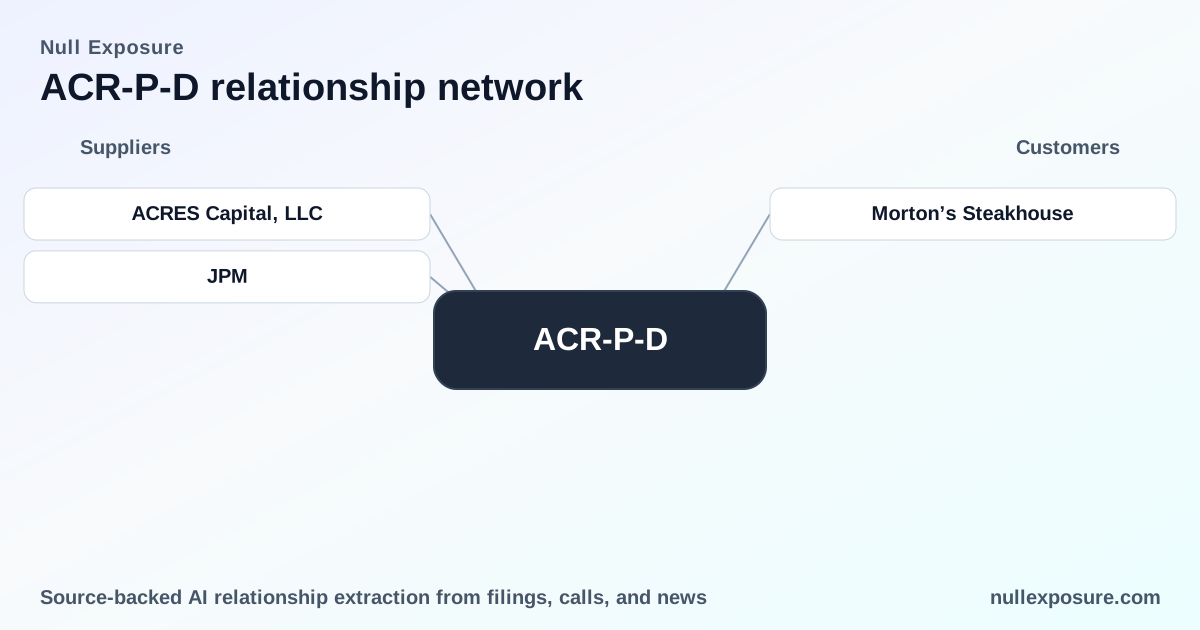
The public record available to investors highlights two counterparty relationships that drive operations and financing: ACRES Capital, LLC as the external manager, and JPMorgan as a financing counterparty.
ACRES Capital, LLC — external manager and operational lead
ACRES Capital, LLC is the external manager that operates the company’s loan origination and commercial real‑estate finance activities, focusing on middle‑market CRE verticals such as multifamily, student housing, hospitality, industrial and office assets across top U.S. markets. According to multiple press releases and market notices in FY2025–FY2026, the issuer is externally managed by ACRES Capital, LLC, and that manager is identified as the entity responsible for sourcing and administering the core loan collateral that supports the issuer’s capital structure and distributions (see Marketscreener and PR Newswire notices in late 2025–early 2026).
Source: Marketscreener and PR Newswire coverage of the issuer’s FY2025–FY2026 announcements (news items dated December 2025–March 2026).
JPMorgan — financing counterparty and capital markets trades
Institutional reporting around the issuer’s FY2026 disclosures shows that a position or portion of a previously issued financing arrangement was sold to or with JPMorgan, and that transaction is recorded as a non‑controlling interest on the issuer’s accounts. This indicates active secondary trading of financing positions and the use of large banking counterparties to execute and manage capital flows tied to loan securitizations and financing arrangements.
Source: Q4 2025 earnings call transcript coverage reported in March 2026 referencing JPMorgan activity.
(Every public mention in the filing and market press references the external manager relationship; the press cycle in Dec‑2025 through Mar‑2026 details dividends, repurchases and CLO pricing tied to the same manager.)
What those relationships mean for credit and operational risk
- Operational dependency: Because the issuer is externally managed, operational continuity depends on the manager’s people, systems and funding access rather than internal corporate resources. Prefer holders effectively take exposure to manager execution risk.
- Capital markets sensitivity: The manager’s ability to structure and place CLOs or loan sales — observed in public pricing announcements — directly affects the issuer’s liquidity and the preferred dividend coverage.
- Counterparty concentration: The appearance of large bank counterparties such as JPMorgan in financing trades introduces counterparty credit and market‑liquidity considerations that should be modeled into stress scenarios.
- Governance and fee alignment: External management structures require close review of fee schedules, incentive allocations and governance levers; misaligned fees can dilute distributable cash flow available to preferred shares.
Practical steps for investors and operators
- Conduct targeted counterparty due diligence on the external manager: review track record in middle‑market CRE, loan performance metrics, and historical securitization outcomes. For implementation support and scoring tools, visit https://nullexposure.com/
- Reconstruct the funding waterfall: map which financing transactions (CLOs, loan sales, bank facilities) support dividend coverage and identify the most sensitive funding lines.
- Stress test counterparty failure: simulate manager disruption and a bank financing pullback to quantify the preferred class’s resilience.
If you need a structured checklist for counterparty diligence or a comparative view across externally managed issuers, NullExposure’s supplier profiles provide that capability: https://nullexposure.com/
Bottom line and recommended next moves
ACR‑P‑D’s investment case is fundamentally a counterparty and capital‑markets story: preferred holders get a contractual claim on cash flows but depend on an external manager’s origination and securitization activity and on large banking counterparties for funding execution. Evaluate the strength and alignment of ACRES Capital, LLC and the issuer’s banking counterparties as primary drivers of credit and operational risk. For investor‑grade supplier profiling and next‑level diligence templates, go to https://nullexposure.com/
Key takeaway: prioritize manager resilience, fee alignment, and financing runway when sizing risk and yield for ACR‑P‑D.