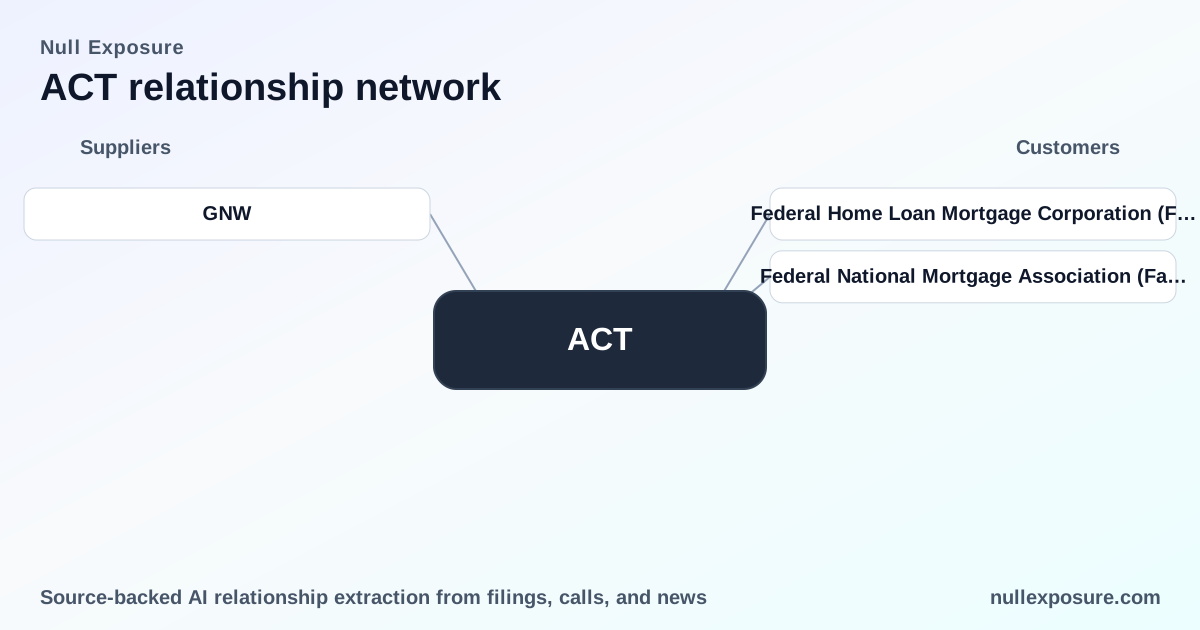
Enact Holdings (ACT): supplier relationships, what they mean for investors
Enact Holdings Inc (ACT) is a specialized mortgage insurer that earns premium income by underwriting borrower defaults on U.S. mortgage loans and manages risk through reinsurance, capital markets, and retained underwriting gains. The company monetizes through recurring insurance premiums, investment returns on capital, and structured reinsurance arrangements that optimize capital efficiency; Enact’s financial profile (FY figures show roughly $1.24B revenue and a market capitalization near $5.9B) underpins a capital‑intensive but high-margin business. For investors and operations managers, the supplier footprint—particularly arrangements with legacy Genworth entities—is a direct lever on operating continuity, cost structure, and counterparty concentration. Learn more about supplier signals and relationship analytics at https://nullexposure.com/.
A short business model primer for investors
Enact sells private mortgage insurance to lenders who need to reduce capital requirements on higher‑risk first‑time and moderate‑down‑payment borrowers, collecting premiums and retaining exposure to loss severities that it hedges through long‑dated reinsurance treaties and capital‑market instruments. The firm also uses shared services arrangements and vendor outsourcing for functions like investment management, IT and administrative support to keep fixed costs scalable. Given reported profitability and modest valuation multiples (trailing P/E ~9.0), the operating model emphasizes capital leverage and cost discipline as core value drivers.
Key takeaway: Enact’s economics are driven by premium scale, reinsurance terms that expand underwriting capacity, and a small set of outsourcers that provide operational leverage and concentration risk. Visit https://nullexposure.com/ for supplier risk profiles and dynamic relationship mapping.
What the supplier relationships in public signals actually are
Below I cover every supplier relationship surfaced in the available results and summarize the practical implications for investors and operators.
- Genworth Financial, Inc.
- Enact executed a stock repurchase program tied to a purchase arrangement with Genworth Financial that authorized Enact to buy back up to $500 million of its common shares; this arrangement was reported in a community update referenced on March 9, 2026. The repurchase agreement links Enact’s capital allocation decisions directly to a counterparty relationship with a legacy Genworth entity, which is material for liquidity planning and share‑count mechanics. According to a Simply Wall St community note dated March 9, 2026, the $500 million repurchase agreement was recorded as a key development.
- Genworth Holdings, Inc.
- A Form 4 filing reposted by StockTitan states that certain insider sales were effected pursuant to a Share Repurchase Agreement entered into between Enact and Genworth Holdings, Inc. dated February 2, 2026. The SEC filing language confirms that Genworth Holdings is an active contracting counterparty in the repurchase transaction and, separately, in shared services described elsewhere in Enact disclosures (Form 4 via StockTitan, filing posted March 2026).
Both results reference Genworth‑related entities performing dual roles: capital counterparty for a sizable repurchase program and a provider of corporate shared services. The two items in the public signals are distinct filings/announcements but collectively point to significant operational and capital ties to Genworth legacy organizations.
Supplier constraints and what they signal about Enact’s operating posture
Company disclosures and extracted constraint excerpts paint a coherent picture of Enact’s supplier stance:
- Contracting posture — long‑term orientation. Enact’s reinsurance treaties are written for ten years or more and include unilateral commutation mechanics subject to performance triggers; that structure signals multi‑year capital commitments rather than short, transactional reinsurance. A June 30, 2022 credit facility with a five‑year tenor (maturing in June 2027) demonstrates a blend of long‑term reinsurance plus medium‑term financing instruments.
- Service provider dependence and concentration. Enact explicitly depends on third‑party servicers and vendors for premium reporting, delinquency monitoring, and mitigation, and a Shared Services Agreement with Genworth furnishes investment management, IT, HR and administrative services. The Genworth tie is an explicit concentration risk because it covers critical corporate functions.
- Segment focus — services orientation. The company relies on third‑party vendors for unique or cost‑efficient services and uses their risk controls as an input to Enact’s operational risk profile. That makes vendor governance a core control point rather than a peripheral cost item.
Investor implication: long reinsurance tenors increase underwriting capacity and predictability of loss sharing, but they also lock in counterparty exposure; heavy reliance on a small set of corporate service providers raises operational risk and potential single‑point failure concerns.
Operational and financial implications — what to watch next
Enact’s supplier posture creates a few concrete monitoring items for investors and operators:
- Credit and counterparty risk around the Genworth arrangements given their role in both capital transactions and shared services.
- Renewal triggers and commutation provisions in long‑dated reinsurance treaties, which will determine how fast Enact can pivot underwriting capacity in a changing housing cycle.
- Maturity profile of financing (e.g., the revolving facility maturing in mid‑2027) and the company’s free‑cash‑flow cadence, especially while executing a sizable repurchase program tied to external counterparties.
A short list of operational watchpoints:
- Confirm the operational redundancy plan if the Shared Services Agreement with Genworth changes.
- Review treaty commutation triggers and reinsurance concentration statistics at each earnings cycle.
- Monitor liquidity and covenant footing relative to the $500M repurchase authorization.
Relationship-by-relationship recap (concise)
Genworth Financial, Inc. — The publicly reported development shows Enact entered a share repurchase agreement allowing repurchases up to $500 million, linking balance‑sheet actions to a Genworth counterparty (community update reported March 9, 2026 on Simply Wall St). This is material to capital allocation and counterparty exposure.
Genworth Holdings, Inc. — A Form 4 filing notes that insider sales were effected pursuant to a Share Repurchase Agreement dated February 2, 2026 between Enact and Genworth Holdings, confirming Genworth Holdings’ contractual role in the repurchase mechanism (SEC Form 4 reposted by StockTitan, March 2026).
Bottom line and recommended next steps
Enact runs a capital‑efficient mortgage insurance model supported by long‑tenor reinsurance, selective outsourcing, and explicit Genworth ties that affect both capital deployment and day‑to‑day operations. The combination of high margin economics and concentrated supplier services/capital counterparties is a classic trade‑off: attractive returns in steady markets, elevated vendor/counterparty risk in stressed environments.
For investors and operational leaders: validate fallback plans for shared services, scrutinize reinsurance commutation mechanics at renewal, and track repurchase activity against liquidity and covenant metrics. For structured visibility into supplier risk and counterparty concentration, review the supplier intelligence options at https://nullexposure.com/.
If you want a tailored supplier risk brief for Enact (ACT) focused on counterparty heat maps and contractual exposure windows, start a request at https://nullexposure.com/ and get a prioritized action plan for investor due diligence.