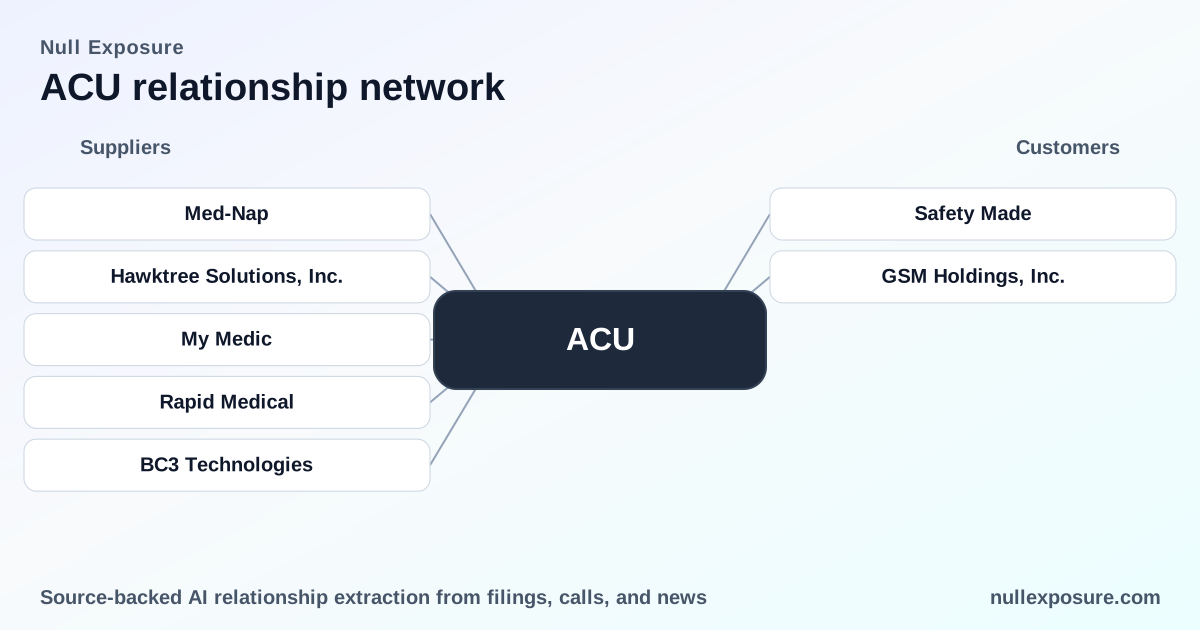
Acme United (ACU): Supplier relationships, M&A moves and what they mean for investors
Acme United monetizes a broad portfolio of cutting, measuring, first‑aid, sharpening and safety products sold into school, office, hardware, sporting goods and industrial channels across North America, Europe and Asia. Revenue derives from packaged product sales, targeted acquisitions that expand proprietary first‑aid inventory and distribution, and selective investment in manufacturing capacity to internalize critical components of the first‑aid value chain. For investors, the company’s supplier posture is a hybrid of outsourced production in Asia and Europe with strategic onshore acquisitions and manufacturing investments that raise gross margin control and product differentiation.
Learn more about supplier intelligence and relationship monitoring at https://nullexposure.com/.
How Acme structures supply and procurement — the practical constraints investors should price in
Acme’s operating model shows geographic diversification of sourcing combined with incremental vertical integration through acquisitions and plant investments. Public disclosures and recent filings signal three persistent characteristics:
- Global sourcing backbone with APAC and EMEA exposure. Company commentary notes most products are sourced outside the U.S., with suppliers located in Asia and Europe alongside U.S. partners — a classic low‑cost manufacturing posture that benefits margins but increases exposure to trade and logistics volatility. (Company sourcing disclosures, FY2024–FY2025.)
- North American strategic consolidation. Acquisitions and asset purchases are used to bring emergency and first‑aid components onshore and into owned brands, improving supply visibility and distribution leverage in the U.S. (Acquisition announcements FY2024–FY2026; company commentary on Elite First Aid acquisition.) The company specifically acquired assets of Elite First Aid (Wake Forest, NC), underlining a focus on domestic supply and tactical medical product capabilities.
- Moderate spend scale for certain operating items. Operating lease cost disclosure ($1.7 million in 2024) implies some mid‑range capital and facility commitments rather than heavy fixed‑asset intensity, consistent with a supplier footprint that blends owned plants with outsourced manufacturing. (Operating lease cost disclosure, 2024.)
From a contracting and maturity standpoint, Acme operates as a buyer leveraging external suppliers for commodity components while selectively buying assets to internalize higher‑value, brand‑differentiated first‑aid products. That posture reduces cost but creates concentration and logistic risk where APAC suppliers supply packaged consumer goods. These are company‑level signals to price into scenario analysis when modeling margin variability and working capital risk.
Direct supplier and partnership relationships that matter
Below are every supplier and partner relationship disclosed in the review set, summarized with source context and timing.
Med‑Nap — onshore production investment
Acme continues to invest in advanced production equipment at its Med‑Nap facility in Brooksville, Florida to produce medical‑grade alcohol prep pads, antiseptic wipes and components for first‑aid kits, indicating a push to internalize critical consumables. This was disclosed during the 2025 Q4 earnings call. (2025 Q4 earnings call; first seen March 2026.)
Hawktree Solutions, Inc. — small asset bolt‑on
Acme acquired the assets of Hawktree Solutions for approximately $1 million, a low‑cost asset purchase that expands product or capability sets in the first‑aid portfolio without major capital outlay. The transaction was reported in FY2025 coverage. (Simply Wall St summary, FY2025.)
My Medic — asset purchase to expand emergency portfolio
Acme entered into an Asset Purchase Agreement to acquire substantially all assets of My Medic, a move designed to broaden its emergency and first‑aid product offering and capture branded share in tactical/consumer first‑aid categories. The announcement appeared in FY2026 reporting. (TradingView news summary, FY2026.)
Rapid Medical — paired asset acquisition
Acme simultaneously agreed to acquire substantially all assets of Rapid Medical alongside My Medic, consolidating additional emergency medical inventory and distribution rights under Acme’s First Aid Only brand and accelerating product breadth. The action was disclosed in the same FY2026 notice as the My Medic agreement. (TradingView news summary, FY2026.)
BC3 Technologies — distribution partnership for hemostatic spray
BC3 Technologies announced that its SEAL Hemostatic Spray will be distributed by First Aid Only, an Acme United brand, giving Acme access to an advanced hemostatic product and strengthening its trauma management offerings in the market. This distribution arrangement was reported in FY2024 coverage. (CityBiz news, FY2024.)
What these relationships mean for valuation, operations and risk
Acme’s combination of targeted acquisitions (Hawktree, My Medic, Rapid Medical) and manufacturing investment (Med‑Nap) delivers a clear playbook: buy niche product sets and bring high‑value components in‑house to protect margins and channel placement. That approach produces several investable consequences:
- Margin upside plus integration costs. Asset purchases are small relative to revenue but increase gross margin potential over time as Acme leverages scale and cross‑sells products through First Aid Only; investors should expect near‑term integration costs with mid‑term margin accretion.
- Supply diversification with concentrated risks. APAC and EMEA sourcing offers cost advantages but creates exposure to freight and tariffs; the company’s U.S. acquisitions are corrective moves that reduce single‑market dependency and improve criticality control for first‑aid consumables.
- Contracting posture is opportunistic and asset‑focused. Rather than long‑term global verticals, Acme shows a preference for bolt‑on buys and selective capex, which lowers fixed operating leverage but raises the importance of effective M&A integration and distribution execution.
- Operational significance for procurement teams. Procurement must manage multi‑regional supplier relationships, onshore manufacturing ramp (Med‑Nap) and newly acquired inventory assimilation — all factors that affect working capital and inventory turnover assumptions in models.
For a deeper, relationship‑driven view of supplier exposure and acquisition impact, visit https://nullexposure.com/ — the homepage contains tools and research tailored to investors monitoring supplier concentration and M&A sourcing risk.
Bottom line and calls to action
Acme United is executing a pragmatic mix of global sourcing for cost efficiency and selective vertical integration to own differentiated first‑aid products and distribution channels. The company’s recent asset purchases and onshore manufacturing investments increase control over higher‑value items while leaving commodity sourcing exposed to APAC and EMEA supply chains. Investors should model modest near‑term integration costs and potential mid‑cycle margin improvement, but also incorporate trade and logistics volatility into downside scenarios.
For portfolio managers and procurement strategists looking to benchmark supplier relationships and M&A impact, explore additional research and supplier mapping at https://nullexposure.com/.
Concluding: the supplier signals and disclosed deals position Acme United as a nimble consolidator in the first‑aid niche with a diversified production footprint; the company’s success depends on execution of integration, the pace of domestic manufacturing scale‑up, and resilience of its Asia/Europe supply lines. Stay informed at https://nullexposure.com/.