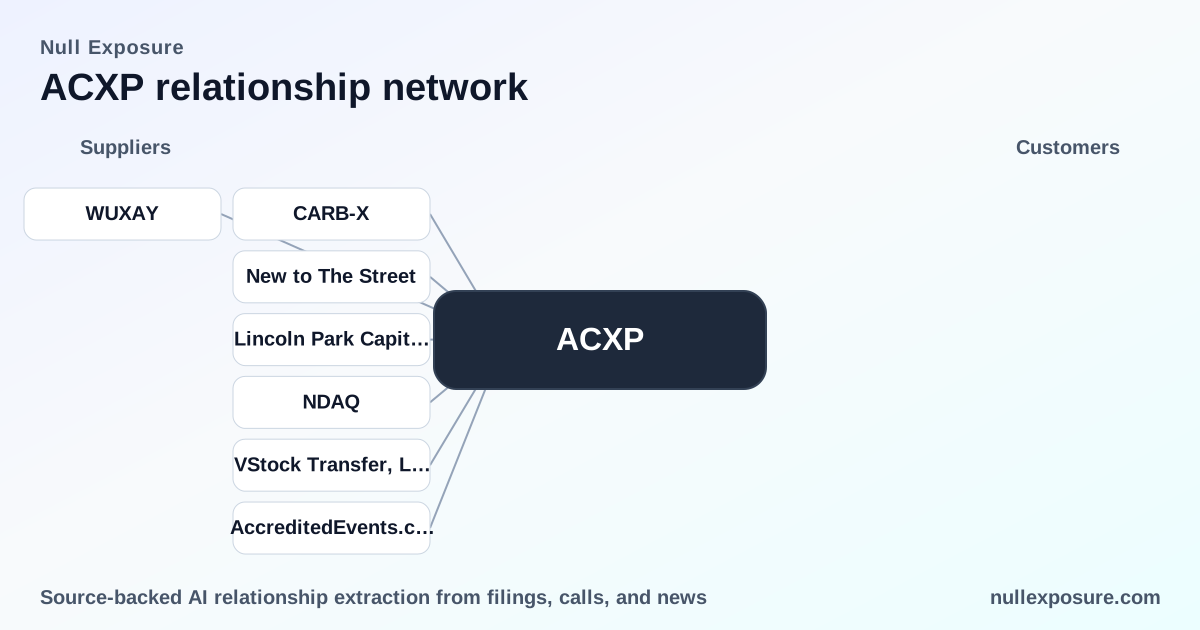
Acurx Pharmaceuticals (ACXP): what suppliers and service partners reveal about risk, runway and commercial readiness
Acurx Pharmaceuticals operates as a clinical-stage antibiotic developer that leverages third-party scientific collaborators, contract manufacturers and investor-facing media partners to advance ibezapolstat and other DNA Pol IIIC inhibitors toward commercialization. The company monetizes by progressing candidates through clinical milestones to licensing or product sales, while funding operations through a mix of non‑dilutive grants, at‑the‑market offerings, equity lines, and targeted investor marketing.
For investors and operators assessing supplier exposure, the signal set shows a small-cap biotech with active outsourced manufacturing and clinical services, concentrated R&D spend, short-term commercial/IR contracts, and an explicit playbook to supplement cash through equity programs and media partnerships. Learn more about supplier risk scoring and sourcing intelligence at https://nullexposure.com/.
How Acurx runs its external relationships — the operating picture, up front
Acurx is not vertically integrated: the company relies on contract research organizations, contract manufacturing organizations, and media/IR vendors to fill critical operational roles. The company’s contracting posture skews short‑term for marketing and IR engagements but includes framework agreements for clinical services and a standing ATM / equity line to access capital. This hybrid model creates operational flexibility but concentrates execution risk with a handful of third parties and APAC manufacturers that supply clinical‑stage materials.
- Short contractual tenors dominate for investor relations and media vendors, often six to twelve months and recognized as stock‑based compensation.
- Framework agreements exist for clinical services and capital markets access (e.g., master clinical services and ATM / equity line programs).
- Manufacturing is outsourced and APAC‑heavy, with specific reliance on Indian CMO capacity for drug substance and product.
If you manage counterparty risk for a portfolio company, this profile signals active monitoring of supplier performance and cash management is required. For deeper supplier intelligence on ACXP, visit https://nullexposure.com/.
Supplier and partner roster — everything the sources show
Below I list every relationship surfaced in the collected results, with a concise description and source reference for each.
CARB‑X
Acurx referenced a potential CARB‑X grant as a non‑dilutive financing catalyst that would provide meaningful near‑term value to shareholders (the company quoted an approximate $1 per share value if approved). Source: Acurx earnings call transcript cited on InsiderMonkey, March 2026 (discussion of CARB‑X grant).
New to The Street
Acurx re‑signed a comprehensive media partnership with New to The Street to run long‑form televised interviews, national TV commercials and online campaigns aimed at investor outreach and visibility. This is an active marketing and IR relationship used to amplify corporate messaging. Source: company press releases syndicated on Newswire and multiple local press outlets, FY2025–FY2026.
AccreditedEvents.com
As part of the expanded media/IR program, Acurx will participate in AccreditedEvents.com investor forums, providing access to qualified and accredited investors through in‑person and virtual events. This is positioned as a targeted capital markets engagement channel. Source: press materials published to News‑JournalOnline and AccessNewsWire, FY2025.
Lincoln Park Capital
Acurx established an equity line with Lincoln Park Capital for up to $12 million, creating committed capital capacity to sell shares over time and support liquidity. This relationship is primarily financial/capital markets in nature rather than operational. Source: media coverage of the equity line referenced on TS2/PRNewswire summaries, FY2025.
The Nasdaq Capital Market (Nasdaq)
Acurx transferred its common stock to the Nasdaq Capital Market with a CUSIP adjustment and split‑adjusted trading under the existing ticker ACXP, a corporate action that impacts share administration and market access. Source: stock listing note reported on StockTitan, referencing Nasdaq action, FY2025.
VStock Transfer, LLC
VStock Transfer serves as Acurx’s transfer agent, handling conversion of physical certificates to book‑entry form and processing cash payments in lieu of fractional shares following corporate actions. This is an administrative securities‑services relationship. Source: StockTitan report describing transfer agent instructions to shareholders, FY2025.
WuXi AppTec
Acurx works with WuXi AppTec for medicinal chemistry, biology and pharmacology support to accelerate structure‑activity relationships and drive discovery of additional DNA Pol IIIC inhibitors, signaling an active scientific collaboration for preclinical development. Source: Nature coverage describing WuXi AppTec’s role in Acurx scientific collaborations, FY2021.
What the constraints tell investors and operators about exposure
The corpus of constraint excerpts reads as a compact operating model statement rather than isolated facts. Key company‑level signals:
- Contracting posture: short‑term for marketing/IR; active but framework agreements for clinical services. Multiple vendor arrangements (4–12 month terms) are common for investor relations and media; conversely, a Master Clinical Services Agreement and an ATM/sales agreement establish longer‑running frameworks for trial operations and capital access (evidence in company filings).
- Manufacturing concentration and APAC sourcing are real execution risks. The company sources drug substance and product primarily from Indian sites and acknowledges dependence on CMOs for commercial supply; this raises supply continuity and cost exposure for scale‑up.
- Service provider heavy: clinical, CROs, and CMOs are critical. The business model depends on third‑party CROs/CRO services for trial conduct and third‑party manufacturers for materials and product—this is core to Acurx’s delivery model.
- Material spend concentration exists in R&D. Filings show a small number of vendors accounting for a large share of R&D expense (one vendor ~63% in 2023; two vendors ~35% in 2024), creating outsized operational leverage to single points of failure.
- Capital management is proactive and market‑facing. The ATM offering and Lincoln Park equity line provide clearly defined paths to raise capital through the public market as trials progress.
- Named counterparties in filings include Syneos Health (clinical services framework) and Piramal (CMO in India). These relationships are explicitly cited in public disclosures as part of the company’s vendor ecosystem.
These constraints collectively imply moderate operational concentration with high strategic criticality of a small number of suppliers; governance and contingency planning should focus on manufacturing redundancy and vendor performance metrics.
For vendor benchmarking and supplier risk dashboards tailored to ACXP, see https://nullexposure.com/.
Investment implications and recommended monitoring
- Operational risk: Relying on a few CMOs in APAC amplifies supply and timeline risk—monitor lot release, stability data, and dual‑sourcing plans.
- Funding tail: The Lincoln Park equity line and ATM program reduce immediate cash cliff risk but require market access; track share issuance cadence and dilution impacts.
- Market perception: Active paid media and AccreditedEvents participation shift the company toward a market‑facing funding cadence; quantify spend versus capital raised to assess ROI.
If you are evaluating ACXP as a portfolio holding or a supplier counterparty, prioritize auditability of manufacturing quality, contractual termination rights, and clarity on grant outcomes (CARB‑X) that change non‑dilutive capital assumptions.
For a bespoke supplier risk brief on Acurx and a prioritized remediation roadmap, visit https://nullexposure.com/ to request a tailored report.
Acurx’s roadmap to commercialization rests on external execution: successful trials, uninterrupted CMO supply, and disciplined capital deployment will determine whether these supplier relationships are strategic assets or concentration liabilities.