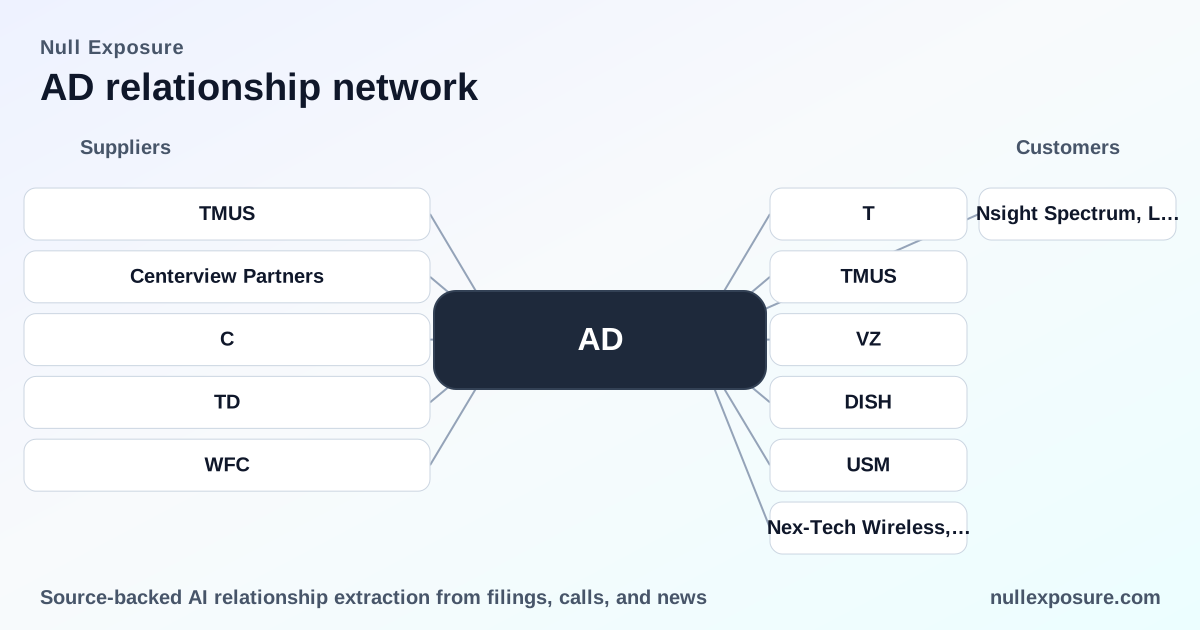
Array Digital Infrastructure (AD): Supplier relationships that shape cash flow and capital allocation
Array Digital Infrastructure operates a portfolio of wireless infrastructure and spectrum assets and monetizes through long-term lease agreements with mobile operators, asset sales and financing arrangements that convert spectrum and tower economics into distributable cash. The company's business model is driven by contract-backed recurring cash flows from wireless carriers, opportunistic spectrum monetization and active capital markets engagement to recycle capital into shareholder distributions. For investors evaluating supplier exposure, the network of financial advisors, lenders and anchor tenants defines both growth optionality and execution risk. Learn more about how we map supplier relationships at https://nullexposure.com/.
Quick company snapshot for investors
Array reported TTM revenue of $162.96 million and a market capitalization around $4.16 billion. Profitability metrics show positive net margins (29.9%) but negative EBITDA on the disclosed figure, reflecting the capital-intensive and timing-sensitive nature of spectrum transactions. Valuation multiples (EV/Revenue ~32.2) reflect a premium assigned to recurring carrier cash flows and valuable spectrum inventory.
How suppliers and advisors move the P&L — relationship-by-relationship
T-Mobile (TMUS)
Array stated on its 2025 Q2 earnings call that an MLA with T-Mobile will significantly strengthen the tower business with substantial increases in long‑term revenue and profitability, indicating T‑Mobile is a material tenant/customer driving recurring cash flows. This is sourced from Array’s 2025 Q2 earnings call commentary (first reported March 2026).
Centerview Partners
Centerview provided advisory support on a major spectrum sale and subsequent capital return transaction, acting as a key adviser alongside other investment banks to ensure deal execution and shape post‑sale strategy. A news report covering the FY2026 spectrum sale and special dividend mentions Centerview Partners as an advisor (Intellectia/press coverage, March 2026).
Citigroup Global Markets (C)
Citigroup Global Markets served as the lead financial advisor on the company’s FY2026 spectrum sale and the special dividend plan, positioning the bank at the center of capital markets execution and valuation negotiation. This is documented in press coverage of Array’s FY2026 transaction (Intellectia/press coverage, March 2026).
TD Securities / Toronto Dominion LLC (TD)
TD Securities participated as an advisor on the FY2026 spectrum sale, and a separate Marketscreener item references Array entering a fifth amendment to its credit agreement with Toronto Dominion LLC, signaling TD’s dual role as adviser and lending counterparty. The advisory role is recorded in transaction press coverage (Intellectia, March 2026); the credit agreement amendment is reported via MarketScreener (March 2026).
Wells Fargo (WFC)
Wells Fargo acted as an advising bank on the FY2026 spectrum sale and related special dividend program, contributing to the transaction’s financing and syndication structure. This role is noted in the FY2026 transaction reporting (Intellectia/press coverage, March 2026).
What the constraints tell investors about Array’s operating model
The extracted contract and procurement evidence in filings highlights several company-level operational characteristics:
- Contracting posture — licensing and framework agreements are prominent. Company filings reference multiple license purchase agreements and software license and maintenance contracts, signaling that Array’s operations rely on a mix of asset sale/license agreements and longer‑form framework arrangements for service delivery and systems support.
- Role diversity — Array behaves simultaneously as buyer and service purchaser. Filings describe commitments for device purchases, software licensing and third‑party service providers, which indicates a procurement posture that combines large-capital purchases with outsourced operations for fulfillment and systems.
- Segment exposure — services and software form a non-trivial part of cost structure. Evidence of managed services statements of work and software licensing suggests recurring operating costs are embedded in services/software contracts rather than purely capital expenditures.
- Concentration and criticality — carrier counterparties and financial advisors are strategically critical. The prominence of large carriers and tier‑one banks in disclosed transactions implies high counterparty concentration on a small set of counterparties whose decisions materially affect Array’s revenue and capital outcomes.
- Maturity of relationships — long-term license and master service agreements point to durable, contract-backed cash flows. Multiple references to master service agreements and license purchase agreements indicate contractual horizons that support long-range revenue visibility.
These constraints are company-level signals drawn from Array’s filings and transaction notices; they establish an operating model where contract terms, counterparty credit and capital markets execution are the primary drivers of value realization.
Investment implications and the practical risk map
Array’s supplier and advisor network creates a predictable cash engine while exposing the company to execution and counterparty concentration risks.
- Upside drivers: Long-term MLAs with national carriers like T‑Mobile drive durable revenue uplifts and justify premium valuation multiples when combined with opportunistic spectrum monetization. Advisory relationships with Citigroup, Centerview, TD Securities and Wells Fargo materially reduce execution risk on complex transactions.
- Key risks: Heavy reliance on a few counterparties and on large one-off spectrum transactions concentrates execution risk and timing of distributable cash. Service and software contracts create recurring cost obligations that can compress free cash flow when transaction timing slips.
If you want a systematic supplier-risk view tied to capital allocation outcomes, start here: https://nullexposure.com/.
Tactical takeaways for operators and investors
- Treat carrier MLAs as the core cash engine; underwrite valuations to the contractual rent-roll and counterparty credit rather than to episodic spectrum sales.
- Stress-test capital return plans against scenarios where advisory execution or credit amendment timelines lengthen; the credit amendment with Toronto Dominion underlines that financing flexibility is actively managed.
- Monitor banking/advisory relationships post-transaction—availability and cost of capital from lead advisors determine how much spectrum proceeds convert into shareholder distributions versus reinvestment.
For more granular supplier mapping and to track relationship changes in real time, visit our research hub: https://nullexposure.com/.
Bottom line
Array’s supplier ecosystem blends carrier tenancy (revenue), advisory banks (execution) and lender relationships (financing) into a capital-recycling model that has delivered material special distributions while preserving a recurring core business. Investors should value Array on a dual axis: the durability of carrier MLAs and the firm’s demonstrated ability to monetize spectrum through high-quality advisory and financing partners. For decision-ready supplier intelligence and model inputs, explore our platform at https://nullexposure.com/.