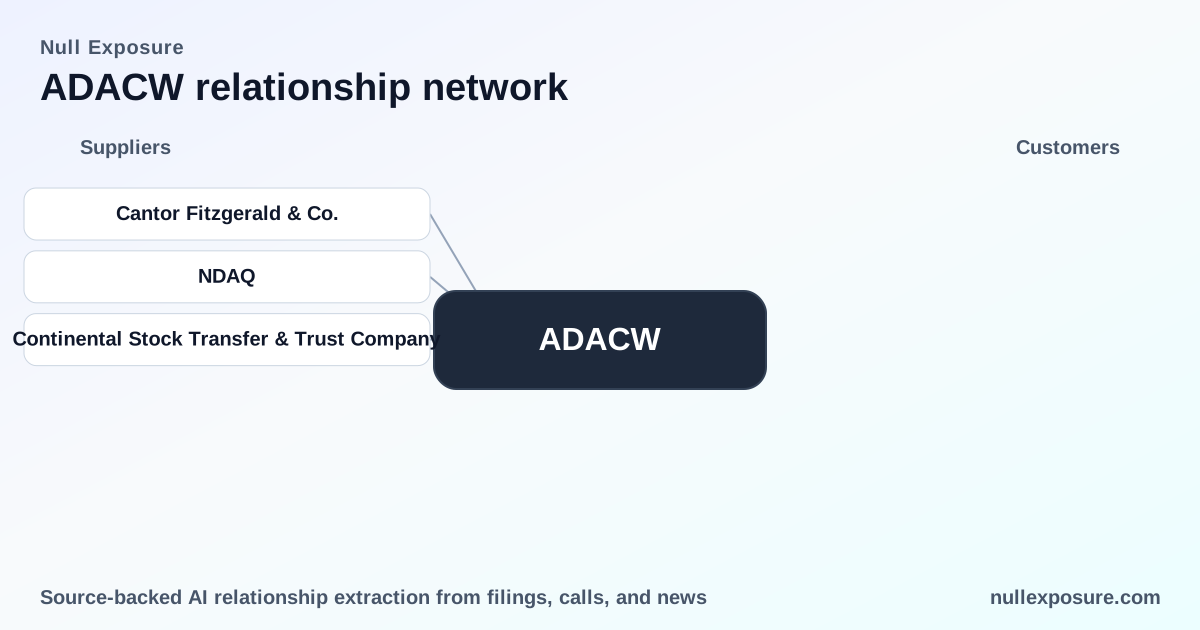
ADACW: What investors need to know about the warrant’s third‑party relationships
Thesis: ADACW is a SPAC warrant instrument that derives value from a successful business combination and secondary market trading, not from ongoing operating cash flow. The commercial posture is transactional — the warrant’s economics are driven by underwriting and listing execution, transfer agent mechanics, and market liquidity around a targeted technology/media/telecom acquisition. For investors and counterparties evaluating supplier risk, the most relevant relationships are the book‑running manager (underwriting), the exchange listing, and the transfer agent that handles separations and recordkeeping. For actionable background and counterparty checks, see https://nullexposure.com/.
The short take: structural drivers and what to watch
ADACW’s value proposition is binary and event‑driven: either a value‑creating merger unlocks upside for warrant holders, or the instrument reverts to its residual trading value. That dynamic concentrates commercial importance in a small set of service providers: the underwriter who prices and distributes the offering, the exchange that provides market liquidity and listing rules, and the transfer agent that enables unit separations and shareholder mechanics. These relationships are operationally limited in number but strategically critical at discrete moments — IPO pricing, listing, and post‑separation trading. For deeper supplier risk analysis and monitoring tools, visit https://nullexposure.com/.
Who ADACW works with and why it matters
Cantor Fitzgerald & Co.
Cantor Fitzgerald is acting as the sole book‑running manager for ADACW’s offering, which places them at the center of pricing, distribution, and investor placement for any primary capital event. According to a StockTitan news item in March 2026, Cantor Fitzgerald was named sole book‑running manager for the offering, and a MEXC news release in the same period corroborates Cantor’s lead role in underwriting execution. — StockTitan (Mar 2026); MEXC (Mar 2026).
Nasdaq (listing venue)
The Ordinary Shares and Warrants are listed on the Nasdaq Global Market under the symbols ADAC and ADACW, which establishes the trading venue and rulebook that govern marketability and disclosure obligations. The MEXC release in March 2026 states that the separated Ordinary Shares and Warrants will trade on Nasdaq under those tickers, anchoring liquidity and institutional access. — MEXC news release (Mar 2026).
Continental Stock Transfer & Trust Company (transfer agent)
Continental Stock Transfer & Trust Company is the transfer agent responsible for unit separations and recordkeeping, which is operationally critical for holders who need to split Units into Ordinary Shares and Warrants for trading. The MEXC announcement instructs brokers to contact Continental to facilitate separation of Units, confirming the firm’s role in post‑listing mechanics. — MEXC news release (Mar 2026).
How these relationships shape the operating model
The relationship map reveals an operating model that is transactional, concentrated, and execution‑dependent:
- Contracting posture: Short‑term, event‑driven contracts dominate — underwriting agreements and transfer agent engagements are structured around the IPO/listing and the subsequent separation event rather than long‑term supply relationships.
- Concentration: A small number of suppliers control critical functions: underwriting distribution (Cantor), listing venue (Nasdaq), and shareholder operations (Continental). That concentration increases single‑counterparty exposure during the deal window.
- Criticality: These vendors are high‑criticality for warrant holders at specific junctures — pricing and allocation at IPO, listing decisions for market access, and transfer agent processes for unit splits.
- Maturity: The supplier set reflects standard capital markets practice for SPACs and is operationally mature: major underwriters and established transfer agents provide proven execution capacity rather than nascent vendor relationships.
There are no recorded supplier constraints in the provided data set; as a company‑level signal, no explicit vendor limitations or contract flags were reported in the collection available for ADACW. That absence should be treated as neutral — it means the data set does not record constraint excerpts, not that execution risk is zero.
Investment implications and risk checklist
ADACW’s counterparty map leads to a concise risk and opportunity checklist for investors and operators:
- Underwriting concentration risk: With Cantor Fitzgerald as sole book‑runner, pricing and distribution dynamics depend heavily on a single underwriter’s syndicate strategy and institutional access. That can compress or enlarge demand around the offering.
- Listing and liquidity dependency: Nasdaq listing underpins the warrant’s tradability; any delisting or trading suspension would sharply reduce liquidity and valuation pathways.
- Operational friction at separation: The transfer agent (Continental) handles separations; operational delays or broker coordination failures can create short‑term trading dislocations for holders attempting to split Units.
- Event‑driven valuation: Warrant economics remain binary — success hinges on a compelling business combination and subsequent market reception, not on recurring operating revenue.
Practical next steps for managers and investors
- For diligence: verify the underwriting agreement terms and any lock‑up or greenshoe language through the sponsor’s IPO documents and underwriting release notices; confirm Continental’s operational procedures for unit separation and how brokers are expected to interact with the agent.
- For monitoring: keep an eye on Nasdaq notices and trading halts, and track communications from Cantor Fitzgerald concerning distribution or repricing actions.
- For counterparty stress testing: model scenarios where underwriting appetite weakens or where separation logistics introduce multi‑day lags that could widen spreads.
If you need structured supplier risk scoring or real‑time monitoring for SPAC instruments like ADACW, start here: https://nullexposure.com/.
Final verdict and recommended focus
ADACW’s third‑party relationships are standard for a SPAC warrant vehicle but strategically concentrated. The underwriter, exchange, and transfer agent collectively determine whether the warrant will be liquid and tradeable around a combination event. For investor evaluation, prioritize contract terms with Cantor Fitzgerald, Nasdaq listing status updates, and Continental’s operational readiness for unit separation. For portfolio managers and researchers building counterparty risk frameworks, those three relationships are the decisive levers for near‑term execution and valuation outcomes.
For a consolidated view of counterparties and to subscribe to supplier intelligence on market instruments, visit https://nullexposure.com/.