Adagene Inc (ADAG) — supplier relationships that accelerate a clinical-stage antibody play
Adagene is a clinical-stage biotech that discovers and develops monoclonal and engineered antibody therapeutics and monetizes primarily through license deals, strategic collaborations and milestone-driven partnerships rather than product sales. Revenue today is negligible and value is driven by clinical progress and validation from large pharma partners. For investors and operators evaluating ADAG as a supplier, the relevant signal is not current cash flow but the strategic leverage that partner validation (and regulatory designations) provides to de-risk programs and unlock downstream economics. Visit https://nullexposure.com/ for deeper supplier-risk and partnership analysis.
Quick read: how ADAG’s commercial model really works
Adagene operates as a research-and-development engine that converts discovery-stage platforms into late-stage assets through external partnerships. The company captures value through:
- Upfront payments, development and regulatory milestones, and tiered royalties or profit‑share in partner agreements.
- Selective co-development arrangements where larger pharma takes on late‑stage development and commercialization costs in exchange for economics and regulatory leverage.
- Technology licensing (antibody formats and engineering know-how) that creates recurring strategic relationships rather than predictable product revenue.
This is a capital‑light commercialization posture for a small-cap clinical-stage company: success is binary and partner-dependent, and commercial concentration is inherently high.
What the headline partnerships are and why they matter
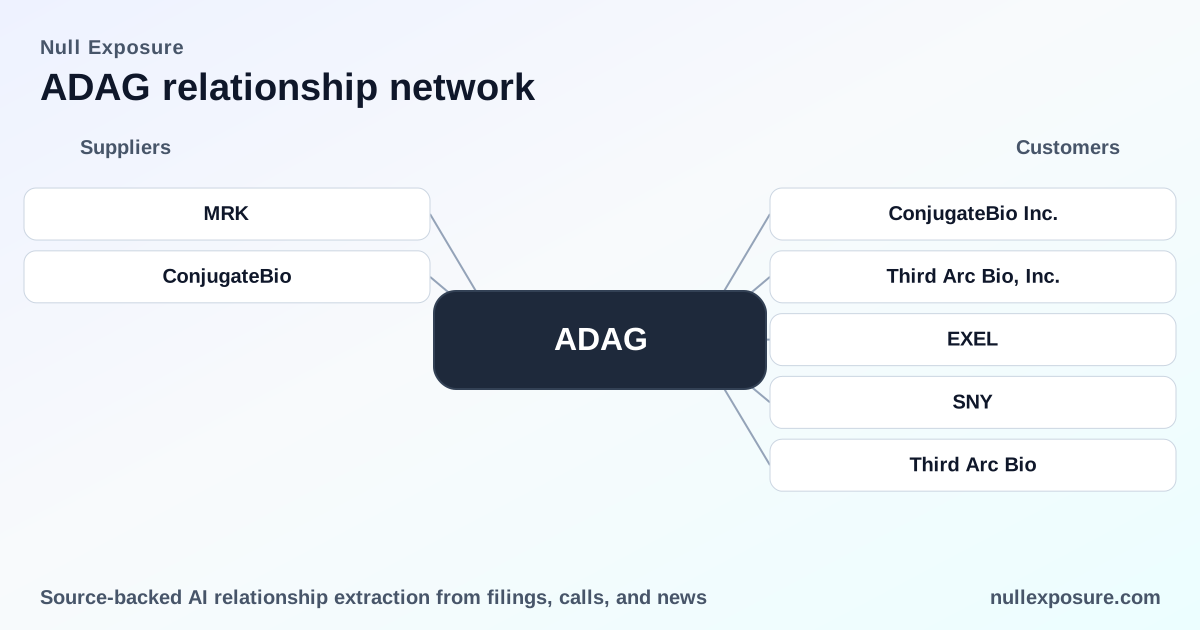
Merck / Merck Sharp & Dohme — regulatory momentum for ADG126 with KEYTRUDA
Adagene announced that muzastotug (ADG126) in combination with Merck’s anti‑PD‑1 therapy KEYTRUDA received FDA Fast Track designation for adult patients with microsatellite stable metastatic colorectal cancer (MSS mCRC) without active liver metastases. This is a regulatory acceleration for a candidate intended to be combined with a major PD‑1 franchise, which materially improves the asset’s external validation and commercial optionality. Source: GlobeNewswire press release, December 16, 2025.
According to a regional news outlet restating the same development, the FDA Fast Track designation was also reported in March 2026 coverage, reinforcing market awareness and investor attention on this co‑development angle with Merck. Source: Macau Business, March 9, 2026.
ConjugateBio — a technical supply/partner arrangement for bispecific ADC work
Adagene maintains a partnership with ConjugateBio under which ConjugateBio will provide a proprietary antibody used in bispecific ADC (antibody‑drug conjugate) development, positioning ADAG to combine its discovery platforms with conjugation expertise. This is a supplier/technology collaboration that strengthens Adagene’s engineering pipeline and supports internal or partnered ADC programs. Source: StockTitan news aggregation, March 9, 2026.
How these relationships change the investment calculus
The Merck Fast Track designation is the most consequential signal: alignment with a top PD‑1 therapy expands late‑stage utility and commercial scale for ADG126 if clinical readouts follow regulatory progress. The ConjugateBio collaboration is more tactical—technology reinforcement rather than headline de‑risking—but it increases program optionality and downstream partnership attractiveness.
For platform investors and operators, the value proposition is: early-stage ownership with partner-mediated de‑risking and upside tied to milestone realization and licensing economics. Visit https://nullexposure.com/ for supplier diligence that maps these partnership clauses to revenue and downside scenarios.
Operational characteristics and company-level signals
With no explicit constraint entries provided, the company‑level financial and operational picture is the primary lens:
- Clinical-stage R&D posture: Adagene is pre-commercial and focused on progressing assets through trials and regulatory interactions rather than building a commercial sales organization.
- Revenue concentration and immaturity: Reported TTM revenue is extremely low (roughly six figures) while operating margins and profitability are deeply negative, indicating dependence on financings and partner cashflows to fund operations.
- Capital and market scale: Market capitalization is small (about $84.8 million) with limited free‑float; institutional ownership is meaningful but not dominant, which creates liquidity and governance dynamics typical of small-cap biotechs.
- Contracting posture: The company uses partner-centric contracting (licenses and co-development) to transfer late-stage risk and fund development, implying contractual dependency on a handful of high-impact partners.
- Criticality of partner validation: Given the lack of commercial revenue, validation by large pharma and regulatory designations are the primary value drivers.
These signals define ADAG as an early-stage, partner‑reliant supplier whose risk profile is dominated by clinical outcomes and counterparty execution.
Investment risks and operational flags to watch
- Binary clinical risk: Value is tied to a small number of programs; failed readouts materially impair valuation.
- Concentration risk in partners and programs: A handful of collaborations (e.g., with Merck) dominate near-term upside; counterparty strategy changes or trial setbacks are consequential.
- Funding runway and dilution: Negative EBITDA and minimal revenue imply ongoing dependence on capital markets and milestone receipts.
- Execution complexity: ADC and bispecific programs require specialized manufacturing and regulatory expertise; the ConjugateBio relationship mitigates part of that but does not eliminate execution risk.
Tactical takeaways for investors and operators
- Prioritize legal and commercial terms in any diligence: milestone schedules, royalty floors, termination rights, and data‑sharing governance determine realized economics more than headline collaborators.
- Monitor regulatory milestones (e.g., Fast Track interactions) as valuation inflection points rather than waiting for commercial revenue.
- Model multiple scenarios for financing and dilution given current burn and the operational profile.
For detailed counterparty mapping and to benchmark ADAG’s supplier contracts against peers, see the analysis hub at https://nullexposure.com/.
Closing view
Adagene is a classic small‑cap, partner‑driven biotech: strategic relationships with major pharma provide the path to commercial optionality, while technical collaborations shore up developmental complexity. Investors should value ADAG as a bet on clinical de‑risking and partner execution rather than on near‑term cash flows. For operators assessing supplier risk and contract structure, focus diligence on the partnership economics and regulatory milestones that will determine who captures long‑term value.
For granular supplier intelligence and to track ADAG’s evolving partner terms, visit https://nullexposure.com/ for subscription-grade research and contractual mapping.