ADAM (Adamas Trust, Inc.) — who funds and distributes its balance sheet
Adamas Trust acquires and manages mortgage-related single-family and multi-family residential assets and monetizes them through interest spread, securitizations, repurchase financing and capital-markets issuances (equity and senior notes). The company funds asset purchases with a mix of short‑term and longer‑term repurchase agreements, selective CDO/securitization issuance and public debt, and uses third‑party servicers to operate the underlying loans — an operating model that trades liquidity flexibility for counterparty and servicer concentration risk. Learn more about supplier exposure and capital partners at https://nullexposure.com/.
What the January 2026 note offering reveals about funding strategy
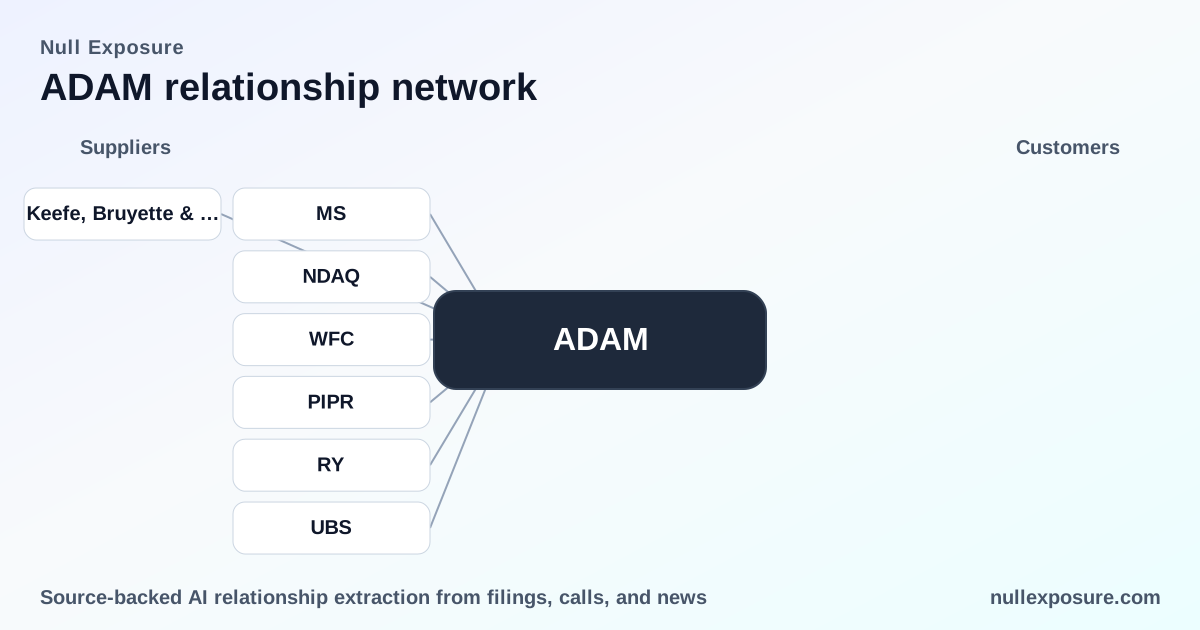
Adamas priced a public offering of senior notes in early January 2026 and retained a syndicate of major dealers as joint book‑running managers, then applied to list the notes on the Nasdaq Global Select Market under the ticker ADAMO. That combination — tapped capital markets plus an established dealer syndicate — signals an explicit strategy to lengthen liabilities and diversify funding sources beyond repos and securitizations. According to the company press release on January 6, 2026, the offering was managed by a group of banks that included Morgan Stanley, Wells Fargo, Piper Sandler, RBC, UBS and Keefe Bruyette & Woods, and the company applied to list the notes on Nasdaq (GlobeNewswire, Jan 6, 2026).
The counterparties named in the January 2026 release
Below are plain‑English descriptions of each relationship named in the offering announcement, with source citations.
Morgan Stanley & Co. LLC
Morgan Stanley acted as one of the joint book‑running managers for Adamas Trust’s January 2026 senior note offering, underwriting and distributing the paper to institutional investors. (GlobeNewswire press release, Jan 6, 2026).
Wells Fargo Securities, LLC
Wells Fargo Securities served as a joint book‑running manager on the offering, providing distribution and syndication capacity to the transaction. (GlobeNewswire press release, Jan 6, 2026; StockTitan coverage, Jan 2026).
Piper Sandler & Co.
Piper Sandler was named as a joint book‑running manager, indicating the company leaned on midsized and bulge‑bracket dealers to execute the note placement. (GlobeNewswire press release, Jan 6, 2026).
RBC Capital Markets, LLC
RBC Capital Markets joined the dealer syndicate as a joint book‑running manager for the senior notes, contributing distribution reach for the issuance. (GlobeNewswire press release, Jan 6, 2026).
UBS Investment Bank
UBS Investment Bank participated as a joint book‑running manager, supporting underwriting and placement efforts for the notes. (GlobeNewswire press release, Jan 6, 2026).
Keefe, Bruyette & Woods, Inc.
Keefe, Bruyette & Woods was named among the joint book‑running managers, reflecting the use of specialty mortgage capital markets desks alongside global banks. (GlobeNewswire press release, Jan 6, 2026; StockTitan coverage, Jan 2026).
Nasdaq Global Select Market (Nasdaq)
Adamas applied to list the newly issued notes on the Nasdaq Global Select Market under the symbol “ADAMO,” a step that will provide a centralized exchange listing and secondary market liquidity if approved. (GlobeNewswire press release, Jan 6, 2026).
How contracting posture and supplier roles shape operational risk
Adamas runs a dual‑track financing model that blends short‑term repo and longer‑term non‑recourse financing. Company filings as of December 31, 2024 disclose repurchase agreements with initial terms up to two years alongside mark‑to‑market repo lines with 30–90 day tenors, and the firm issues securitizations/CDOs to obtain longer‑term financing. This structure gives the company funding flexibility but creates a layered counterparty risk profile: short‑dated repos require active rollover and liquidity management, while longer repos and securitizations transfer credit risk off the balance sheet.
- Concentration: filings note repurchase agreements with six financial institutions (and amounts outstanding with nine counterparties at period end), which indicates moderate counterparty concentration on the funding side (company filing, Dec 31, 2024).
- Criticality: Adamas outsources servicing to licensed third‑party subservicers and relies on those vendors to preserve collateral value and comply with regulations; these service providers are operationally critical because Adamas does not directly service the loans (company filing, Dec 31, 2024).
- Maturity and lifecycle: relationships are both active (existing repurchase counterparties and servicers) and prospective (flow agreements and future loan purchases), so counterparties operate across servicing, distribution and funding stages.
Those characteristics position the company as a large incremental buyer of mortgage assets that negotiates flow and purchase agreements, while also acting as an issuer/distributor of equity and debt when market conditions permit (equity distribution agreement and the January 2026 note sale provide direct evidence).
Visit https://nullexposure.com/ for a structured view of counterparties and contract types for ADAM.
Operational implications for partners and operators
The named dealer syndicate performs three practical roles: underwriting distribution, price discovery and liquidity provisioning for Adamas’s note program. For servicers and repo counterparties, the arrangement implies ongoing operational integration — regular collateral valuation, margining activity and compliance checks. The firm’s repeated use of both short‑term repos and securitizations increases the importance of counterparties that can scale funding quickly and provide routine repo capacity.
- For dealers: bookrunner status gives market access and fee income; success of future issuances will sustain this relationship.
- For repo banks and servicers: they act as both counterparties and operational providers; weak performance by a servicer or a sudden withdrawal of repo capacity would have immediate balance‑sheet impacts (company filings, Dec 31, 2024).
If you evaluate supplier counterparty risk for ADAM, prioritize stress scenarios on repo rollovers and servicer operational failure, and incorporate the concentration signals disclosed in filings.
Key takeaways for investors evaluating ADAM supplier relationships
- ADAM funds assets with a mix of short‑dated repos and longer‑term securitizations and notes, giving it funding flexibility but exposing it to rollover risk. (Company filing, Dec 31, 2024).
- Major dealers (Morgan Stanley, Wells Fargo, Piper Sandler, RBC, UBS, Keefe Bruyette & Woods) handled the January 2026 note placement, indicating established capital‑markets access. (GlobeNewswire, Jan 6, 2026).
- Servicers are mission‑critical suppliers because Adamas outsources loan servicing; operational failures would directly affect returns and loss mitigation. (Company filing, Dec 31, 2024).
- Counterparty concentration is meaningful but not extreme: repurchase agreements are concentrated across a small group of banks (six to nine counterparties referenced in filings). (Company filing, Dec 31, 2024).
If you want a tailored counterparty scorecard for ADAM’s funding and servicing partners, start here: https://nullexposure.com/.
Final recommendation
For investors and operators, the practical question is whether Adamas’s dealer network and diversified funding stack sufficiently offset repo rollover and servicer concentration risk. The January 2026 note offering improves liability mix and liquidity profile in the near term; however, monitor repo counterparty behavior, servicer performance metrics and note trading liquidity on Nasdaq once ADAMO begins trading. For a deeper counterparty breakdown and monitoring framework, visit https://nullexposure.com/ and request the ADAM counterparty briefing.