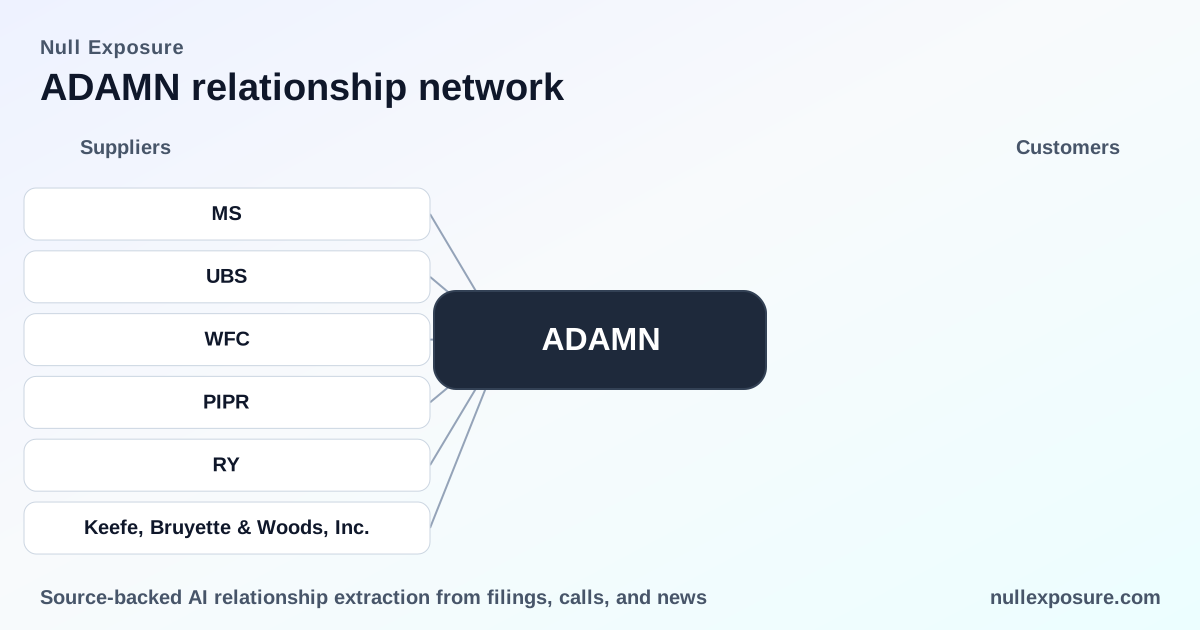
ADAMN: Supplier relationships that underwrite a mortgage REIT’s financing fabric
Adamas Trust, Inc. acquires, finances and manages mortgage-related single-family and multi-family residential assets and monetizes those positions through asset yields, securitizations, repurchase financing and public debt issuance. The company’s economics depend on its ability to source discounted loan pools, place those assets into longer-dated structured financings, and continuously renew short-term repurchase funding while third‑party servicers preserve cash collection and loss-mitigation performance. Investors should evaluate the network of investment banks, repo counterparties and servicers that enable that model because those relationships determine funding costs, roll risk and operational continuity.
If you want the full supplier view for portfolio due diligence, start here: https://nullexposure.com/
How the supplier map supports Adamas’s business model
Adamas runs a hybrid financing posture: long-term structured debt (securitizations and senior notes) for duration and leverage, and short-term repurchase agreements for working capital and inventory financing. That dual approach lowers blended funding costs when markets are stable but increases liquidity and counterparty risk during market stress.
- Contracting posture: mix of long-term maturities (senior notes and CDO/securitization structures) and short-term repo facilities tied to SOFR. Company filings through December 31, 2024 document securitization maturities stretching to 2069 and repo tenors from 30 days up to 24 months.
- Concentration and spend: the business purchases pools at scale—historical purchases include roughly $1.9 billion of loans and over $300 million purchased from a single originator in 2024—so vendor and funding counterparties are material to operations.
- Criticality and maturity: third‑party servicers and capital markets desks are operationally critical; securitizations and interest-rate hedges (caps) extend the maturity profile but embed counterparty dependency.
These signals come from the company’s public filings and the 2026 senior‑note offering disclosure.
Who showed up on the desk for Adamas’s January 2026 note deal
Adamas priced a public offering of senior notes in early January 2026. The GlobeNewswire press release announcing the transaction lists the joint book‑running managers involved; each relationship below is sourced to that notice.
Morgan Stanley & Co. LLC
Morgan Stanley acted as a joint book‑running manager on Adamas Trust’s January 2026 public offering of senior notes, positioning the bank as a primary capital markets intermediary for the issuer. According to the GlobeNewswire release announcing the pricing on January 6, 2026, Morgan Stanley was named among the lead managers. (GlobeNewswire, Jan 6, 2026)
UBS Investment Bank
UBS Investment Bank served as a joint book‑running manager on the same senior‑note transaction, providing distribution capabilities to fixed‑income investors for Adamas’s issuance. The participation is recorded in the company’s January 6, 2026 announcement. (GlobeNewswire, Jan 6, 2026)
Wells Fargo Securities, LLC
Wells Fargo Securities was listed as a co‑book‑runner for the offering, supplying underwriting and placement services for Adamas’s senior debt issuance. The trade was disclosed in the January 2026 GlobeNewswire release. (GlobeNewswire, Jan 6, 2026)
Piper Sandler & Co.
Piper Sandler participated as a joint book‑running manager for the senior notes, supporting the transaction with distribution and underwriting functions as described in the offering announcement. (GlobeNewswire, Jan 6, 2026)
RBC Capital Markets, LLC
RBC Capital Markets was named among the joint book‑running managers on the January 2026 note offering, adding coverage and syndication reach for the deal. This role is recorded in the GlobeNewswire pricing notice. (GlobeNewswire, Jan 6, 2026)
Keefe, Bruyette & Woods, Inc.
Keefe, Bruyette & Woods was included as a joint book‑running manager on the senior‑notes pricing announcement, supplying investment‑banking support tailored to mortgage‑sector credit products. The listing appears in the January 6, 2026 press release. (GlobeNewswire, Jan 6, 2026)
What the relationship list means for investors — practical implications
The January 2026 underwriting club reflects access to active fixed‑income distribution channels and a credible set of large financial institutions. That supports Adamas’s stated strategy to use public debt to extend maturities and finance asset acquisition.
From company disclosures through December 31, 2024, a set of firm-level constraints adds nuance:
- Long-term structural financing is core: Securitizations and CDO-style financings with stated maturities out to 2069 and senior notes issued (for example, 9.125% due 2029) show the firm actively uses long‑dated, non‑recourse funding to lock in leverage and duration. This reduces short-term refinancing frequency but raises structural liquidity risk if asset cash flows underperform. (Company filings, FY2024)
- Short-term repo usage is material and rate‑sensitive: Repurchase agreements—typically one year or less, with terms from 30 days to 24 months and pricing linked to SOFR—provide working capital flexibility but create rollover exposure and vulnerability to margin/rehypothecation demands. (Company filings, FY2024)
- Large‑enterprise counterparties and active stage: The firm uses multiple institutional counterparties (nine counterparties with repo exposure as of Dec 31, 2024) and engages third‑party servicers for loan administration; these relationships are operationally active and consequential for collections and loss mitigation. (Company filings, FY2024)
- Scale of transactions: Purchase activity and portfolio carrying values indicate spend and exposure well into the hundreds of millions, consistent with a spend band above $100 million and concentrated sourcing strategies. (Company filings, FY2024)
These points are company-level signals drawn from public disclosures and the January 2026 offering notice—together they define how supplier relationships translate into funding stability, operational resilience and refinancing risk.
If you’re evaluating counterparty exposure for a model or credit memo, review the servicing playbook, repo counterpart list and recent securitization covenants. For a consolidated supplier risk view, visit https://nullexposure.com/
Key risks and upside to track
- Funding roll risk: Heavy reliance on short‑term repos and active note markets makes funding costs and availability the principal near‑term value driver. Monitor repo counterpart concentration, haircuts and SOFR‑linked spreads.
- Servicer execution risk: Third‑party servicers perform loss mitigation and collections; weak servicer performance translates directly into higher delinquency and loss severity. The company retains oversight and conducts diligence, but servicer performance is operationally critical.
- Liquidity protection from long‑dated paper: Long‑term securitizations and senior notes lock in capital at fixed spreads and reduce immediate roll pressure—this is durability insurance for cash flows when asset yields exceed funding costs.
Final takeaway and next step
Adamas Trust runs a capital‑markets‑centric financing model that balances long‑dated securitizations with active short‑term repo facilities and relies on a small club of large underwriters for public debt placement. For investors, the supplier network—investment banks, repo counterparties and servicers—determines funding resilience and operational risk exposure.
For a deeper supplier‑level diligence package and relationship scoring, see the full coverage at https://nullexposure.com/ — or start a targeted review of counterparty and servicer risk profiles today at https://nullexposure.com/