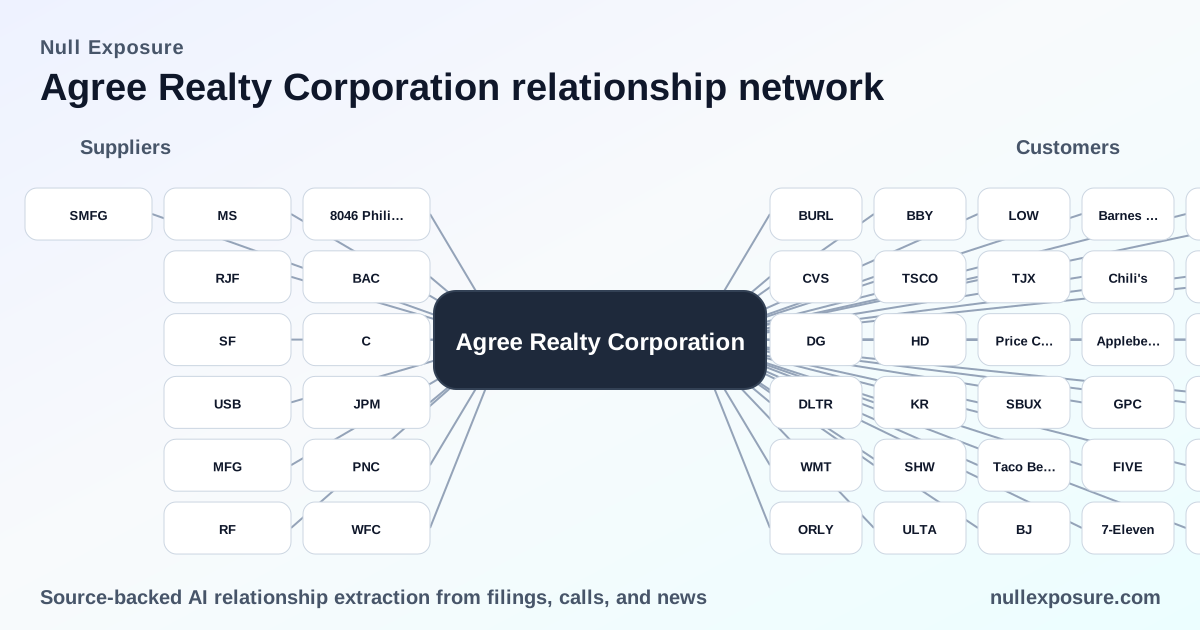
Agree Realty (ADC): who funds, arranges and sold to the REIT — a counterparty guide for investors
Agree Realty is a net-lease retail REIT that acquires, develops and owns single-tenant retail properties leased to large national and regional retailers; it monetizes through long-term rental cash flows, disciplined capital recycling and leverage via unsecured notes, term loans and a committed revolving facility. The company’s business model is financed and amplified by a concentrated set of banking and capital markets counterparties that manage its debt stack, hedging and transactional activity. Learn more about counterparty analytics and supplier risk at https://nullexposure.com/.
Why the counterparty map matters: financing is the operating lever
Agree’s operating leverage is primarily financial rather than operational: the company converts real estate cash flows into shareholder returns using secured and unsecured credit facilities, public notes and bespoke hedges. The constraint signals in the company filings show a clear posture: long-term commitments, large notional exposures and an active use of market counterparties to execute capital markets transactions.
Key operating-model signals:
- Contracting posture — long-term and framework agreements. The company maintains a $1.25 billion revolving credit facility and multiple multi-year unsecured notes and term loans, indicating preference for committed, syndicated capital lines rather than short-term bilateral funding.
- Concentration and criticality. Total gross indebtedness in the low billions, including over $2.2 billion of senior unsecured notes, makes major bank and capital-markets relationships materially critical to liquidity and refinancing plans.
- Maturity and hedging sophistication. Forward-starting interest rate swaps and terminated hedges show active interest rate management across planned issuances and executed offerings.
- Spend scale. Multiple relationships are associated with nine-figure instruments (term loans, revolver usage, public note issuances), signalling a high-spend band and institutional counterparty set.
If you run or invest alongside Agree, tracking these counterparties is essential for monitoring refinancing risk and funding optionality. Learn how we surface counterparty concentrations at https://nullexposure.com/ (home).
Counterparty map: the lenders, arrangers and a property seller
Below is a plain-English summary of every counterparty relationship reflected in recent public reporting and news items.
8046 Philips Highway LLC
Agree purchased a retail property on June 30 from 8046 Philips Highway LLC, a single-asset seller in the transaction that closed in 2023. This is a property-level vendor relationship tied to an asset acquisition. (Jax Daily Record, July 24, 2023)
BofA Securities
BofA Securities acted as one of the joint book-running managers on a $400 million senior unsecured notes offering, participating in the deal execution and distribution of the issuance. (PR Newswire release, FY2025)
Citigroup
Citigroup served as a joint book-running manager for the $400 million unsecured notes offering, supporting marketing and allocation to investors. (PR Newswire release, FY2025)
J.P. Morgan
J.P. Morgan participated both as a joint book-running manager on the unsecured notes issuance and as a joint lead arranger on a term loan, indicating a multi-role banking relationship across debt capital markets and syndicated bank financing. (PR Newswire and StockTitan reporting, FY2023–FY2025)
PNC Bank, National Association
PNC Bank, N.A. served as the Administrative Agent on the $350 million term loan, which places PNC in a core agent role for the syndicated bank facility. (StockTitan reporting, FY2023)
PNC Capital Markets LLC
PNC Capital Markets functioned as a joint book-running manager on the unsecured notes and as a joint lead arranger for the term loan, linking the firm to both capital markets distribution and bank-syndication activity. (PR Newswire and StockTitan reporting, FY2023–FY2025)
Wells Fargo Securities, LLC
Wells Fargo Securities participated as a joint lead arranger on the term loan and as a joint book-running manager on the notes offering, demonstrating a repeated role across credit and markets execution. (StockTitan and PR Newswire reporting, FY2023–FY2025)
Morgan Stanley
Morgan Stanley served as a co-manager on the $400 million notes issuance, supporting distribution to fixed-income investors as part of the co-manager group. (PR Newswire release, FY2025)
Raymond James
Raymond James acted as a co-manager on the unsecured notes offering, contributing to the syndication and placement of the deal. (PR Newswire release, FY2025)
Stifel
Stifel served as a co-manager on the $400 million notes issuance, participating in the distribution group for the transaction. (PR Newswire release, FY2025)
US Bancorp
US Bancorp featured among the co-managers for the unsecured notes issuance, providing distribution and underwriting support. (PR Newswire release, FY2025)
Citibank, N.A.
Citibank, N.A. (listed separately from Citigroup in filings) acted as one of the joint lead arrangers for the term loan, reinforcing Citi’s role in bank-syndication for Agree’s credit facilities. (StockTitan reporting, FY2023)
Mizuho
Mizuho was listed as a joint book-running manager on the unsecured senior notes, positioning the bank in the group responsible for executing the public debt sale. (PR Newswire release, FY2025)
Regions Securities LLC
Regions Securities served as a co-manager on the notes offering, handling distribution responsibilities alongside other regional and national firms. (PR Newswire release, FY2025)
SMBC Nikko
SMBC Nikko participated as a co-manager on the unsecured notes sale, adding international/bank-led distribution coverage to the deal. (PR Newswire release, FY2025)
(Each relationship above is drawn from recent press releases and market reports identifying the banks as arrangers, book-runners, co-managers or administrative agents tied to Agree’s term loan, revolver and public note issuances.)
What these relationships reveal about risk and optionality
- Refinancing dependency is real but diversified. Agree’s capital structure features a large revolver and multiple public and private debt instruments underwritten by overlapping groups of global and regional banks; that diversification reduces single-provider concentration but creates a networked refinancing dependency across capital markets participants.
- Transaction maturity is long-term. The combination of a multi-year term loan, senior unsecured notes and a revolving facility indicates a preference for multi-year funding horizons rather than short-term commercial borrowings.
- Hedging activity reduces interest-rate volatility but requires counterparty management. Forward-starting swap agreements and terminated hedges show active rate management that produces balance-sheet complexity and counterparty exposure.
- Valuation and yield context. Agree trades with a premium multiple profile (trailing P/E ~45, Price/Book ~1.57) and a yield under 4%, which positions the stock as an income-oriented REIT with growth expectations priced in; financing terms and execution capacity therefore directly impact the investment case.
If your model rests on refinancing flexibility or stable spreads on unsecured paper, these counterparties are the first place to watch for changes in execution appetite and pricing.
Actionable next steps
- For investors: monitor upcoming maturities, revolver utilization and book-runner composition ahead of any new issuance; changes in the lead manager roster can signal shifting distribution capacity.
- For operators and counterparties: prioritize documentation and counterparty limits with the arrangers above; administrative agent roles (e.g., PNC Bank on the term loan) are operationally critical.
Explore comprehensive counterparty monitoring and live relationship signals at https://nullexposure.com/ — start with the homepage to see how we surface these network risks.
Agree’s funding ecosystem is composed of repeat institutional lenders and capital-markets houses that both underwrite and syndicate its debt — tracking execution, hedging and lead-manager behavior across this set is the single most direct way to forecast funding cost volatility and liquidity risk for ADC. For detailed counterparty exposure dashboards, visit https://nullexposure.com/.