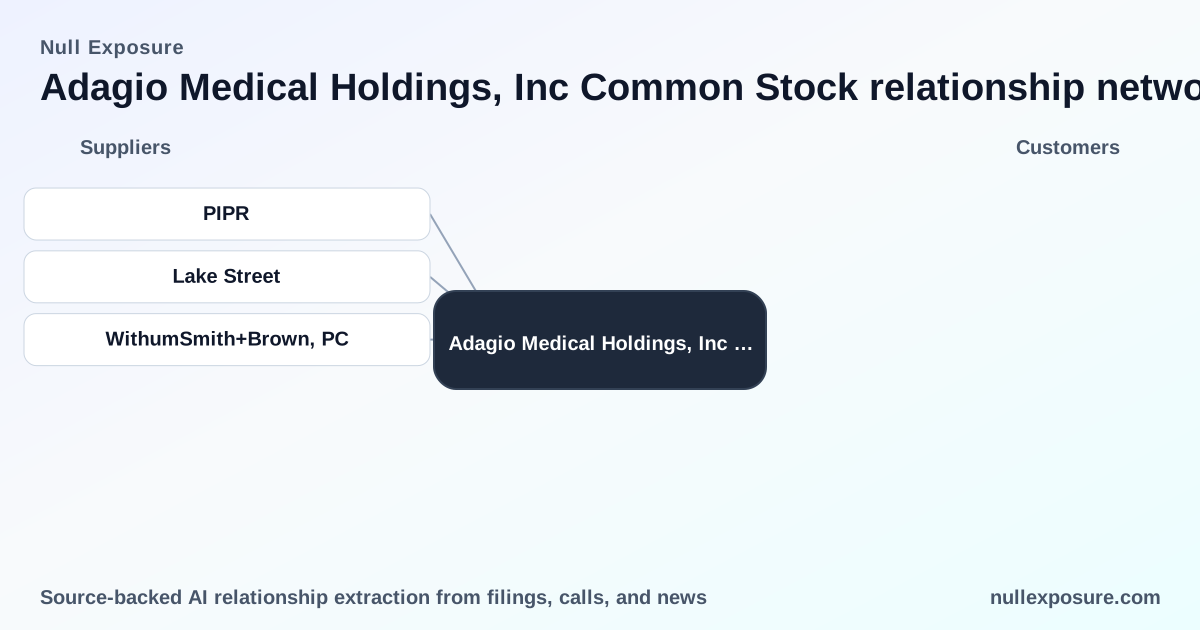
Adagio Medical (ADGM): Supplier relationships, concentration risks, and short‑term funding partners
Adagio Medical is a medical‑device developer that commercializes targeted cardiac‑ablation technologies and associated disposable components; it monetizes through device sales, consumable disposables, and services tied to electrophysiology procedures. Revenue remains modest relative to R&D and SG&A outlays, so supplier relationships and near‑term capital partners materially influence execution and runway. For institutional investors evaluating ADGM, the supplier picture today is a mix of strategic third‑party manufacturers, audited quality partners, related‑party services in wind‑down, and capital markets intermediaries active in a recent private placement. For more background on counterparties and supplier risk profiling visit https://nullexposure.com/.
Quick take: what to watch as an operator or investor
Adagio operates with high supplier concentration and material single‑source exposure, while relying on a compact roster of financial and audit partners for near‑term financing and compliance. The combination of modest revenue, negative operating margins, and reliance on third‑party manufacturing increases operational leverage — supplier downtime or qualification delays translate directly into production risk. If you are evaluating exposure, prioritize counterparty continuity, alternative supplier qualification timelines, and the contractual status of related‑party services. Learn how these signals map to commercial risk at https://nullexposure.com/.
The direct counterparties disclosed in recent filings and press coverage
Below are the relationships surfaced in public notices and press releases, with concise, investor‑oriented summaries and source citations.
Piper Sandler — placement agent for a private placement
Piper Sandler acted as the sole placement agent in Adagio’s financing that priced up to $50 million, positioning the firm to extend cash runway through equity issuance. According to MarketScreener and StockTitan coverage on March 9, 2026, Piper Sandler led distribution for the private placement. (MarketScreener / StockTitan, March 9, 2026)
Lake Street — financial advisor on the offering
Lake Street served as financial advisor to Adagio in the same offering, supporting transaction structuring and adviser due diligence for the private placement. This role was referenced in coverage of the financing announcement. (MarketScreener / StockTitan, March 9, 2026)
WithumSmith+Brown, PC — independent accounting firm
WithumSmith+Brown, PC was ratified as Adagio’s independent accounting firm for the fiscal year ending December 31, 2025, formalizing audit and financial reporting oversight as the company scales commercial operations. This ratification was disclosed in a company press release published via The Globe and Mail. (The Globe and Mail press release, March 2026)
Operational constraints and supplier risk signals that shape execution
Below I translate the filings’ constraint excerpts into practical, investor‑grade signals about Adagio’s operating model and supplier posture.
-
Contracting posture: long‑term facility commitments. Adagio leases approximately 14,600 square feet including clean‑room space under an operating lease that expires January 2030. This represents a long‑term fixed cost base tied to manufacturing readiness rather than a purely variable model, increasing fixed‑cost leverage if revenue growth lags.
-
Concentration and materiality: a few suppliers dominate payables. The company reported that two suppliers exceeded 10% of accounts payable (55% of AP) as of December 31, 2024, and legacy metrics showed three suppliers made up 72% of AP in 2023. Supplier concentration is a material commercial risk: a disruption at these vendors would have an outsized effect on production and working‑capital needs.
-
Single‑source and qualification risk for components. Filings explicitly warn that single‑source suppliers for specific components could take “up to a few months” to replace and qualify, and inability to secure alternatives would materially affect operations. For investors, this equals short supplier lead times and costly qualification timelines that can impede scale‑up.
-
Manufacturing outsourcing and critical components. Adagio relies on third‑party manufacturers for critical disposables — for example, the Esophageal Warming Balloon sold with its iCLAS™ Cryoablation System is supplied by an external manufacturer. That relationship places product quality and supply continuity outside the company’s direct control and ties regulatory compliance to vendor performance.
-
Quality and regulatory oversight: third‑party audit partners. TÜV SÜD Product Service GmbH conducts scheduled and unannounced audits at the Laguna Hills facility, which signals active regulatory surveillance and dependence on certified quality partners to maintain market access.
-
Service‑provider exposure: cybersecurity and outsourced G&A. The company acknowledged cybersecurity exposures tied to third‑party service providers and reported outsourced finance and accounting services under a Shared Services Agreement; these are operational dependencies with confidentiality and continuity implications.
-
Related‑party contracting and wind‑down: Fjord Ventures. Filings name Fjord Ventures (owned and operated by the CEO) as a counterparty: Adagio incurred $0.9M, $0.4M, and $1.4M in finance, accounting, and administrative services across reported periods; a sub‑lease with Fjord expired March 31, 2024, and the company served termination notice for a Facilities and Services Agreement on January 30, 2025, effective July 30, 2025. These facts indicate material related‑party spend that is being unwound, reducing one concentration vector but also posing transitional execution risk as services are reprocured or internalized.
-
Spend bands and scale of supplier commitments. Supplier spend for related services sits in multiple bands: sub‑$100k for some legacy sub‑lease expenses, $100k–$1M and $1M–$10M for Shared Services Agreement spend across reporting periods — a profile consistent with a company transitioning from legacy support structures toward in‑house or market competitive contracts.
What this means for investors and operators
-
Balance sheet and runway are influenced by capital market partners. The March 2026 private placement led by Piper Sandler and advised by Lake Street is a near‑term financing lever that shapes runway and reduces immediate pressure on supplier renegotiation, but operational continuity depends on supplier qualification and alternative sourcing.
-
Concentration is the single largest operational risk. With two suppliers representing a majority of accounts payable and third‑party manufacturers providing critical disposables, supplier failure or regulatory non‑compliance would cause immediate production and revenue interruptions.
-
Related‑party unwind creates transition risk but reduces governance friction. The termination of Fjord‑provided facilities and services removes a governance concentration point but requires timely reprocurement or internal capability build‑out to avoid gaps in finance, accounting, and facilities services.
If you need a consolidated counterparty risk brief or a supplier‑concentration heat map tailored to institutional due diligence, get practical insights and bespoke reports at https://nullexposure.com/.
Final assessment and recommended monitoring
Adagio’s supplier landscape is compact and materially concentrated, with immediate financing support from investment‑bank placement and advisory partners. Key monitoring priorities for investors are supplier qualification timelines, remaining vendor concentration after Fjord unwind, regulatory audit outcomes from TÜV SÜD, and execution of the private placement proceeds against commercialization milestones. For an actionable supplier risk checklist and tracking template, visit https://nullexposure.com/.