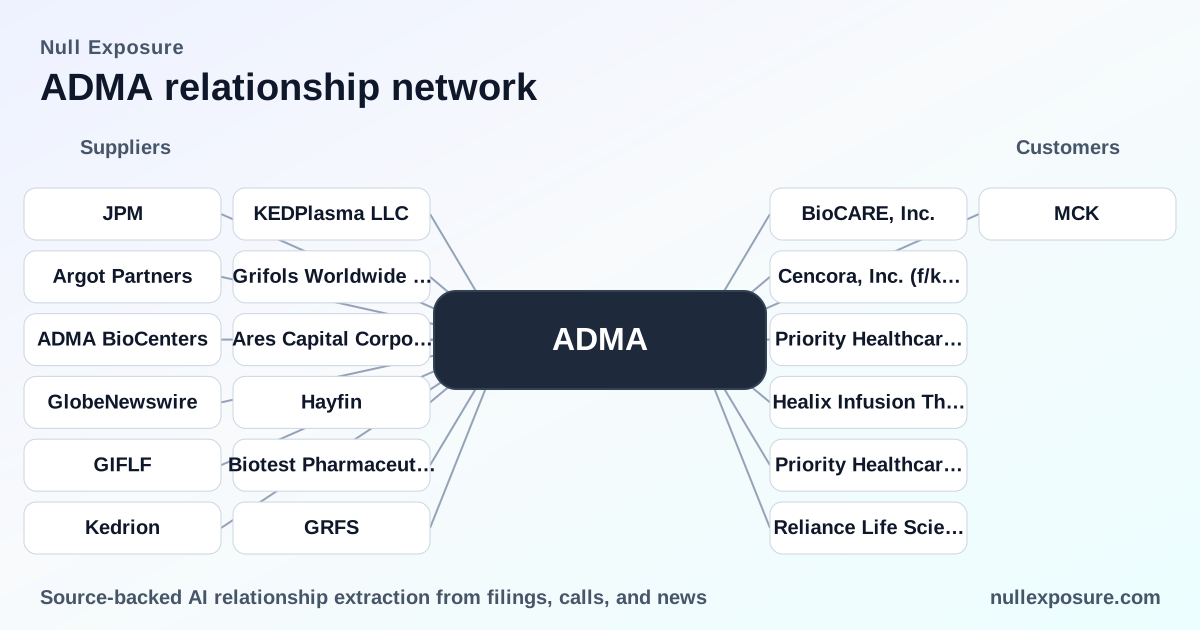
ADMA Biologics: Supplier relationships that power a plasma-play with durable contracts and concentrated inputs
ADMA Biologics develops, manufactures and markets plasma‑derived therapies for immunodeficiencies and infectious disease; it monetizes by converting collected source plasma into proprietary products (notably ASCENIV and Nabi‑HB), selling finished biologics and operating in‑house and third‑party manufacturing and plasma collection through ADMA BioCenters. The company generates roughly $510 million in trailing revenue with strong gross and operating margins, and it supports production through long‑dated supply contracts and captive collection capacity that directly tie raw material availability to product output and margin stability. For a concise supplier risk profile and monitoring playbook, visit https://nullexposure.com/.
Why suppliers matter: long contracts, volume commitments, and a captive collection arm
ADMA’s model commoditizes the most constrained input in its value chain—high‑titer plasma—while locking price and volume through multi‑year purchase agreements. The company combines third‑party supply with its own FDA‑licensed plasma collection centers, creating a hybrid sourcing posture where contracted supply and internal collection are both strategic levers for risk and growth. ADMA’s margins and manufacturing throughput are dependent on meeting minimum plasma volumes and on the durability of its long‑term contracts.
- Contracting posture: The record shows explicit long‑term contracts that include minimum annual volumes and price escalators, pushing the firm toward predictable supply costs and revenue scalability.
- Concentration and criticality: A small portion of tested donor samples meet ADMA’s high‑titer specification; the company signals materiality risk if collection efficiency falls below target. That scarcity makes supplier performance critical to revenue delivery.
- Maturity: Contracts extend over multiple years (up to the late 2030s for at least one counterparty), shifting supplier relationships into a strategic, rather than tactical, operating dimension.
- Geography: Sourcing is primarily U.S.‑centric via ADMA BioCenters and contracted suppliers, which simplifies regulatory alignment but concentrates exposure to U.S. plasma supply dynamics.
Explore an analyst‑grade view of ADMA’s counterparties and risk profile at https://nullexposure.com/.
Relationship roll call — who’s on the ledger and what they do
Below I cover each counterparty that appears in ADMA’s supplier and press records, with plain‑English summaries and source notes.
-
KEDPlasma LLC — ADMA executed a Plasma Purchase Agreement effective August 6, 2024, with a term expiring July 2031 and renewal provisions; the agreement commits KEDPlasma to supply minimum plasma volumes on a non‑exclusive basis. Source: ADMA Form 10‑K, FY2024 disclosure of the KEDPlasma Agreement.
-
Grifols Worldwide Operations Limited (Grifols) — ADMA entered an Amended and Restated Plasma Purchase Agreement effective October 1, 2024, with a term expiring September 2039 and minimum annual RSV plasma supply (35,000 liters) plus annual price escalators. Source: ADMA Form 10‑K, FY2024 A&R Grifols Agreement disclosure.
-
Ares Capital Corporation — Ares is lender under ADMA’s senior secured credit facility; the facility carries standard acceleration and collateral remedies that could result in Ares taking possession of collateral in specified default scenarios. Source: ADMA Form 10‑K, FY2024 credit facility discussion.
-
Hayfin — ADMA and its subsidiaries entered into a credit agreement with Hayfin on March 23, 2022, establishing a funded lending relationship that remains part of the company’s capital structure. Source: ADMA Form 10‑K, FY2024 Hayfin Credit Agreement reference.
-
Biotest Pharmaceuticals Corporation — ADMA’s historical Plasma Supply Agreement dated June 6, 2017 ties Biotest (as a former contract manufacturer/counterparty) to supply hyperimmune plasma for Nabi‑HB under a 10‑year term. Source: ADMA Form 10‑K, FY2024 reference to the 2017 Plasma Supply Agreement.
-
Kedrion — Industry commentary and investor call transcripts list Kedrion among reliable plasma suppliers in the industry context that ADMA references when discussing its sourcing landscape. Source: InsiderMonkey coverage of ADMA earnings call (FY2025 transcript).
-
JPMorgan Chase Bank, National Association / J.P. Morgan — J.P. Morgan serves both as a financing advisor and counterparty in capital markets activity; ADMA executed a $125 million accelerated share repurchase (ASR) agreement with JPMorgan in early 2026 as part of a planned ~$200 million 2026 buyback program, and J.P. Morgan led a prior debt refinancing tied to a $225 million revolver. Source: GlobeNewswire press release and multiple FY2025–FY2026 news items describing the ASR and refinancing.
-
Argot Partners — Argot Partners is ADMA’s investor relations/communications contact and is cited in press releases and conference announcements supporting investor outreach. Source: GlobeNewswire and ADMA press materials (FY2025–FY2026).
-
ADMA BioCenters — ADMA operates its own network of FDA‑licensed source plasma collection centers (ten U.S. facilities reported) that provide in‑house raw material for manufacturing, including high‑titer RSV plasma collections. Source: Company disclosures and press materials cited in FY2026 conference announcements.
-
GlobeNewswire — GlobeNewswire appears as the distribution channel for ADMA press releases (for example, the January 2026 conference and March 2026 ASR announcement), and these releases are the primary vehicle for ADMA’s official public statements about supplier contracts and capital returns. Source: GlobeNewswire press releases distributed FY2025–FY2026.
What the constraints tell investors about ADMA’s operating model
The documented constraints translate into operational and financial implications investors should track.
-
Long‑term contracting is structural. ADMA’s supplier agreements with Grifols and KEDPlasma are multi‑year, with Grifols locked through 2039 and KEDPlasma through 2031; these contracts embed minimum volume guarantees and price escalators, which stabilize input availability and support revenue planning but create locked‑in cost trajectories. (Excerpted contract language is disclosed in ADMA’s FY2024 10‑K.)
-
Hybrid sourcing reduces but does not eliminate supply concentration. Operating ADMA BioCenters shifts some supply risk in‑house and keeps plasma provenance on company balance sheets; however, ADMA still relies on third‑party suppliers for sizeable minimum volumes, and only a small proportion of donor samples meet high‑titer thresholds—a materiality signal for production risk at the product level.
-
Supplier relationships are operationally critical. The manufacturing segment is dependent on timely fulfillment from plasma sellers and third‑party fill/finish providers; ADMA characterizes these providers as service partners in manufacturing, CRO activities and cybersecurity support, indicating an integrated outsourcing posture rather than pure vertical integration.
Investment implications and monitoring checklist
- Upside catalyst: Long‑dated minimum supply contracts reduce short‑term raw material shocks and support steady production of ASCENIV and Nabi‑HB, underpinning margin expansion and predictable revenue.
- Key risks: Concentration in high‑titer supply, the small share of qualifying donor samples, and dependence on a handful of long‑term suppliers are top operational risks that can constrain growth if collection or supplier performance declines.
- Monitor: contract renewal milestones (especially Grifols 2039), KEDPlasma volume ramp to the 2026 period, ADMA BioCenters utilization rates and quarterly disclosures tied to plasma availability.
For deeper supplier analytics and trend monitoring for ADMA, go to https://nullexposure.com/.
Bottom line
ADMA’s commercial model is built on converting scarce, high‑titer plasma into premium biologics backed by multi‑year supply agreements and captive collection capacity. The contracts deliver predictability but concentrate supply risk; investors should value ADMA’s margin profile against the operational imperative of sustaining minimum plasma volumes and maintaining contractor performance. For a practical monitoring framework and supplier risk signals, visit https://nullexposure.com/.