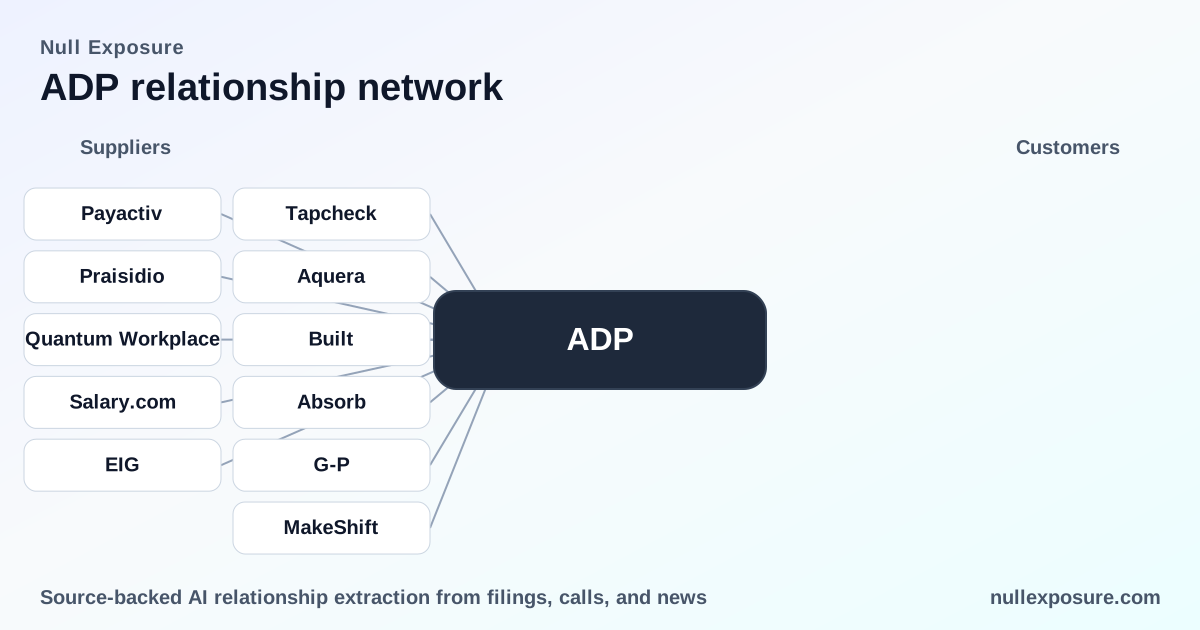
ADP as a Supplier: How ADP Monetizes HR Ecosystems and What Its Partner Map Signals for Investors
Automatic Data Processing, Inc. (ADP) operates as a platform-first HR services company that monetizes through recurring cloud and subscription fees, payroll and benefits processing margins, and value-added marketplace partnerships that drive client retention and upsell. ADP converts scale in payroll and HCM (human capital management) into predictable revenue and cross-sell opportunities, while augmenting its product offering through curated third‑party integrations and AI agents that increase stickiness and route-to-market for smaller software vendors.
Explore more on supplier relationships and commercial signals at https://nullexposure.com/.
What ADP’s Marketplace announcement means for revenue and distribution
ADP’s March 2026 Marketplace initiative creating a curated set of AI agents is a commercial move that accelerates platform utility without heavy internal R&D for every vertical use case. By hosting third‑party agents — and exposing them to ADP’s large employer customer base — ADP creates follow-on subscription and referral revenue and preserves control over primary payroll flows. The initiative reinforces ADP’s subscription-first contracting posture and a product roadmap focused on integration-led growth, not just standalone software sales.
A good place to assess these supplier ties and their commercial weight is at https://nullexposure.com/.
The partner list — one-line investor summaries and sources
- Tapcheck — ADP included Tapcheck in its curated set of AI agents, positioning on-demand pay and financial wellness services as complementary to payroll; ADP cited this partnership in its March 2, 2026 press release. Source: ADP press release, March 2, 2026 (mediacenter.adp.com/2026-03-02-ADP-Marketplace-Launches-AI-Agents-to-Help-Make-Work-Easier,-Smarter).
- Aquera — Listed among the curated AI partners, Aquera’s inclusion signals help-desk and HR automation integrations that feed ADP’s case management and employee services strategy; cited in ADP’s March 2026 announcement. Source: ADP press release, March 2, 2026.
- Built — Named by ADP as an AI agent partner, Built likely supports hiring and onboarding workflows that extend ADP’s HCM functionality and improve customer lifetime value. Source: ADP press release, March 2, 2026.
- Absorb — Included in the partner roster to complement learning and training modules, Absorb’s presence helps ADP offer training-to-payroll continuity for clients focused on workforce development. Source: ADP press release, March 2, 2026.
- G‑P — Cited as one of ADP’s curated agents, G‑P’s inclusion indicates a focus on benefits and HR operations tooling within ADP Marketplace. Source: ADP press release, March 2, 2026.
- MakeShift — ADP included MakeShift to bolster scheduling and shift management functionality, a practical extension of payroll accuracy for hourly workforces. Source: ADP press release, March 2, 2026.
- Payactiv — As an on-demand pay and financial services partner, Payactiv’s placement in ADP’s agent list deepens ADP’s employee financial wellness suite and payroll-adjacent monetization routes. Source: ADP press release, March 2, 2026.
- Praisidio — Listed among AI partners to enhance HR decisioning and risk management workflows, Praisidio supports ADP’s move into more automated HR advisory capabilities. Source: ADP press release, March 2, 2026.
- Quantum Workplace — Included to strengthen employee engagement and performance management offerings, aligning engagement metrics with ADP’s HR datasets. Source: ADP press release, March 2, 2026.
- Salary.com — Brought into the marketplace to provide compensation benchmarking and pay analytics that integrate with ADP’s payroll and HR planning tools. Source: ADP press release, March 2, 2026.
- Employ (EIG) — Cited by ADP as a curated AI agent partner; public filings indicate Employ is referenced with inferred ticker EIG, linking ADP Marketplace distribution to firms with private or public equity. Source: ADP press release, March 2, 2026; Finviz coverage, March 9, 2026 (finviz.com/news/327268/adp-marketplace-launches-ai-agents-to-help-make-work-easier-smarter).
Each partner was publicly listed by ADP in the March 2026 announcement and covered in subsequent industry reporting; the inclusion set frames ADP’s go‑to‑market for AI-enabled HR utilities (ADP press release, March 2, 2026; Finviz coverage, March 9, 2026).
How these relationships fit ADP’s operating model and contract posture
ADP’s supplier behavior is consistent with a subscription-oriented contracting model and a platform that acts as a buyer and integrator of third‑party services. Company-level evidence shows ADP recognizes fees for cloud-based subscriptions and capitalizes certain software costs consistent with an enterprise SaaS orientation, implying long-term recurring revenue and upgrade paths for marketplace add-ons. Separately, ADP operates reinsurance and indemnity arrangements that position the company as a buyer of risk-transfer services in payroll/PEO contexts, which underscores its responsibility for client outcomes in insurance and liabilities.
- Contracting posture: Subscription-heavy revenue with capitalized hosting and internal software treatment implies predictable, recurring cash flows and a preference for long-term contracts.
- Concentration and criticality: ADP’s platform interlocks payroll, benefits, and compliance — partners therefore gain distribution but are not individually critical to ADP’s core payroll economics. ADP retains control over critical payroll flows, reducing vendor concentration risk at the enterprise level.
- Maturity and integration: The curated nature of the AI agents shows a conservative, controlled integration strategy rather than open marketplace chaos; this suggests mature vendor governance and paced monetization.
Investment implications — revenue levers and risk signals
- Upside engine: ADP’s marketplace turns third‑party functionality into upsell and referral revenue with low incremental cost to ADP and strengthened customer retention. ADP’s scale (market cap ≈ $84.6B; FY revenue ≈ $21.2B) makes the marketplace an efficient distribution channel for partners.
- Margin profile: With operating margin near 26% and a profit margin around 20%, ADP’s core business funds platform investments without eroding profitability. These partnerships are additive to high-margin software and services.
- Risk vector: Marketplace reliance introduces partnership execution risks — integration quality and partner economics must preserve payroll accuracy and regulatory compliance; ADP’s buyer/indemnity posture shows it assumes significant downstream risk in some lines.
- Valuation sensitivity: ADP trades at a forward P/E of about 17.6 and a PEG ~2.7, pricing steady growth rather than aggressive multiple expansion; marketplace monetization will need to show measurable ARR accretion to move sentiment meaningfully.
If you evaluate supplier risk or want a structured view of ADP’s partner exposures, start your analysis at https://nullexposure.com/.
Bottom line and next steps for investors
ADP is executing a platform extension strategy that converts third‑party HR capabilities into distribution-led revenue while preserving control over payroll — a defensive monetization strategy that fits ADP’s subscription economics and risk posture. The March 2026 partner list demonstrates selective, integration-focused curation rather than indiscriminate marketplace expansion, which supports sustainable monetization without meaningful margin dilution.
For deeper supplier relationship maps and commercial risk scoring, visit https://nullexposure.com/ to benchmark ADP’s partner set against peer platforms and to monitor execution metrics that will move the stock.