Adaptive Biotechnologies (ADPT): Supplier relationships and operating implications for investors
Adaptive Biotechnologies operates an immune‑medicine platform that commercializes diagnostic assays and assay-driven services—most notably the clonoSEQ oncology assay—by processing clinical samples, integrating with provider systems for ordering, and recognizing recurring revenue from testing volume and partnerships; the company reported roughly $277 million in trailing twelve‑month revenue and a commercial footprint that increasingly leverages EMR integrations to drive orders. Investors should evaluate Adaptive as a diagnostics operator with concentrated supplier exposures, significant integration-driven distribution, and financing structures that influence cash interest expense. Learn more about how these signals affect counterparty risk and procurement strategy at https://nullexposure.com/.
How Adaptive makes money and why suppliers matter
Adaptive monetizes through processing laboratory tests, licensing its immune repertoire technology, and expanding clinical adoption via EMR integrations that convert installed capacity into recurring orders. Operational leverage sits in lab throughput and software integrations: the company’s gross margin ($205.6M gross profit on $277M revenue TTM) implies scalable economics if volume continues to grow, but scalability is contingent on uninterrupted access to laboratory equipment, clinical channels, and financing that supports commercial expansion. That dependency on third parties is both a growth enabler and a potential constraint; see the company‑level supplier signals below. Visit https://nullexposure.com/ for deeper supplier intelligence on ADPT.
Company‑level supplier and contracting signals investors must weigh
Adaptive’s public disclosures present three consistent operating characteristics that drive supplier risk and capital posture:
- Long‑term facility commitments increase fixed costs. Adaptive leases approximately 100,000 square feet at its Seattle headquarters under an agreement that runs through August 2033 with options to extend twice for five years, indicating a multi‑year fixed‑cost base and a stable operational footprint (long‑term contract signal).
- Supplier concentration is material to operations. The company discloses reliance on a limited number of suppliers—and in some cases single suppliers—for laboratory instruments and materials, acknowledging that failure of a supplier could force costly substitutions and processing delays. This is a company‑level concentration risk that elevates the importance of supplier continuity planning.
- Reliance on external service providers for specialized capabilities. Adaptive uses consultants, contractors and advisors to support R&D, regulatory and commercialization strategies, signaling a hybrid internal‑external model where certain capabilities are externally sourced rather than owned in‑house.
Together these signals create a profile of a capitalized diagnostics operator with fixed site exposure, concentrated supply chains, and an integration‑driven revenue model—attributes that directly influence procurement strategy, contingency reserves, and the negotiating leverage Adaptive holds with suppliers.
What the company’s disclosed relationships tell investors
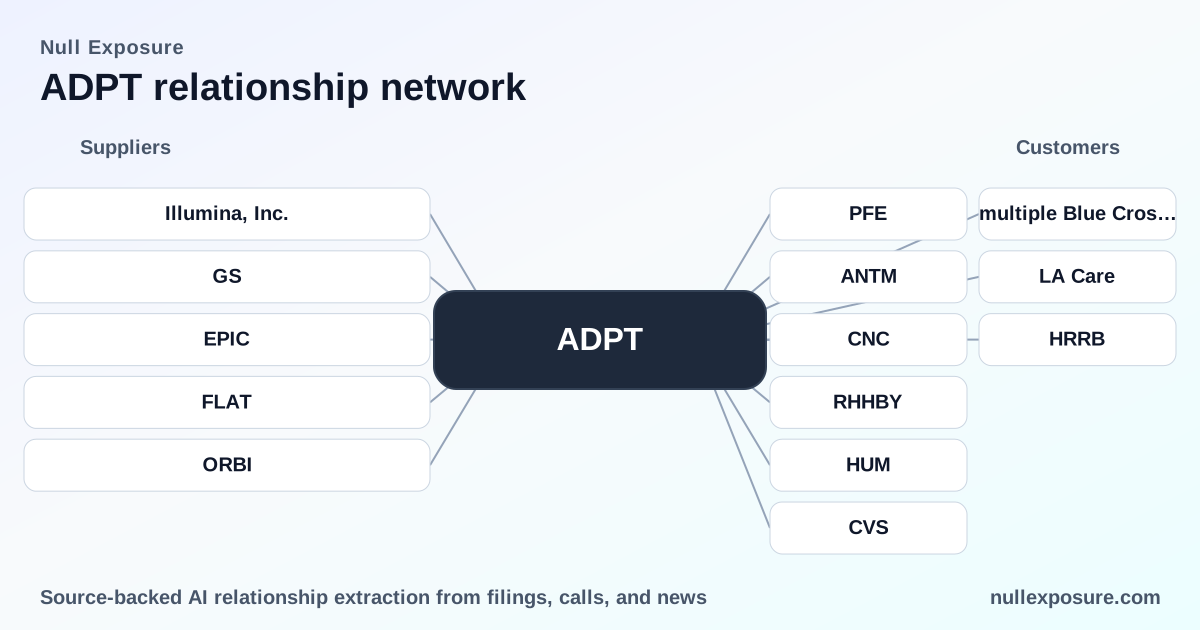
Illumina — sequencing systems in the lab
Adaptive discloses that sequencing is performed using the Illumina NextSeq System and that the company has qualified that system for intended uses, establishing a technical dependence on Illumina sequencing for routine laboratory operations. According to Adaptive’s FY2024 10‑K, the NextSeq system is the sequencer used for processing samples (FY2024 10‑K filing).
Goldman Sachs & Co. LLC — institutional holder / broker record
A public filing reported share ownership records naming Goldman Sachs & Co. LLC in a transaction record dated February 27, 2026, reflecting institutional custody or trading activity rather than an operational supplier relationship. The transaction was captured in a SEC filing summary reported via StockTitan in FY2026 (SEC filing reported in early 2026).
Epic — EMR integrations driving order flow
On the Q4 2025 earnings call, management stated that Epic integrations were completed in eight accounts during the quarter, bringing the total to 173 integrated accounts, and that these integrated accounts now drive approximately 40% of ordering volume, highlighting Epic as a distribution enabler for Adaptive’s testing business (Q4 2025 earnings call).
Flatiron — clinical workflow expansion for clonoSEQ
Adaptive reported accelerated EMR integrations including the integration of clonoSEQ into Flatiron’s Onco EMR, a move that expands access within community oncology settings and supports broader adoption of the assay outside academic centers (Q4 2025 earnings call).
OrbiMed — royalty financing and interest expense
Adaptive disclosed interest expense tied to a royalty financing agreement with OrbiMed, reporting $3 million of interest expense in Q4 and $11.8 million for the year, with corresponding interest income line items also disclosed; this establishes OrbiMed as a financing counterparty that affects net interest and cash flow (Q4 2025 earnings call).
Strategic implications for investors and operators
- Procurement and continuity risk require attention. The combination of long‑term facilities and supplier concentration increases the financial impact of equipment disruption. Investors should model sensitivity to procurement delays and capex shock scenarios rather than assume rapid substitution.
- Integration is a commercial moat; keep monitoring adoption metrics. With EMR integrations reportedly driving 40% of orders, distribution partnerships (Epic, Flatiron) are a primary growth lever; track incremental ordering rates per integrated account and contract renewal terms to quantify sustainability.
- Financing structures affect free cash flow. Royalty financing with OrbiMed creates recurring interest expense that reduces cash available for reinvestment—an important input when forecasting runway or future lab expansion.
Bottom line and action items for investors
Adaptive is a commercial diagnostics operator whose revenue growth is highly dependent on external manufacturers for lab equipment, EMR partners for distribution, and financing counterparties for cash support. Key investor focus areas: supplier continuity plans, EMR integration growth cadence, and the cost of financing embedded in royalty agreements.
- For a supplier‑centric investor due‑diligence checklist and detailed counterparty maps, start here: https://nullexposure.com/.
- If you are evaluating operational counterparty risk or scenario models for ADPT, see our supplier intelligence hub at https://nullexposure.com/ for structured analysis and monitoring.
Adaptive’s fundamentals reflect a company in scale‑up mode: strong gross margins contingent on throughput, concentrated supplier exposure that elevates event risk, and integration partnerships that are central to commercial conversion. Investors must therefore weigh upside from adoption against execution risks in the supply chain and financing profile.