ADT Inc. — supplier relationships, strategic posture, and what investors should price in
ADT is a subscription-first security services company that monetizes through recurring monitoring fees, professional installation and hardware sales, and an expanding set of software-enabled services under its proprietary ADT+ platform. The business combines long-duration customer contracts with capital spending on hardware and long-term vendor commitments for cloud and device supply; profits are driven by scale in accounts and margin expansion from software and AI-enabled analytics. For investors evaluating ADT as a supplier to partners or as a counterparty, the company is capital-intensive, contractually locked-in on several supplier relationships, and actively consolidating AI sensing capabilities through M&A. Learn more about supplier signals and commercial exposure at https://nullexposure.com/.
How ADT runs the supplier side of the business
ADT’s operating model is a blend of asset-backed contracts and recurring services. Revenue is stickier than typical retail hardware plays because monitoring contracts and professional service agreements create multi-year cash flows. That structure forces ADT into a supplier posture that is simultaneously procurement-heavy (buying cameras, sensors, locks) and strategic (locking in cloud and analytics partners for years). Key characteristics:
- Contracting posture: ADT holds both long-term commitments (multi-year cloud and supply deals, real estate leases to 2034) and short-term transitional agreements when divesting business units.
- Concentration and criticality: A relatively small group of suppliers accounts for large purchase commitments and device supply; this increases concentration risk while securing scale pricing.
- Maturity and spend profile: Evidence shows seven-year cloud commitments and $100m+ purchase bands, indicating a mature procurement program and predictable vendor spend.
If you want a deeper supplier map or to benchmark ADT’s commercial commitments against peers, visit https://nullexposure.com/ for a tailored analysis.
What the headline relationships are (and why they matter)
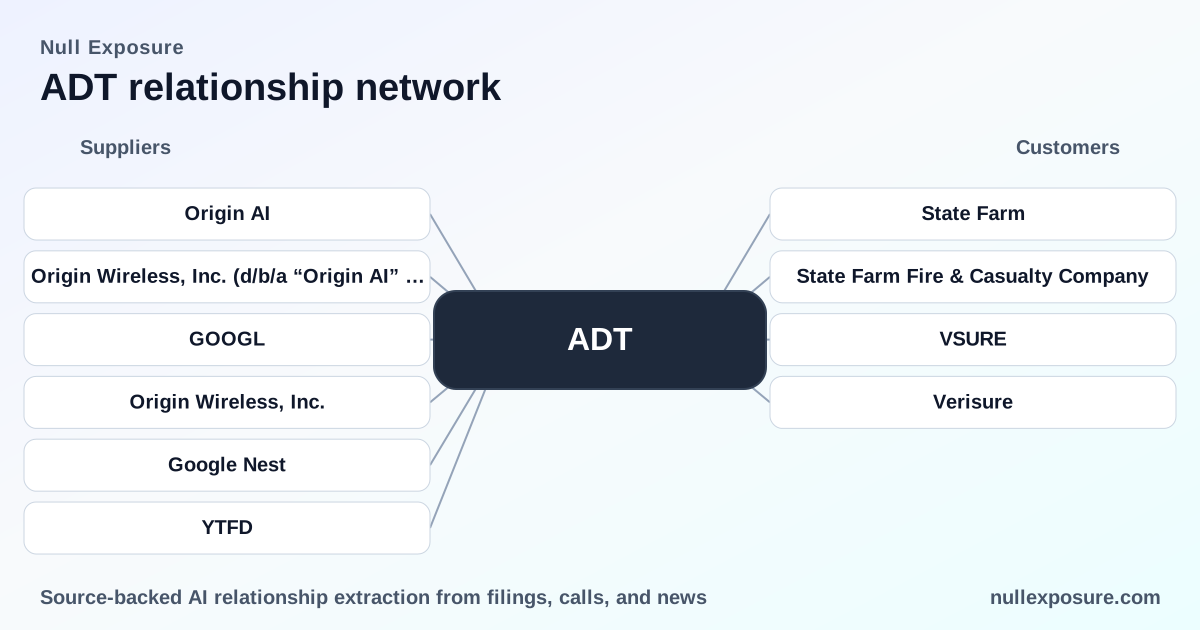
ADT’s recent public disclosures and press coverage reveal four relationship threads that matter for commercial counterparties and investors: a targeted AI acquisition, multi-layer ties to Google, and continued hardware partnerships with Google Nest and Yale.
Origin AI / Origin Wireless — ADT bought AI sensing capability
ADT acquired Origin Wireless (doing business as Origin AI) for $170 million in cash to bring an AI sensing platform and associated intellectual property into the ADT ecosystem, positioning ADT to own more of the edge-to-cloud sensing stack. This is explicitly a strategic bolt-on to power ADT’s AI roadmap and reduce dependence on third-party analytics. According to press coverage of the February 24, 2026 announcement, ADT completed the Origin AI purchase for $170 million in cash. (GlobeNewswire disclosure reported via StockTitan and TradingView, Feb–Mar 2026.)
Google — multi-year cloud and device commercial ties, now eyed for Gemini integration
ADT maintains a commercial agreement with Google that spans device supply and cloud services; ADT committed to purchasing $200 million of Google Cloud Platform services through December 2030 as part of a December 2023 addendum, and ADT is evaluating integrating Google’s Gemini AI into ADT+. The Google relationship is therefore both a large, long-term spend commitment and a strategic partner for analytics/AI. The Google cloud commitment and the broader Google commercial agreement are described in ADT’s corporate filings and recent coverage discussing ADT’s AI strategy (company filing addendum, Dec 2023; ad-hoc-news coverage, Mar 2026).
Google Nest — device integration under ADT+
ADT continues to support Google Nest hardware within its ADT+ platform and rolled Google Nest integration and new capabilities such as Trusted Neighbor into its 2025 product roadmap, keeping Google Nest in the interoperable device set that feeds ADT’s monitored services. This device-level collaboration underpins ADT’s product breadth and customer retention. ADT’s 2025 results and product commentary mention continued rollout of ADT+ integrating Google Nest devices (GlobeNewswire press release, Mar 2, 2026).
Yale — lock and accessory support maintained inside ADT+
Yale remains a supported hardware partner for ADT’s smart-lock and automation offerings; the company confirms Yale support as part of ADT+ rollouts that enhance lock integration and professional monitoring. Maintaining Yale compatibility preserves ADT’s addressable market for professional installations and recurring service conversions. The company reaffirmed Yale support in its 2025 results and product disclosures (GlobeNewswire press release, Mar 2, 2026; ad-hoc-news coverage, Mar 2026).
Operating constraints and company-level commercial signals investors should price
ADT’s public disclosures surface a mixture of explicit named commitments and company-level procurement signals that shape counterparty risk and supplier negotiation leverage.
- Long-term contracted spend is material. ADT committed to $200 million of Google Cloud services through 2030, a named vendor-level commitment that fixes future cloud spend and creates switching costs and cost predictability with Google (company filing addendum, Dec 2023).
- Large equipment purchase commitments exist. ADT disclosed supplier commitments in the hundreds of millions for security system equipment across multi-year windows, indicating $100M+ vendor spend bands that produce bargaining power but also concentration exposure (company filing, 2024 disclosures).
- Transitional short-term contracts are also used. During divestitures ADT executes short-term transitional services agreements (TSAs) that imply limited but material short-term supplier obligations (Commercial TSA note in corporate disclosures).
- Physical leases and capital commitments are long-dated. ADT’s real estate and equipment leases extend into the 2030s, reflecting a capital-heavy operating footprint that suppliers should factor into counterparty terms.
- Supply-chain and tariff exposure is present. ADT sources components where tariffs or trade actions (notably on goods from China and Mexico) can affect margins; this is a company-level supply risk flagged in filings.
- Multiple supplier roles coexist. ADT functions with manufacturers, distributors, resellers and service providers in its vendor ecosystem — a mature, multi-role supply model that supports scale but raises concentration and operational reliance.
These constraints imply that the supplier relationship with ADT is commercially significant, long-tailed, and often critical to product delivery; vendor diligence must account for multi-year commitments, tariff sensitivity, and integration requirements for analytics and cloud services.
If you manage supplier risk or need a prioritized remediation roadmap against ADT-exposure, consult ADT’s commercial footprint mapping at https://nullexposure.com/.
Strategic implications and risk-adjusted outlook
ADT’s acquisition of Origin AI and active evaluation of Google’s Gemini position the company to internalize more analytics and reduce variable costs tied to third-party analytics subscriptions, which should accelerate gross margin expansion on monitoring and software services. However, material multi-year vendor spend and supply concentration create tightening supplier negotiations and make ADT sensitive to device availability and tariff-driven price shocks. For counterparty pricing and credit assessment, treat ADT as a high-certainty revenue counterparty with medium supplier concentration risk and meaningful long-term contractual commitments.
For a supplier scorecard or to model ADT’s vendor commitments into your revenue and credit scenarios, see the detailed analytics at https://nullexposure.com/ — engage the team for tailored supplier exposure reports.
Final takeaway for investors and operators
ADT is executing a deliberate shift to own more of the sensing-to-cloud value chain while relying on long-term cloud and device supply relationships that create predictable cost structure and switching friction. Investors should price in structural recurring revenue growth and margin upside from AI and ADT+ adoption, balanced against vendor concentration and tariff exposure that can compress margins under adverse trade conditions. For practical next steps, map your exposure to ADT’s $100M+ supplier bands, confirm long-dated contract terms in any counterparty negotiations, and track ADT’s integration of Origin AI and Google technologies as key catalysts. For more supplier-focused intelligence and scenario modeling, visit https://nullexposure.com/ and request an exposure briefing.