Addus HomeCare (ADUS): supplier relationships, service posture, and integration risk
Addus HomeCare derives recurring revenue by delivering personal care services to elderly and medically vulnerable patients across the U.S., and it grows scale and route density through bolt-on acquisitions of local care franchises and operations. The business monetizes via fee-for-service state- and Medicaid-driven reimbursement plus private-pay care, and management supplements organic growth with strategic tuck-ins that convert local operator cash flows into centralized EBITDA. Investors should value Addus for its margin leverage from scale, acquisition optionality, and exposure to managed care reimbursement trends. For a concise hub of supplier-relationship intelligence and due diligence tools, visit https://nullexposure.com/.
How Addus runs the business and where suppliers fit in
Addus operates a distributed field-delivery model built from legacy local operators integrated into a national platform. Revenue is concentrated in services rather than products, so third-party suppliers that deliver software, payroll, training, and compliance services function as operational enablers rather than direct revenue drivers. Recent financials show revenue near $1.42B and EBITDA of $156.2M (TTM), with trailing P/E around 19.3 and forward P/E near 14.8, indicating market expectations for margin improvement and continued growth. Addus’s playbook is acquisition-driven: smaller home‑care operators are absorbed, integrated into centralized back-office systems, and then levered for reimbursement and scale efficiencies.
These dynamics shape supplier relationships: contracting posture tends toward standardizing critical back-office services to support many small operating units, creating dependence on certain software and managed-service providers while keeping local clinical vendor relationships decentralized.
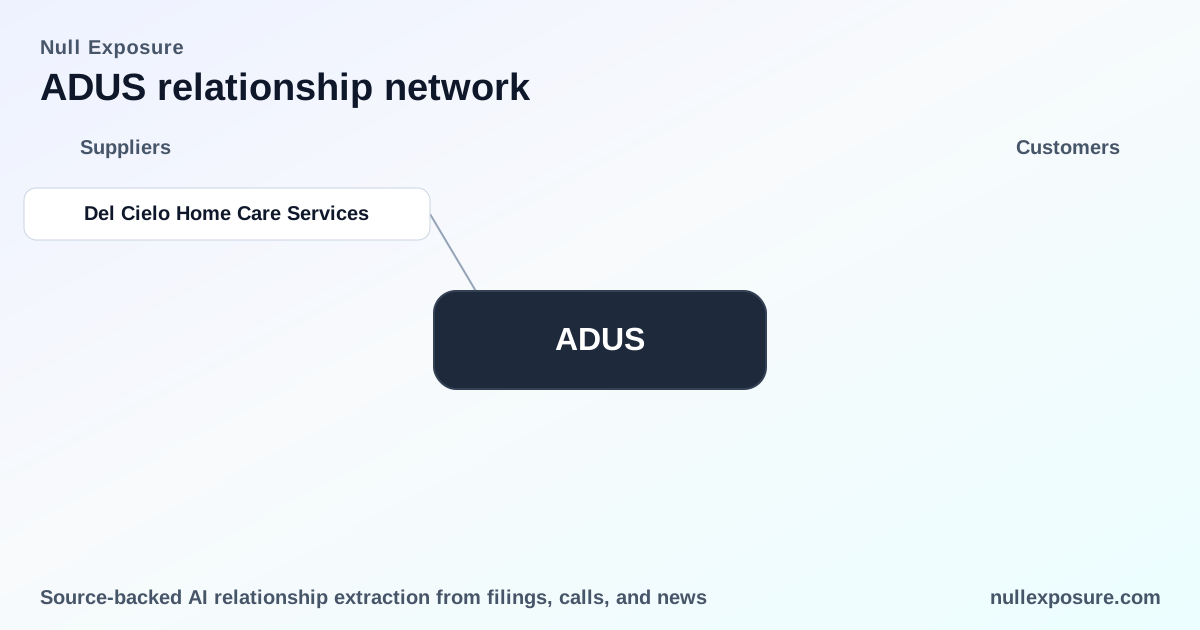
The explicit supplier relationship: Del Cielo Home Care Services (acquisition)
Addus acquired the personal care operations of Del Cielo Home Care Services on October 1, 2025, for $7.4 million, converting a local Texas operator into an owned operation to scale route density in that market. A Home Health Care News article covering FY2025 reported the deal and the purchase price. (https://homehealthcarenews.com/2025/11/addus-achieves-rate-increases-in-2-states-driving-positive-outlook/)
Why this matters: Addus’s acquisition of Del Cielo is a prototypical tuck‑in that supports local market consolidation, increases utilization of centralized operational platforms, and spreads fixed overhead across more revenue — a repeatable supplier/acquisition dynamic for the company.
What disclosures say about Addus’s supplier ecosystem
Addus’s public disclosures identify a software-led back-office posture and explicit risk governance for third‑party providers. According to company filings, Addus licenses the Qlik Business Intelligence (Qlik) platform to provide historical, current, and forward-looking operational performance analysis. The company also discloses implemented processes to identify, assess, and manage cybersecurity risks associated with its use of third‑party service providers.
These statements constitute company-level signals that Addus treats certain suppliers as critical operational partners: analytics software for performance management and managed processes for third‑party cybersecurity. They also imply centralized contracting for corporate IT and compliance tools, which reduces operational friction across newly acquired local units.
What the supplier constraints tell investors: contracting posture, concentration, criticality, maturity
- Contracting posture: Addus shows a centralized contracting posture for enterprise software and governance functions — it licenses enterprise BI (Qlik) and has formalized third‑party risk processes. This supports rapid integration of acquisitions by standardizing reporting and compliance.
- Concentration: While local clinical and caregiver relationships remain decentralized and numerous, concentration risk is higher around core corporate suppliers (analytics, payroll, compliance platforms). A disruption to these core suppliers would produce outsized operational drag.
- Criticality: The evidence positions software suppliers as mission-critical enablers rather than ancillary vendors; BI and cybersecurity processes underpin billing accuracy, utilization tracking, and regulatory compliance.
- Maturity: The documented governance around third‑party risk and a licensed BI platform indicate a maturing operating model that scales beyond founder-led, manual processes — an important signal for investors assessing integration risk and potential margin expansion.
Operational implications for partners, buyers, and risk managers
Addus’s model — acquisition-led roll-up with centralized analytics and risk controls — produces several predictable outcomes for counterparties and acquirers:
- Integration is standardized but not trivial. Acquiring local operators like Del Cielo transfers revenue streams quickly, but realizing margin uplift depends on integrating back-office systems and staff into the Qlik-driven analytics and compliance framework.
- Service providers with enterprise-grade offerings command strategic status. Firms that supply BI, payroll, electronic health records, or cybersecurity services are negotiating with a buyer that centralizes contracts and demands scale discounts and SLAs.
- Single‑vendor disruptions would be material at the corporate level. Given Addus’s reliance on key software and governance providers, operational continuity planning and contractual protections are investment-grade priorities.
- Regulatory and reimbursement risk remain dominant. Supplier relationships facilitate compliance, but Addus’s cash flow ultimately tracks state Medicaid policies and managed-care reimbursement rates; suppliers mitigate execution risk but do not change macro reimbursement dynamics.
For a centralized view of vendor risk and supplier relationships for healthcare operators, explore resources at https://nullexposure.com/.
Bottom line: what investors and operators should do now
Addus’s supplier footprint is consistent with a scaling, acquisition-first home‑care consolidator: centralized enterprise software and formal third‑party risk processes coexist with numerous local clinical vendors. That structure supports margin expansion if management executes integration, but it concentrates operational risk around a small set of corporate suppliers.
Investment and operational action steps:
- Prioritize monitoring Addus’s integration metrics (caregiver utilization, margin uplift post-acquisition) and track any vendor service interruptions.
- Evaluate contractual terms and service-level protections for core suppliers when modeling downside scenarios.
- Consider supplier concentration as a modifier to downside risk; add a qualitative discount if modeling prolonged supplier outages or cybersecurity incidents.
For continued supplier intelligence and to track how Addus and peer operators manage third‑party risk, visit https://nullexposure.com/.
Key takeaway: Addus is executing an acquisition-driven growth strategy that depends on a handful of enterprise suppliers for analytics and compliance; those suppliers are operationally critical, and the company’s documented governance signals a growing maturity that supports integration and margin capture — but concentration of supplier risk deserves close attention.