Advantage Solutions (ADV): Supplier Relationships and Strategic Implications for Investors
Advantage Solutions monetizes by selling outsourced execution, merchandising and analytics services to consumer goods and retail clients, generating recurring fee and project revenue from in‑store teams, data and technology-enabled field services. With trailing revenue of $3.54 billion and a business model that combines large-scale field operations with partner technology and financing arrangements, the company converts client contracts and execution scale into cash flow while managing working capital and debt load through active creditor negotiations. For a compact view of coverage and sourcing on ADV, see https://nullexposure.com/.
Why supplier and counterparty relationships drive the investment thesis
Supplier and counterparty arrangements for a business like Advantage are not peripheral: they affect execution quality, technology integration, and the company’s capital structure. Technology and analytics partners determine the speed and quality of retail execution, while financial agents and trustees shape the company’s options when refinancing or restructuring debt. Investors should evaluate these relationships for operational criticality and contractual flexibility rather than treating them as simple vendor line items.
Relationship-by-relationship breakdown: what to know and where it came from
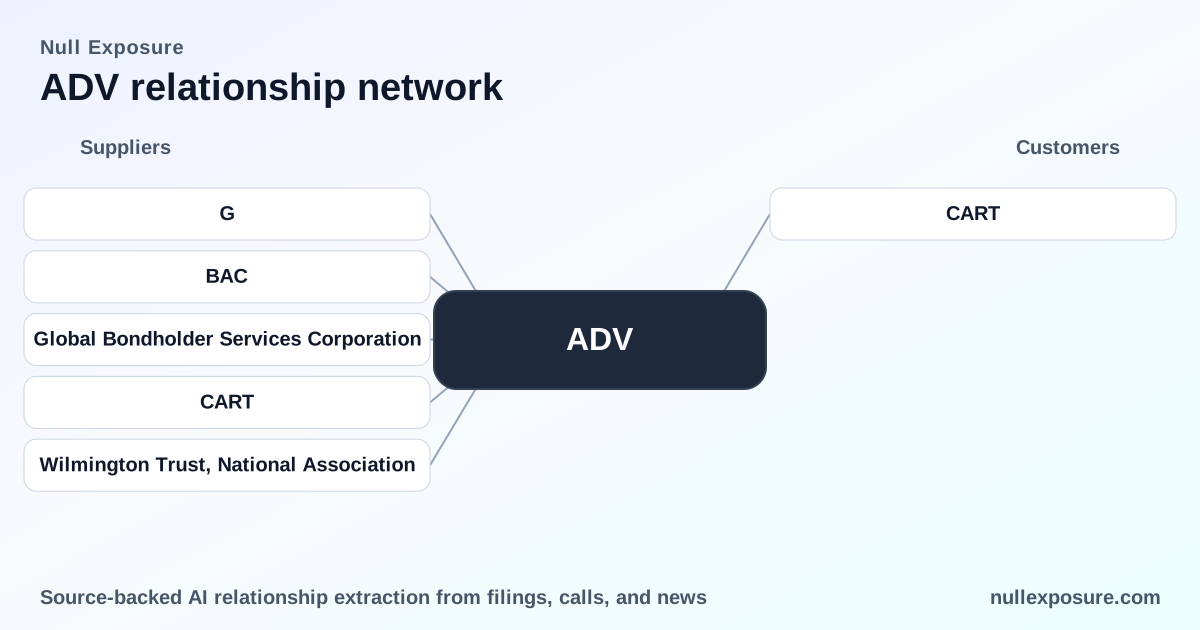
Below are the partners surfaced in the disclosure set, each with a concise, investor‑focused reading and a citation to the underlying source.
Genpact — transformational technology partner
Genpact was recognized for its work with Advantage in the Consumer Goods category of the Salesforce Partner Innovation Awards, reflecting a technology implementation that enhances Advantage’s consumer goods analytics and CRM-driven field workflows. Source: Sahm Capital press release on Genpact’s Salesforce award (Nov 13, 2025).
Bank of America, N.A. — administrative agent on first‑lien credit facility
Bank of America is acting as administrative and collateral agent under Advantage’s Existing First Lien Credit Agreement and is directly involved in the company’s Exchange Offer, Consent Solicitation and proposed Term Loans Transactions to refinance and amend the term loan facility. This relationship is central to Advantage’s liability management and refinancing strategy. Source: company 8‑K reporting the material event (filed Mar 9, 2026).
Global Bondholder Services Corporation (GBSC) — exchange and information agent
Advantage engaged GBSC to serve as exchange agent and information agent for its Exchange Offer and Consent Solicitation, meaning GBSC coordinates the mechanics and communications of the debt exchange process with noteholders. Source: company 8‑K describing engagement of GBSC (filed Mar 9, 2026).
Instacart — operational data + field execution tie‑in
Instacart’s in‑store shopper audit insights are configured to trigger alerts to Advantage field teams, enabling Advantage to act immediately on prioritized in‑store issues — a clear example of third‑party observational data being operationalized into Advantage’s field workflow. Source: QuiverQuant news release on Instacart partnership (Mar 2026).
Wilmington Trust, National Association — trustee and collateral agent for indenture changes
Wilmington Trust acted as trustee and collateral agent when Advantage, guarantors and the trustee executed a Second Supplemental Indenture to effect proposed amendments, guarantor release and collateral release tied to the company’s restructuring steps. This relationship is the legal mechanism enabling pledged‑asset and guarantor adjustments. Source: company 8‑K reporting supplemental indenture (filed Mar 9, 2026).
What the constraints tell investors about Advantage’s operating model
The disclosure set includes two company-level constraints that illuminate the operating posture without tying them to any single counterparty.
- The company discloses it engaged third‑party professional service consultants beginning in Q1 FY2023 to drive operational efficiencies and workforce alignment. This indicates an openness to external operational partners and a contracting posture oriented toward short‑term consulting engagements to reduce cost and optimize processes.
- Expense recognition shows a consultant relationship in the $100k–$1m band, with the company recognizing $0.2 million of expense to a consultant in the year ended Dec 31, 2024. This indicates moderate vendor spend per consultant engagement, consistent with targeted, tactical consulting rather than large, long‑term outsourcing contracts.
Taken together, these signals point to a company that uses external expertise for process and cost optimization, keeps individual consultant engagements at modest scale, and retains flexibility in vendor sourcing rather than locking into outsized single‑supplier commitments. Contract maturity and concentration risk therefore read as moderate — Advantage relies on multiple specialist partners for technology and execution rather than a single proprietary platform.
What investors should focus on next: risks and catalysts
The combined relationship set drives two clear investment vectors:
- Operational upside: partnerships with Genpact and Instacart strengthen Advantage’s technology and data-to-execution capability, improving in‑store response times and evidence-driven merchandising. These are positive for margin and client retention if integration executes cleanly.
- Financial risk and remediation: Bank of America’s central role, the engagement of GBSC and Wilmington Trust, and the recent supplemental indenture all signal active liability management and refinancing. These are immediate governance and credit events investors must monitor for dilution, covenant changes, or collateral releases.
Quick checklist for due diligence:
- Review the wording and economics of the Exchange Offer and proposed term loan transactions disclosed in the company's 8‑K (Mar 9, 2026). Debt remediation is the near‑term credit event to monitor.
- Track operational KPIs tied to Instacart and Genpact integrations (shelf compliance, time-to-remediate alerts, client retention).
- Monitor vendor concentration and spend evolution beyond the $0.2m consultant expense to detect scaling of third‑party reliance.
For a consolidated view of counterparties and claimable sources on ADV, visit https://nullexposure.com/ — it’s a practical starting point for focused supplier due diligence.
Bottom line: calibrating risk versus execution upside
Advantage’s supplier mapping shows a dual narrative: enhanced execution capability from technology and data partners, and simultaneous financial pressure requiring active creditor engagement. Investors should value the operational partnerships as potential margin drivers while treating the ongoing Exchange Offer and indenture amendments as material credit events that will determine near‑term balance sheet flexibility.
For investors and operators evaluating supplier strategies or counterparty risk, the next step is focused document review of the 8‑K and monitoring field KPIs post‑Instacart/Genpact integrations. If you want an organized portal to these relationship disclosures and source documents, start here: https://nullexposure.com/.
Actionable final points:
- Prioritize monitoring of the consent solicitation and exchange mechanics in the 8‑K filings for immediate balance sheet impact.
- Measure integration outcomes from Instacart and Genpact by leading retail execution metrics rather than vendor PR.
- Keep vendor spend concentration and consultant engagement levels under surveillance as they scale beyond the current mid‑hundreds‑of‑thousands band.
This positioning gives investors a clear framework to weigh Advantage’s operational modernization against near‑term refinancing activity and the attendant corporate governance consequences.