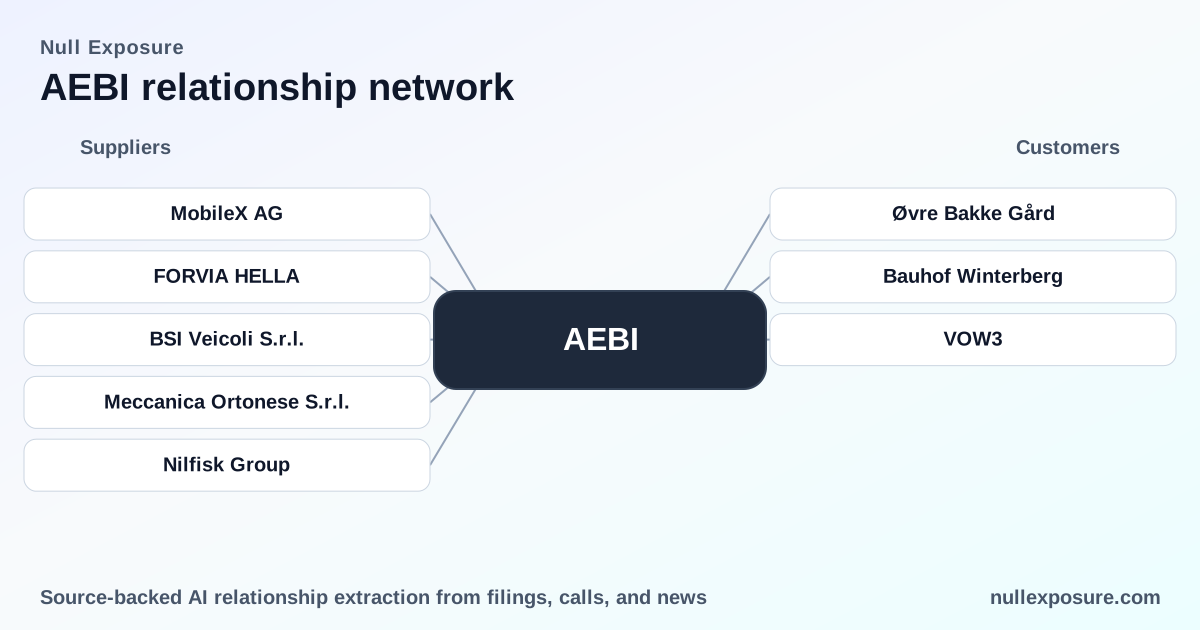
Aebi Schmidt Holding AG (AEBI) — supplier relationships that shape the product stack
Thesis: Aebi Schmidt is a Europe-headquartered manufacturer of special-purpose vehicles and attachments that monetizes through equipment sales, aftermarket parts and service, and selective product-line acquisitions and integrations that expand its addressable market. The company’s operating model combines manufacturing footprint across Switzerland, Germany, the Netherlands and Poland, high insider ownership, and targeted supplier relationships that deliver software, lighting systems and acquired vehicle programs to round out its product portfolio. For investors and operator-partners, the supplier picture underscores a hybrid growth approach: organic manufacturing plus tactical buys and OEM integrations that raise product breadth and aftermarket revenue potential. Explore supplier coverage and alerts at https://nullexposure.com/.
Why it matters: Aebi Schmidt’s supplier and partner choices tell a coherent story—software to improve field service efficiency, lighting and component partnerships to improve OEM fit, and acquisitions to accelerate product entry. These relationships are strategically relevant for assessing aftermarket revenue durability and go-to-market agility.
What the relationships collectively reveal about Aebi Schmidt’s operating model
Aebi Schmidt’s supplier relationships show four consistent operating themes:
- Product-line expansion through acquisitions: Historical deals transferred entire vehicle programs into Aebi’s control, accelerating market entry without building new manufacturing from scratch.
- Component and OEM integration: Partnerships with automotive-tier suppliers for lighting indicate Aebi positions its machines for easy OEM fit and safety compliance.
- Operational digitization via third-party software: Procurement of field-service scheduling software signals investment in service delivery efficiency and aftermarket cost control.
- Limited public contractual disclosure: The available relationship records do not include detailed contractual constraints, so commercial terms and exclusivity profiles are not visible from public sources.
Company-level financial and governance signals reinforce these themes: ~$1.3bn revenue TTM, EBITDA about $94m, ~53% insider ownership, and a multi-country production footprint. That combination supports a capital-light expansion posture through acquisitions and supplier integration rather than broad-scale greenfield investment. See detailed coverage at https://nullexposure.com/ for partner monitoring and alerting.
Supplier relationships you need to know (each relationship covered)
MobileX AG — field-service software supplier (FY2019)
Aebi Schmidt engaged MobileX-Dispatch for scheduling and dispatching field-service technicians, indicating a deliberate move to professionalize and digitalize aftermarket service operations. According to IT-Zoom reporting on FY2019, MobileX announced Aebi Schmidt Group as a new customer for its MobileX-Dispatch platform (IT-Zoom, FY2019).
FORVIA HELLA — lighting component integration (FY2024)
Aebi Schmidt’s Schmidt-branded sweepers were equipped with lighting systems supplied by FORVIA HELLA, showing an OEM-level component relationship that upgrades product safety and visual presence. Bauhof-Online reported in FY2024 that FORVIA HELLA supplied lighting products for a new Schmidt sweeper series (Bauhof-Online, FY2024).
BSI Veicoli S.r.l. — acquired vehicle program (FY2013)
In July 2013 Aebi Schmidt closed an agreement to acquire the BSI vehicle program, effectively bringing that product line under Aebi’s commercial and manufacturing umbrella and expanding its street-cleaning and municipal vehicle offerings. Bauhof-Online covers the July 5, 2013 contract where Aebi Schmidt acquired the BSI vehicle program (Bauhof-Online, FY2013).
Meccanica Ortonese S.r.l. — acquired engineering/program component (FY2013)
The July 2013 agreement also involved Meccanica Ortonese S.r.l., transferring program elements and those firms’ production relationships into Aebi Schmidt’s scope—another move consistent with acquisition-led product expansion. The same Bauhof-Online item documents the transaction involving Meccanica Ortonese (Bauhof-Online, FY2013).
Nilfisk Group — selective product-rights acquisition (FY2019)
Aebi Schmidt purchased rights to two sweepers from the Danish Nilfisk Group to complement its product range, signaling opportunistic bolt-on expansion of complementary products. Bilanz reported that Aebi Schmidt took over rights to two sweepers from Nilfisk at the end of March (Bilanz, FY2019).
What these relationships imply for procurement, risk and concentration
- Contracting posture: The mix of software procurement and OEM component sourcing plus outright acquisitions indicates Aebi Schmidt prefers targeted external sourcing for capabilities it will own or tightly integrate, rather than long-term dependency on single suppliers. The company routinely converts external capabilities into in-house assets.
- Concentration & criticality: The recorded relationships are diverse across software, components and acquired programs, suggesting low supplier concentration risk at the product-category level. However, acquisitions that transfer entire programs create one-off critical dependencies during integration phases.
- Maturity of relationships: Relationships range from one-off acquisitions (BSI/Meccanica, Nilfisk) to ongoing supplier integrations (FORVIA HELLA lighting) and operational software contracts (MobileX), indicating a mix of mature supplier integrations and tactical buys to fill portfolio gaps.
- Disclosure & visibility: There are no explicit contractual constraints captured in the available relationship summaries; this is a company-level signal of limited public detail on commercial terms and exclusivity—investors should treat public relationship headlines as directional rather than fully bilateral-contract proof.
Investment and operational takeaways
- Positive structural thesis: Aebi Schmidt combines a stable manufacturing footprint and aftermarket focus with an active strategy of acquiring or integrating supplier capabilities to broaden product offerings and lock in service revenues.
- Watch list: Monitor integration execution after acquisitions, durability of OEM component relationships (e.g., with FORVIA HELLA), and software-driven service KPIs after the MobileX deployment. These will determine whether incremental revenue is realized and whether margin uplift follows.
- Operational risk: With limited public contractual detail, diligence should prioritize commercial terms (warranties, exclusivity, service-level commitments) when evaluating supplier-derived revenue durability.
For continuous monitoring of Aebi Schmidt’s supplier signals and competitive implications, visit https://nullexposure.com/ and subscribe for alerts.
Final recommendation for investors and operators
Aebi Schmidt’s supplier footprint is pragmatic: acquire where speed matters, integrate where differentiation matters, and outsource operational tooling where efficiency matters. That strategy supports a mid-cycle commercial play focused on aftermarket and specialized vehicles rather than broad-market volume. Investors should value the company on its ability to convert acquisitions and supplier integrations into recurring service revenue and margin improvement; operators and procurement teams should insist on contractual clarity for newly integrated programs to avoid integration drift.
Stay informed on supplier and acquisition events that change the product stack—visit https://nullexposure.com/ for real-time supplier relationship tracking and risk scoring.