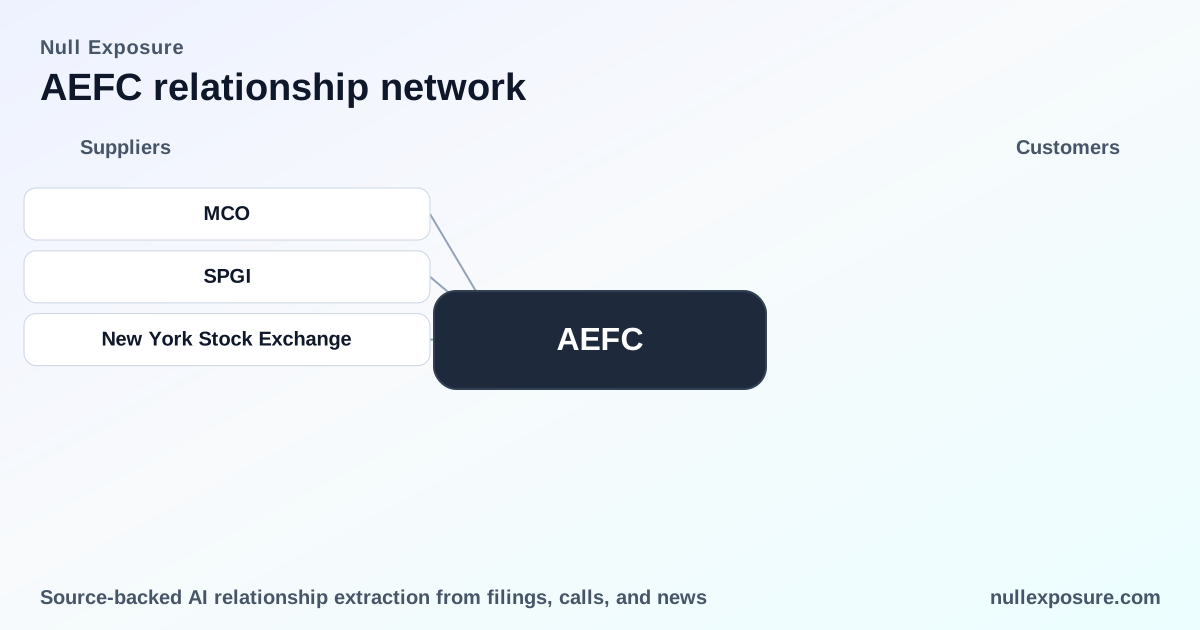
AEFC — Aegon Funding’s listed funding vehicle and the counterparts that matter
Aegon Funding Company LLC (AEFC) is a single-purpose funding vehicle that raises wholesale capital for Aegon through listed, structured notes — in this case a 5.10% subordinated issuance — and monetizes by converting investor capital into term funding for the group at a controlled spread. Investors evaluate AEFC not on operating cashflow but on credit structure, ratings treatment, and listing accessibility; operators and counterparties care about documentation, Solvency II treatment, and exchange listing mechanics. For a concise registry of counterparties and market signals, see Null Exposure’s coverage at https://nullexposure.com/.
How AEFC works in practice is straightforward: it issues debt under a U.S. registration statement, lists instruments on a major exchange, and uses standard rating-agency engagement to achieve Solvency II-compatible capital treatment for its parent. This structure creates dependence on a small set of external validators — rating agencies and an exchange — whose assessments directly affect pricing and investor appetite. For further supplier intelligence and disclosure aggregation visit https://nullexposure.com/.
What AEFC actually sells and where value comes from
AEFC’s product is a financial instrument: listed subordinated notes with a stated coupon (5.10%), intended for institutional holders seeking yield and regulatory capital characteristics for the issuer. Value accrues to AEFC and ultimately to Aegon through a combination of:
- Access to long-tenor, wholesale funding at a target cost of issuance versus internal funding alternatives.
- Structural features designed to secure preferred regulatory treatment (Tier 2 under Solvency II), which lowers the effective cost of capital for the sponsor.
- Market liquidity and investor confidence delivered by an exchange listing and published ratings.
AEFC does not operate like an operating business; its economics are driven by capital markets execution and sponsorship support rather than product sales or recurring operating revenue.
The counterparties named in public coverage — who shows up in the record
Below are every relationship surfaced in the public results for AEFC’s supplier scope. Each relationship summary is concise and followed by the source context.
Moody’s — ratings that support capital treatment
Moody’s was cited as assigning a Baa1 expected rating to the subordinated notes, a level that supports the issuance’s intended Tier 2 classification under Solvency II and influences investor pricing. According to a BusinessWire release republished on DutchNews (first seen March 9, 2026), the notes were structured to be Tier 2 compliant and expected to carry Moody’s Baa1 treatment.
S&P Global — a complementary ratings anchor
S&P Global was referenced as the other expected rater, assigning an anticipated BBB rating, which together with Moody’s provides the cross-agency perspective institutional investors need for regulatory and portfolio allocation decisions. The same BusinessWire release (reported March 9, 2026) documented S&P Global’s expected rating alongside Moody’s for the offering.
New York Stock Exchange — venue and listing mechanics
The issuance was filed under AFC’s U.S. registration statement with an application to list the notes on the New York Stock Exchange, ensuring visibility and tradability for institutional markets; listing intent was stated in the BusinessWire posting (March 9, 2026). The exchange listing is the operational bridge between issuance and secondary market liquidity.
(Primary source for all three relationships: BusinessWire coverage republished on DutchNews, March 9, 2026 — announcement of a USD 925 million Tier 2 subordinated notes issuance.)
For more targeted supplier mappings and issuer-counterparty timelines, visit https://nullexposure.com/.
What these relationships signal about AEFC’s operating posture
- Contracting posture: centralized and standard. AEFC operates as a sponsor-backed issuer using standard securities documentation and regulated listing procedures; contracting follows market templates rather than bespoke vendor agreements.
- Concentration: low breadth, high impact. Public evidence shows a limited set of critical counterparties (major rating agencies and the NYSE); a small number of counterparties controls the primary valuation and distribution channels.
- Criticality: high for those counterparties. Ratings and listing determinations are pivotal to issuance pricing, investor eligibility, and regulatory treatment; these relationships are critical to AEFC’s ability to monetize.
- Maturity: market-standard but event-driven. AEFC’s model is mature in structure — listed subordinated issuance with agency ratings — but each issuance is event-driven, with counterparty engagement clustered around deal execution windows.
There are no recorded contractual constraints or vendor-specific red flags in the supplier-scoped constraints set for AEFC, which signals a clean public record but increases the importance of active monitoring of rating and listing developments as they occur.
Investment and operational implications — what to watch
- Ratings are the single largest driver of pricing and regulatory treatment. The expected BBB/Baa1 combination positions AEFC within investment-grade investor pools; any downgrade would materially affect both investor base and cost.
- Exchange listing underpins liquidity and secondary pricing. NYSE listing intent removes a common distribution barrier and broadens buyer demand among institutional fixed-income desks.
- Sponsor support and documentation matter more than internal operations. AEFC’s credit depends on Aegon’s structural support and the clarity of legal documentation; investors should review registration statements and trust deeds at issuance.
- Concentration risk is a manageable but real governance lever. With a narrow set of suppliers, AEFC is efficient but exposed to single-point shifts in ratings methodology or exchange listing standards.
Final assessment and next steps
AEFC functions as a classical funding conduit: it converts investor demand into term capital for Aegon, with ratings and listing status determining the economics. For investors and operators evaluating AEFC relationships, the priority checklist is simple — confirm ratings, confirm listing mechanics, and review documentation for Tier 2 compliance language. For a structured supplier-risk view and ongoing monitoring, consult Null Exposure’s research hub at https://nullexposure.com/.
If you want a tailored intelligence brief or need help mapping AEFC’s counterparty network into your portfolio risk model, Null Exposure provides ongoing supplier and issuer monitoring and deal-level synthesis at https://nullexposure.com/.