AEHA: A short playbook for investors and operators evaluating supplier exposure
Aesther Healthcare Acquisition Corp (NASDAQ: AEHA) is a special-purpose acquisition company that monetizes through a sponsor-led merger process: raise IPO capital, list on Nasdaq, and convert cash and sponsor equity into a combined public company through a business combination. AEHA currently carries no operating revenue and generates investor returns through successful deal execution and shareholder approvals of a target merger. For investors and counterparty managers, the practical risk is execution — the quality of advisers and auditors materially influences deal timing, cost and regulatory clearance.
Explore how AEHA’s supplier relationships shape that execution pathway at https://nullexposure.com/.
What AEHA is doing right now — concise profile for decision makers
AEHA is a New York-headquartered blank-check vehicle with a market capitalization around $131.7 million and approximately 10.6 million shares outstanding. The company reports no revenue or operating income, consistent with a pre-combination SPAC that will only begin to generate operational economics once a merger closes. Shareholder value therefore depends on M&A outcomes and the credibility of its external advisers rather than on internal operations or product cycles.
Head office, Nasdaq listing, and capital-market positioning make the company highly dependent on external providers for capital markets execution, legal clearance, and audit sign-off — the classic SPAC supplier profile. Learn more analysis and supplier intelligence at https://nullexposure.com/.
Who AEHA works with (and why that matters)
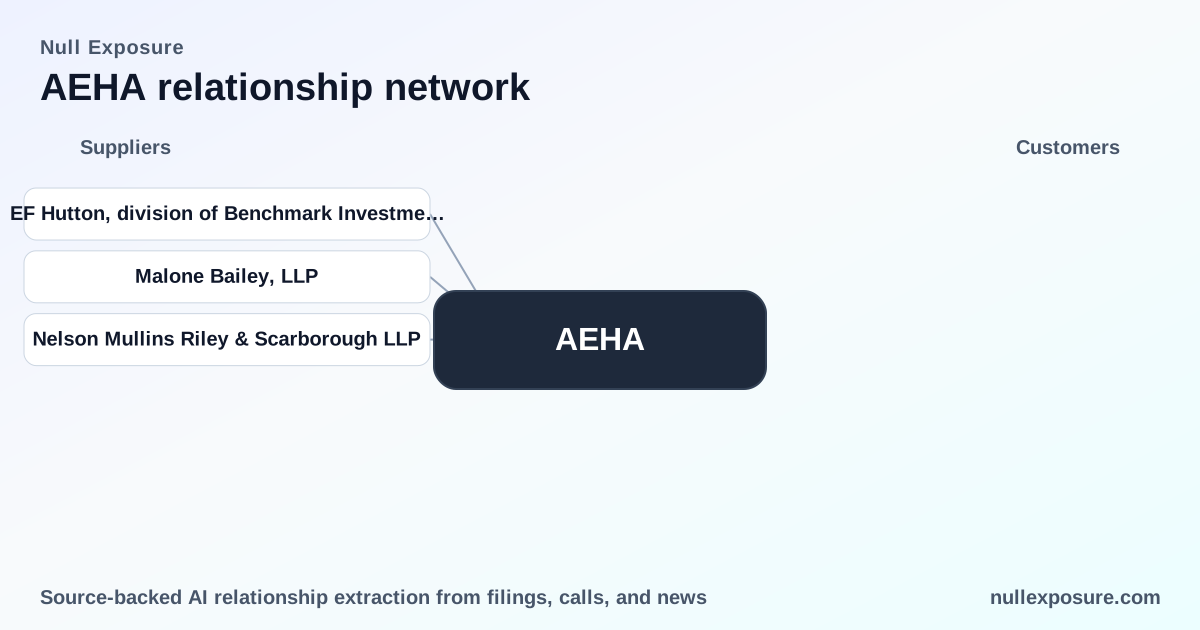
AEHA’s disclosed supplier relationships cluster in the advisory and compliance domain — the parts of a SPAC’s vendor network that determine whether a de-SPAC closes and how cleanly it does so. The principal relationships disclosed in AEHA’s public release are below.
EF Hutton, division of Benchmark Investments, LLC — capital markets advisor
EF Hutton serves as capital markets advisor to Aesther Healthcare Acquisition Corp, supporting the SPAC’s merger process and investor outreach around the combination. According to a GlobeNewswire press release dated August 31, 2022, EF Hutton was named to advise on capital markets strategy and transaction execution for AEHA.
Malone Bailey, LLP — independent auditors
Malone Bailey, LLP acts as AEHA’s auditor, responsible for financial statement audits and opinions required for proxy materials and SEC filings tied to a business combination. The GlobeNewswire announcement of August 31, 2022 lists Malone Bailey as the company’s auditors.
Nelson Mullins Riley & Scarborough LLP — legal counsel
Nelson Mullins Riley & Scarborough LLP serves as legal counsel to AEHA, handling regulatory compliance, transactional documentation and counsel on Nasdaq listing and SEC disclosure obligations. This legal engagement is documented in the company’s August 31, 2022 press release on the proposed business combination.
What the supplier mix signals about AEHA’s operating posture
No constraints were disclosed that name or restrict any specific relationship, so evaluate supply-side characteristics at the company level:
- Contracting posture: AEHA demonstrates a transactional, advisory-focused contracting posture typical of SPACs — it outsources capital markets, legal and audit functions to reputable external firms rather than building in-house capabilities. This setup accelerates time-to-close but transfers execution risk to third parties.
- Concentration: Supplier concentration is highly concentrated in three functional buckets (capital markets, audit, legal). For a SPAC, that concentration is purposeful and normal — a small set of external specialists carries disproportionate influence over deal quality and timeline.
- Criticality: These relationships are mission-critical. A capital markets adviser shapes investor syndication and PIPE placement; auditors and legal counsel deliver the independent assurances required by regulators and public shareholders. Failure or reputational issues with any of these vendors directly imperil the merger process.
- Maturity: The engagements reflect deal-stage maturity — external advisers retained for a high-profile, near-term transaction rather than long-term operating partnerships. That maturity profile implies short, intensive engagements tied to the lifecycle of a single business combination.
Risk and reward through the prism of suppliers
For investors, the upside in AEHA is straightforward: successful closing of a value-accretive merger converts idle SPAC cash into equity in an operating business. Supplier governance therefore becomes a leading indicator for success: strong, credible advisers shorten timelines and reduce regulatory friction; weak or unqualified advisers lengthen processes and increase the probability of deal failure or suboptimal terms.
Key risk factors driven by supplier structure:
- Execution concentration risk — a small number of advisers perform outsized roles; replaceability is limited mid-process.
- Regulatory and reputational sensitivity — auditors and legal counsel are gatekeepers for disclosure standards; any issues here escalate quickly in SEC reviews.
- Sponsor-dependent economics — with no operating revenue, AEHA’s valuation is fully tied to post-merger economics, not internal growth.
For operators evaluating counterparty exposure to AEHA, these relationships indicate where to focus commercial diligence: validate the capital markets adviser’s track record for PIPE pricing and investor demand; confirm audit scope and independence; and understand counsel’s experience with de-SPAC regulatory clearance.
Visit https://nullexposure.com/ for vendor diligence frameworks tailored to SPACs and acquisition vehicles.
Bottom line recommendations for investors and counterparties
- Prioritize adviser pedigree and recent transaction history. For AEHA, the capital markets adviser, auditor, and legal counsel directly govern the speed and certainty of value realization.
- Treat supplier continuity as an operational KPI. Monitor engagement terms and any public indications of adviser change; mid-cycle replacements create measurable execution drag.
- Discount valuation for deal execution risk. A SPAC with high-quality external advisers commands a lower execution-risk discount; conversely, gaps in supply-side credibility justify a higher margin of safety.
AEHA’s current supplier footprint is short, focused and concentrated — exactly the pattern investors expect from a deal-stage SPAC. That structure delivers speed and specialist capability, but it centralizes risk in a handful of external firms. Assess these counterparty relationships with the same rigor used for target diligence.
For deeper supplier profiles and market intelligence on AEHA and comparable SPACs, visit https://nullexposure.com/.
Source note
The supplier relationships described above are disclosed in AEHA’s public announcement of a merger agreement, published via GlobeNewswire on August 31, 2022. The release identifies EF Hutton (division of Benchmark Investments, LLC) as capital markets advisor, Malone Bailey, LLP as auditors, and Nelson Mullins Riley & Scarborough LLP as legal counsel for the transaction.