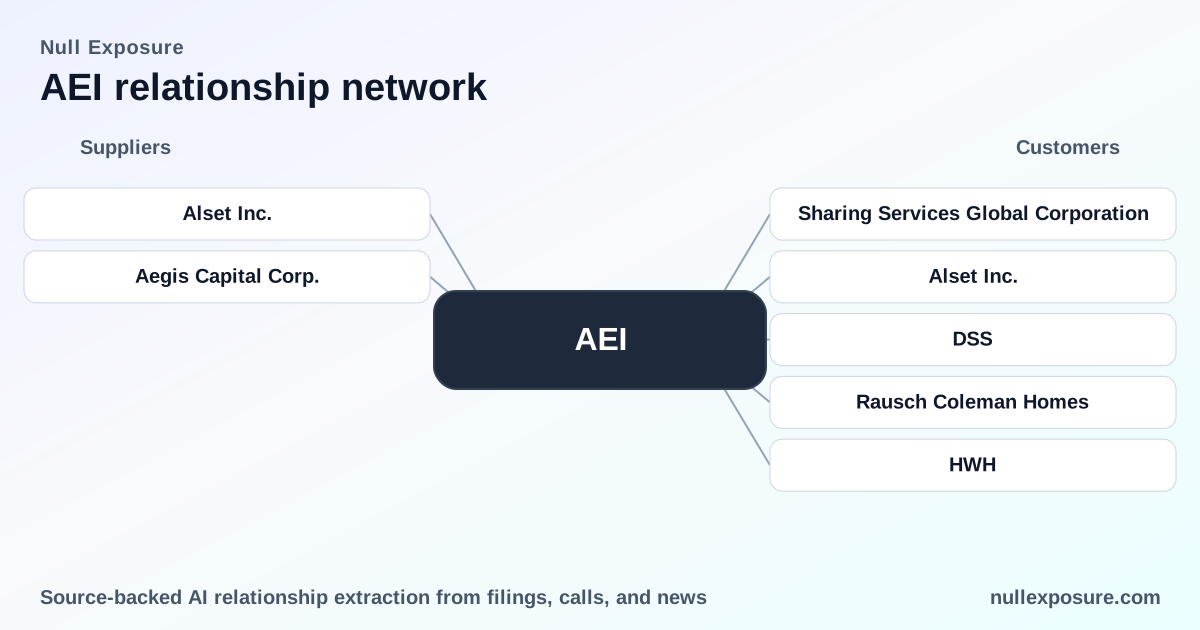
AEI (Alset EHome International): supplier relationships, contracts and investor signals
Alset EHome International Inc. operates as a diversified property developer and digital/biohealth services group across North America and APAC, monetizing primarily through real estate development and leasing, property management fees, and occasional capital markets transactions. The company contracts out core development and property-management activities, collects management fees on assets under management, and supplements cash flow with equity raises and short-term financing. For investors assessing supplier risk, the mix of long-dated leases, outsourced service providers, and occasional capital-market underwriting relationships defines both cost structure and funding pathways.
Explore more supplier intelligence at https://nullexposure.com/.
Why supplier and contracting detail matters for AEI investors
AEI is not a vertically integrated builder; it relies on third-party contractors and property managers to execute development and leasing. That contracting posture translates into predictable operating leverage on capex events and recurring vendor spend tied to local markets. Key operational characteristics investors should internalize:
- Contracting posture: AEI outsources planning, design, construction and property management, which reduces fixed internal headcount but increases vendor concentration and third‑party execution risk. Evidence in filings describes standard property management agreements and outsourced development teams.
- Lease maturity and geography: The company maintains leased office footprints in North America and APAC with leases stretching through 2029, indicating multi-year occupancy commitments and a material annual rent line (about $1.19M in 2024).
- Funding channels: AEI uses both debt instruments (example: a five‑year note at a stated 3% coupon in filings) and equity underwritings to manage liquidity, signaling active use of capital markets to fund operations and growth.
- Spend scale: Annual rent and associated leased-space costs are in the $1m–$10m band, a recurring operating expense that underpins the supplier spend profile.
Together these signals show a company with moderate fixed occupancy costs, outsourced delivery risk, and a funding model that blends bankable notes with small equity raises. For deeper supplier-level context, visit https://nullexposure.com/.
Supplier relationships that shape near-term execution
Below are the supplier relationships surfaced in public coverage and filings that directly influence AEI's operating runway and capital structure.
Alset Inc.
Alset Inc. received a management fee of S$1.29 million from the group in the FY2026 reporting cycle, indicating intra‑group or closely related management payments that feed service-provider economics inside the corporate structure. This was reported in market coverage of the FY2025/FY2026 results (MiniChart, March 2026). Source: MiniChart FY2026 results coverage (Mar 2026), https://www.minichart.com.sg/2026/02/26/alset-international-limited-fy2025-unaudited-financial-results-revenue-losses-segment-review-no-dividend-declared/.
Aegis Capital Corp.
Aegis Capital Corp. acted as sole bookrunner on a $3.8 million underwritten public offering for AEI, demonstrating the company’s reliance on boutique investment banks for small-cap capital raises and distribution capability. The underwriting confirms an active use of equity markets to shore up liquidity (StockTitan news, FY2025 coverage). Source: StockTitan news summary on AEI (FY2025), https://www.stocktitan.net/news/AEI/.
What the relationships imply for risk and governance
The supplier map exposes several investor-relevant constraints and company-level signals:
- Concentration of execution: With development and property management outsourced, project delivery and tenant outcomes depend on third-party vendors; this creates an execution risk layer that is operationally critical but not necessarily captured on-balance-sheet.
- Lease-driven fixed cost base: Long-term leases across NA and APAC with staggered expirations through 2029 create predictable rent outflows; rent expense totaled roughly $1.19M in 2024, which is material for a company with ~$12.1M revenue TTM.
- Funding dependence on capital markets and medium-term notes: Filings reference a five‑year note paying 3% and documented underwritten offerings; capital markets activity is a visible lever for AEI’s working capital and project financing.
- Geographic operational footprint: The company operates across North America and APAC; this diversifies market exposure but increases vendor management complexity and regulatory touchpoints across multiple jurisdictions.
These constraints are company-level signals derived from AEI disclosures and are central to any risk assessment or supplier due diligence.
Investment implications — what active investors should monitor
AEI’s profile is that of a small-cap developer with outsized insider control (insiders hold roughly 90% of shares outstanding), modest institutional ownership, and negative profitability metrics. For investors evaluating supplier relationships and operational durability, focus on these indicators:
- Track vendor concentration and vendor performance on major development projects; delays or cost overruns will flow directly to margins because AEI outsources execution.
- Monitor capital-raising cadence and underwriter relationships; the $3.8M underwritten offering shows AEI’s reliance on boutique investment banks for liquidity.
- Watch lease maturity schedules and annual rent expense, given the company’s multi-jurisdiction footprint and a rent line in the $1–1.3M range in recent years.
- Review related-party and management‑fee flows (such as the S$1.29M payment), which affect free cash flow and governance assessment.
For a systematic supplier-risk review and tailored intelligence, visit https://nullexposure.com/ to see how these relationships map into exposure scoring.
Bottom line: exposure, execution and near-term catalysts
AEI’s operating model is defined by outsourced development, contractual lease commitments across NA and APAC, and intermittent capital markets financing. Supplier relationships—specifically management-fee recipients within the group and investment-bank underwriters for small equity raises—are meaningful for both governance and liquidity. Investors should treat vendor performance and capital-raising capability as primary drivers of near-term valuation; monitor announcements from AEI and its service providers for early signs of execution stress or liquidity strain.
If you need a concise supplier-risk memo or want to convert these relationships into exposure metrics for a portfolio, start here: https://nullexposure.com/.